





Δείτε περισσότερα άρθρα μας στα αποτελέσματα αναζήτησης
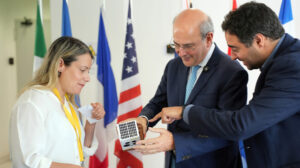
Add Protothema.gr on GoogleThe satellite manufacturing facilities of Open Cosmos Aegean in Pallini were visited today by Deputy Prime Minister Kostis Hatzidakis, who was briefed on the company’s progress under the National Microsatellite Programme, its growing export activities from Greece, and its plans for further expansion.
During the visit, Mr. Hatzidakis toured the satellite production and control facilities, as well as the satellite data acquisition infrastructure. He also held discussions with the company’s leadership on the strategic importance of the project for strengthening state capabilities, enhancing Greece’s technological autonomy, and expanding the international reach of the Greek space ecosystem.
He stated, among other things, that the initiative is not only impressive because it involves space technology and Greek satellites, but also highly significant for the economy, agriculture, transport, national defence, and Greece’s international standing. He emphasized that, in the emerging space era, it is essential for states to maintain an active presence in space policy, and noted that Open Cosmos is a dynamic company whose work—supported by young Greek engineers returning from abroad—deserves government backing.
The operational phase is set to begin in July with the launch of the first Hyperion GR1 satellite and the activation of the already deployed Greek ground station. The 100 kg-class satellite will provide 90 cm-resolution panchromatic imagery and will feature advanced onboard artificial intelligence for data analysis, along with inter-satellite communication links.
Overall, Open Cosmos Aegean is implementing a major share of the National Microsatellite Programme in Greece, building 7 of the 13 satellites in the programme along with one ground station. The Greek Hyperion / Hyperion GR constellation will include complementary Earth observation and connectivity missions: two very high-resolution microsatellites for sub-metric imaging, and five additional satellites equipped with multispectral and hyperspectral sensors, SWIR imaging capabilities, Internet of Things (IoT) receivers, and Automatic Identification System (AIS) technology. All satellites will incorporate inter-satellite links and onboard AI to enable faster collection, processing, and transmission of critical space-based data.
The programme is supported by modern infrastructure, advanced technology, and skilled human resources, enabling Greece to develop end-to-end capabilities to design, build, test, and operate space systems in Earth observation and telecommunications.
The name “Hyperion / Hyperion GR” and the mission emblem were selected through a school competition coordinated by the Ministry of Digital Governance, the Ministry of Education, Religious Affairs and Sports, and the Hellenic Space Centre. The initiative highlighted the project’s connection with younger generations and its broader vision of a Greece that not only uses space technology but actively contributes to its development. The reference to Hyperion, associated with light, observation, and knowledge, symbolically reflects the satellites’ purpose: generating precise data for societal, economic, and environmental benefit.
The satellites being developed in Pallini will support key public-interest applications, including natural disaster prevention and response, environmental monitoring, precision agriculture, maritime surveillance, urban planning, and faster decision-making in public administration. At the same time, the expertise developed through the programme positions Greece as an emerging export hub for space infrastructure, technology, and data services in the wider region.
Rafel Jordá Siquier stated that Open Cosmos Aegean is building satellites and developing technology not only for Greece but for global markets, while also contributing subsystems to the broader ConnectedCosmos satellite cluster. He noted that Greece is now one of Open Cosmos’ four European production bases and confirmed continued investment in the country, leveraging its skilled workforce and supporting the development of internationally oriented space technologies.
>Related articles
Maria Kalama thanked the Deputy Prime Minister for his visit and interest, as well as the Greek government—particularly the Ministry of Digital Governance and the Hellenic Space Centre—for their strong support through the National Microsatellite Programme. She highlighted that the initiative unites a broader ecosystem of more than 13 Greek companies, research institutions such as the National Observatory of Athens, and Greek investors. She also emphasized the strong public engagement around the Hyperion name and mission design as evidence of the programme’s inspirational impact on the next generation.
The Greek satellites will also be integrated into OpenConstellation, Open Cosmos’s collaborative satellite network of 23 satellites, which provides governments, research institutions, and businesses with more efficient and cost-effective access to Earth observation data and services. This integration further strengthens Greece’s participation in a wider European space infrastructure, improving resilience, data access, and technological autonomy.
Currently, Open Cosmos Aegean employs around 30 engineers and specialists, many of whom returned to Greece after international experience. This growing team forms part of a broader effort to establish Greece as a stable and outward-looking hub for advanced space technologies, capable of supporting both national programmes and international commercial missions.
Ask me anything
Explore related questions




