





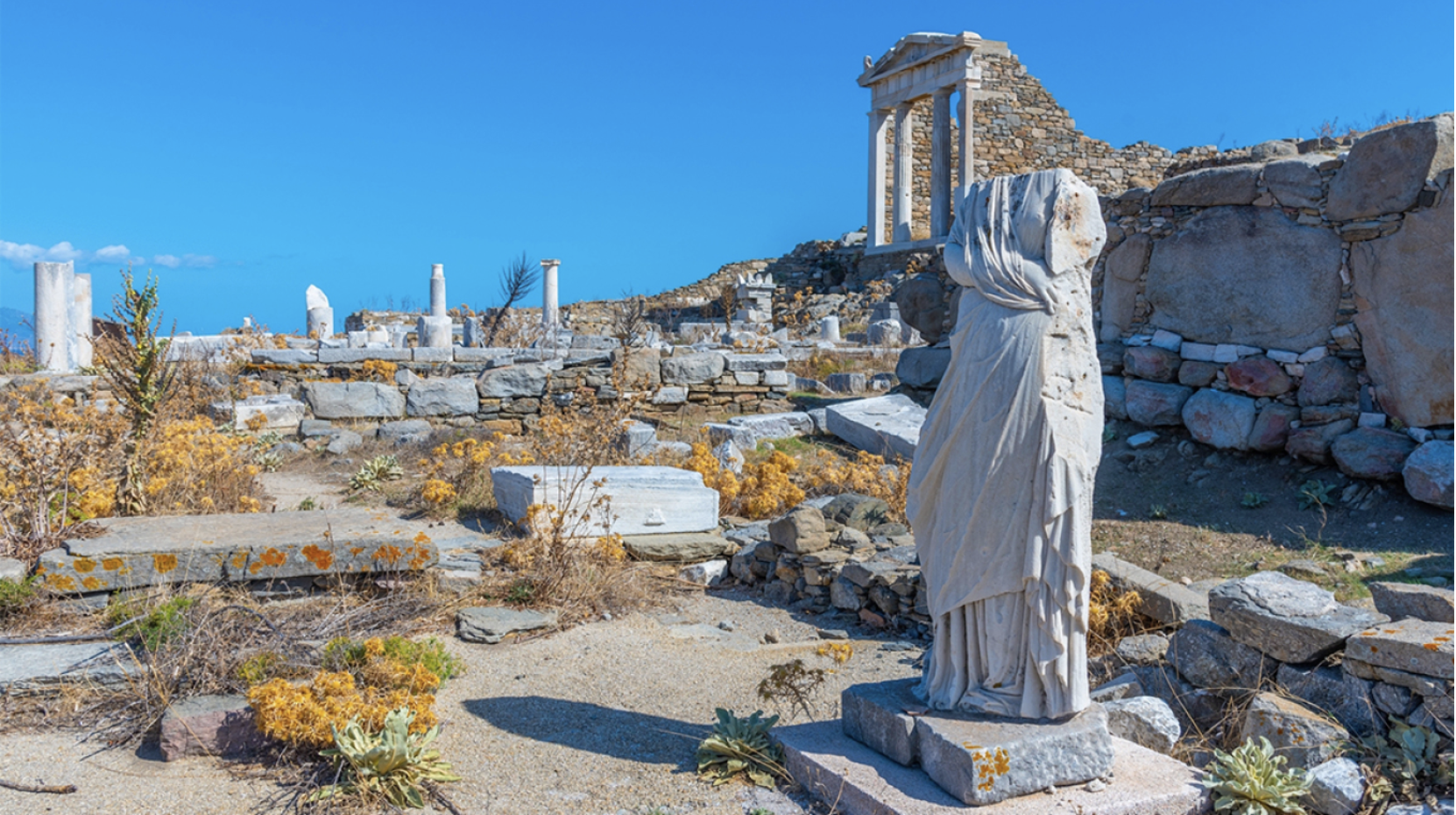
The conclusion reached by the “Monitoring Network of Marine Parameters in Delos” program is that Delos is sinking by one centimeter per year.
As explained by Professor of Natural Disasters at the University of Southern California, Costas Synolakis, during the presentation of the program’s findings at the Academy of Athens, the phenomenon is due to a combination of sea-level rise caused by climate change and geological processes that cause coastal subsidence or uplift.
The study’s authors estimate that by 2025, relative sea level in Delos is expected to rise by 21 cm in the “optimistic scenario” and by 28 cm in the “adverse scenario.” By 2100, the projections are 48 cm and 87 cm respectively.
According to Mr. Synolakis, this evolution is essentially “locked in” due to the high heat capacity of the ocean, which will not decrease even if the greenhouse effect is immediately reduced.
Regarding the long-term consequences from the data recorded by the “Climate Observatory,” which has been operating for the past two years in cooperation with the Academy of Athens, the National Observatory, and the Ephorate of Antiquities of the Cyclades, the findings are as follows:
- The coastline in front of the ancient city of Delos will retreat inland
- The wetland behind the port will expand
- Partially submerged ancient harbor structures will become fully submerged
Closing section
- Areas accessible to visitors will be seasonally or permanently flooded
To address the issue, the Head of the Ephorate of Antiquities of the Cyclades, Dimitris Athanasoulis, proposed—according to Kathimerini—the development of coastal engineering studies, the creation of artificial reefs, and the expansion of seagrass (Posidonia) beds to reduce wave impact, among other measures, while Mr. Synolakis also mentioned the possibility of constructing coastal barriers on Delos’ shoreline.
Ask me anything
Explore related questions




