





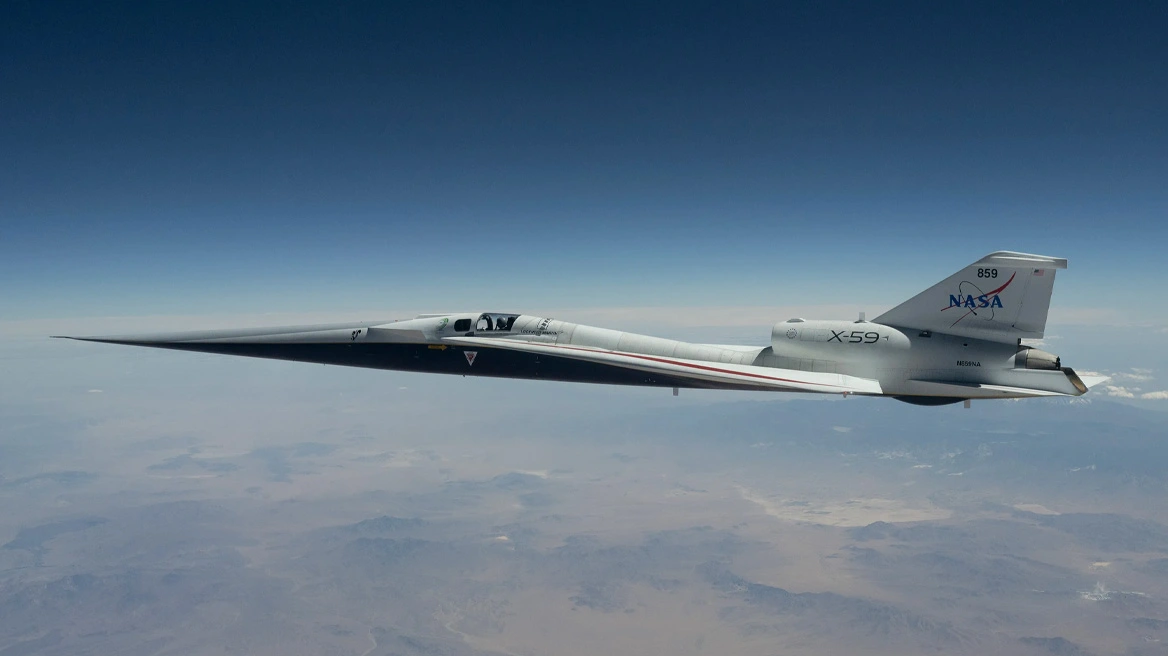
NASA’s X-59 aircraft—often described as the “son of Concorde”—with a development cost of $247 million (approximately €212.5 million), is preparing for its first supersonic test flight.
The aircraft is designed to reach speeds of up to Mach 1.6 (1,960 km/h) and could eventually make the journey between New York and London in just four hours.
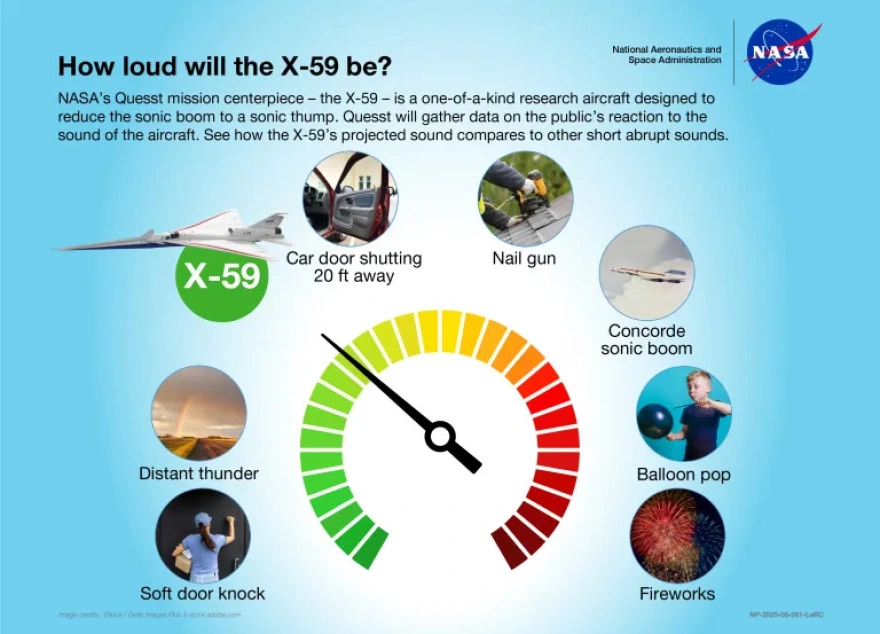
Unlike the Concorde, however, NASA’s experimental X-59 has been specifically engineered to replace the deafening sonic boom with a much quieter “thump,” according to the Daily Mail.
The X-59 has already conducted test flights, with its maiden flight taking place last October. NASA has now announced that it is preparing the aircraft for flights at higher speeds and greater altitudes, including its first test flight at speeds exceeding the speed of sound.
The new tests are expected to begin in June. NASA plans to fly the X-59 at speeds above 1,014 km/h (630 mph) at an altitude of 43,000 feet. This will be followed by a flight during which the aircraft will reach Mach 1.4 (1,490 km/h) at 50,000 feet.
Finally, pilots will push the aircraft to its limits, achieving a top speed of Mach 1.6 at 60,000 feet—roughly twice the altitude and speed of a conventional commercial airliner.
Breaking the Sound Barrier
The X-59 was specifically designed to solve one of the biggest obstacles preventing the widespread adoption of supersonic travel.
When an aircraft flies at subsonic speeds, it pushes air aside, creating ripples in the form of sound waves. However, once an aircraft reaches the speed of sound, it begins to overtake those sound waves, causing them to pile up and merge into a powerful shock wave.
This sonic boom can reach 110 decibels. As a result, supersonic flights are generally prohibited over populated areas.
The New Technology
To address this problem, NASA is developing its Quiet SuperSonic Technology (Quesst), which aims to reduce the sonic boom to a much softer sound.
The aircraft was developed by Lockheed Martin, which received the €212.5 million design contract from NASA in 2016.
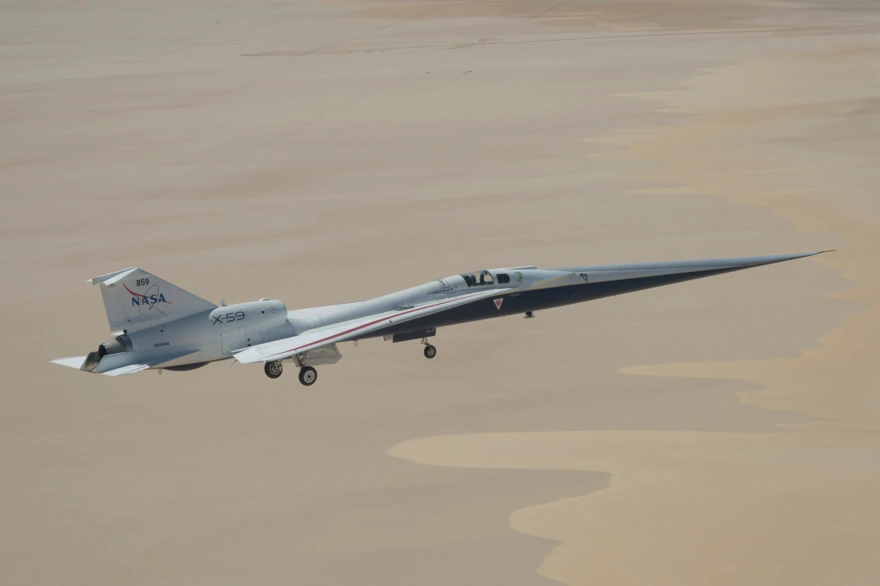
The X-59 features a radically redesigned shape in which every component has been engineered to disperse and soften shock waves. Its most noticeable difference from a conventional jet is its long, slender nose cone, which accounts for nearly one-third of the aircraft’s total length and is designed to break up the shock wave before it forms a loud boom.
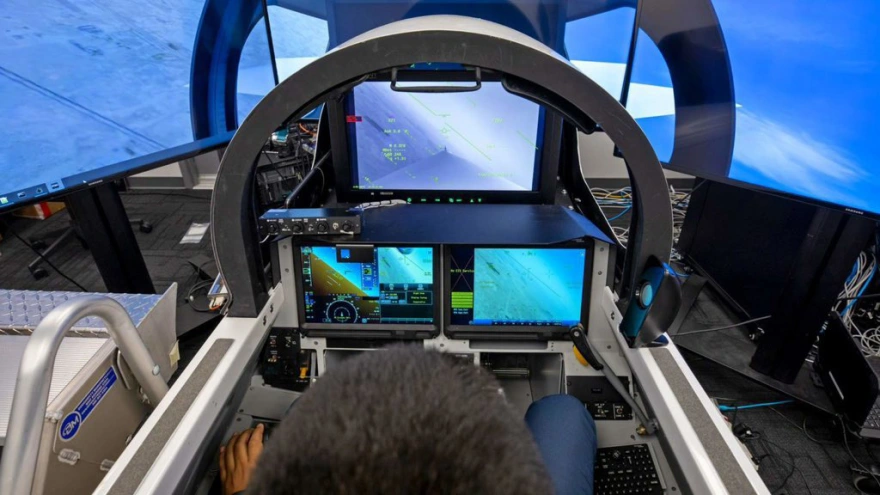
One drawback of this design is that the cockpit is located roughly midway along the aircraft and has no forward-facing windows. Instead, the pilot relies on a camera and augmented-reality display system known as the eXternal Vision System to see ahead.
Achieving these new speed and altitude milestones represents a major step forward for the Quesst program, as they are the performance targets NASA has set for the X-59.
Kathy Baugh, manager of NASA’s Low-Boom Flight Demonstrator project, said:
“Every step toward expanding our flight envelope brings us closer to proving the feasibility of quiet supersonic flight, which is at the heart of the Quesst mission. Completing the first mission-condition flight is especially significant—it is the point at which we begin validating the aircraft’s performance in the environment for which it was designed.”
Although the ultimate goal is to create a quiet sonic boom during supersonic flight, the upcoming series of test flights is not intended to evaluate the aircraft’s noise levels.
The X-59 will be accompanied by a conventional supersonic chase aircraft, whose own, much louder sonic boom would make meaningful noise measurements impossible.
However, the chase aircraft will carry specialized instruments to collect the first measurements of the shock waves generated by the X-59. At the same time, dozens of sensors installed throughout the aircraft’s fuselage will record data on the stresses experienced at high speeds and assess its structural integrity and safety.
These data will pave the way for a new round of tests later in 2026, when NASA will begin evaluating whether the aircraft truly produces the quiet sonic boom predicted by its designers.
“As we look ahead to the upcoming flights, we are ready to push the boundaries even further, moving boldly toward the mission test point this aircraft was built to reach,” Baugh said.
Ask me anything
Explore related questions




