





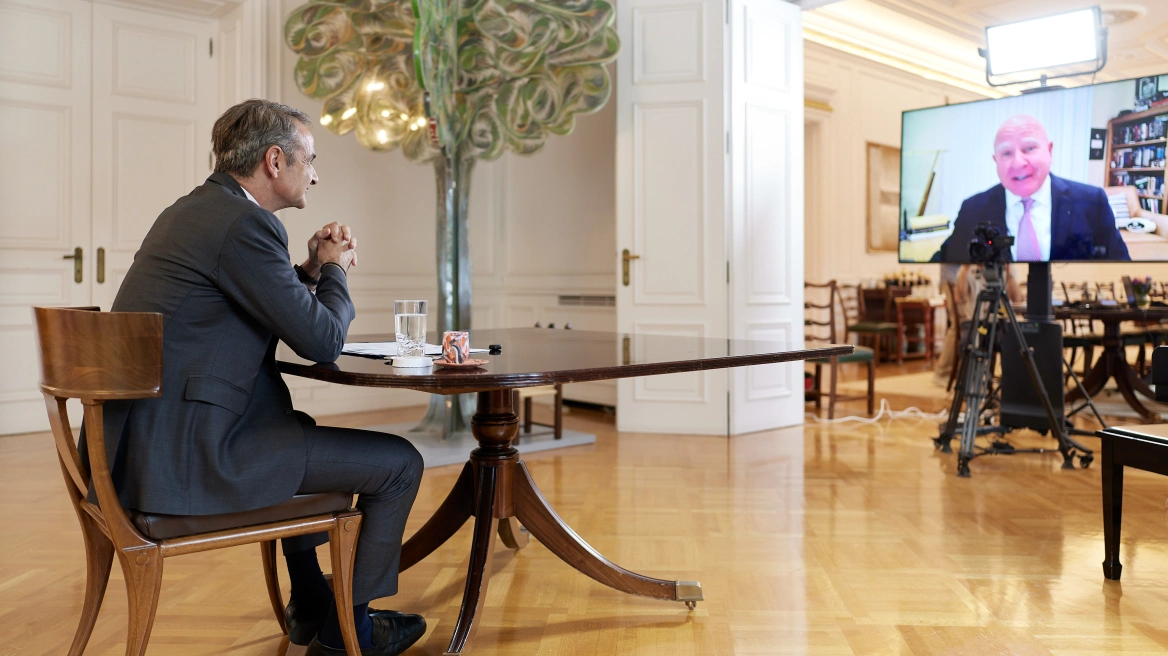
A multi-level message on Greek–Turkish relations, migration, and Greece’s position in the new geopolitical environment was delivered by Kyriakos Mitsotakis in his interview on H.R. McMaster’s podcast, placing at the centre strict deterrence toward Turkey, the management of migration flows from Libya, and Europe’s role in critical hotspots of instability such as the Middle East and the Strait of Hormuz. At the same time, the Prime Minister gave a clear political signal for the future, linking the course of reforms with his intention to seek a third government term.
Strong deterrence
The Prime Minister reiterated that Greece has only one dispute with Turkey: the delimitation of maritime zones in the Aegean and the Eastern Mediterranean, making clear that “Greece’s sovereignty and sovereign rights will never be questioned.”
“A strong economy, strong defence, strong alliances, but also willingness to cooperate with Turkey with clear red lines,” was the framework he outlined.
Active role in the Gulf
Kyriakos Mitsotakis argued that Europe must acquire greater strategic autonomy and operational capacity to intervene in critical regions.
Referring to the Strait of Hormuz, he noted that if an agreement is reached and an international peace presence is required, Europe should be in a position to take an active role.
At the same time, he stressed that the EU must be able to provide tangible support to its partners in the Middle East. “If our Arab friends are attacked, we should be able to support them substantively, not only with nice words,” he said, calling for greater European investment in common security and defence.
“The coast guard is not a reception committee”
He made special reference to the new migration route from eastern Libya to Crete, acknowledging that it is a new challenge for Greece and Europe.
“These people should not be setting off from the Libyan coast,” he stressed, explaining that Athens is cooperating with the Libyan authorities and is even offering training to the country’s coast guard.
The Prime Minister defended the strategy of strict border enforcement, noting that “the Coast Guard is not a reception committee for smugglers,” while sending a clear message that those not entitled to asylum will increasingly face returns from Greece and Europe.
At the same time, he argued that strictness on irregular migration must be combined with organised legal migration pathways to meet the needs of the economy. “I want a big fence for irregular migration, but also a big door for legal migration,” he said.
“I will seek a third term”
He reiterated his goal of a third term: “I will run for a third term, because I believe there is still work that needs to be done and I want to ensure that the changes we are implementing are irreversible,” he said.
As he noted, despite the progress achieved, significant challenges remain, the most important being the cost of living and the need to continue reforms.
Priorities
The Prime Minister presented the country’s economic trajectory as the greatest achievement of recent years, noting that Greece has achieved the fastest reduction in its debt-to-GDP ratio among OECD countries.
At the same time, he argued that nearly 600,000 new jobs have been created, while unemployment has fallen from 18% to 8%.
“Fiscal discipline and growth are not conflicting goals,” he emphasised, rejecting approaches that return to spending policies without fiscal backing.
Referring to European challenges, Kyriakos Mitsotakis focused in particular on the need to strengthen the competitiveness of the European economy.
He spoke of excessive regulation, obstacles in the single market, and the need to create conditions that allow European businesses to grow without bureaucratic burdens.
At the same time, he set competitiveness and defence as the EU’s two top priorities, arguing that Europe must achieve stronger strategic autonomy and invest more in common security.
Ask me anything
Explore related questions




