





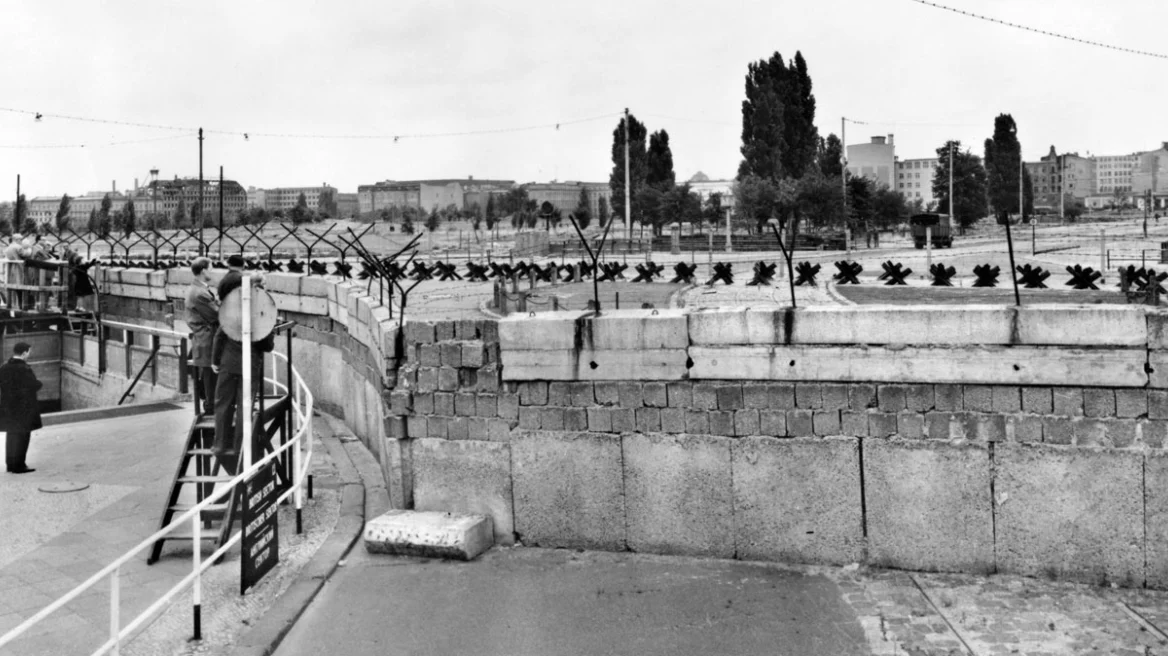
Today is a day of remembrance in Berlin and throughout Germany. Sixty-five years ago today, on the night of August 12–13, 1961, construction of the Berlin Wall began, following a decision by the Volkskammer, East Germany’s parliamentary body, marking a turning point in German history.
It also marked a turning point for the postwar, Cold War world, since the construction of the Wall—initially using barbed wire and later a solid concrete barrier two meters high—sealed the division of Berlin in two, symbolizing the isolation of the Eastern Bloc under Soviet influence from the West.
With a death strip accompanying the impenetrable Wall and immediate repression by border guards who remained constantly on alert under powerful floodlights, free passage by citizens to the other side became, in practice, impossible.
Willy Brandt: “Like a Concentration Camp Fence”
“In the early hours of August 13, soldiers and construction crews, acting on orders from the SED leadership, began blocking the border of the Soviet sector with sections of asphalt, cobblestones and concrete posts. It was the beginning of the Wall, which eventually reached a length of 155 kilometers,” the newspaper Handelsblatt writes in a feature, continuing:
“‘East Berlin sealed off,’ was the headline of an extra edition of the West Berlin newspaper Morgenpost. The then mayor of West Berlin, Willy Brandt, used dramatic parallels to describe the border crossings: ‘In the middle of Berlin, it is not simply a kind of state border that is being erected, but the fence of a concentration camp.’”
The Socialist Unity Party of Germany (SED), by contrast, preferred the term “Anti-Fascist Protective Wall.” However, the person credited with coining the term and a member of the Central Committee, Horst Sindermann, admitted in 1990 that the actual objective was to prevent citizens from fleeing East Germany: “We did not want to empty the country of people. We wanted to preserve the anti-fascist and democratic order that existed in the German Democratic Republic.”
Shadows of the Wall Today
Sixty-five years later, every year on this day, the same scene unfolds: flowers laid in memory of the victims of the Wall on the historic and still deeply moving Bernauer Straße in the heart of Berlin, where the Wall cut houses and courtyards in two overnight; a memorial service at the Church of Reconciliation; and numerous commemorative ceremonies in the German capital and in other German cities along the former internal border between East and West Germany.
And every year, there is also the same painful process of remembrance, reflection and contemplation: of Germany’s fate, the wounds inflicted by Nazism and its consequences for Germany in the new world that emerged from the ashes of the war. A Germany divided in two, a Berlin split down the middle.
This year, a new Wall has been erected at the Brandenburg Gate to commemorate August 13, 1961. It is a temporary, open-air artistic memorial installation. In some places it is transparent, while in others it appears solid and impenetrable, like the concrete of the Wall. Its aim is to recall Berlin’s past while also prompting reflection on today’s walls, borders and divisions.
According to official figures, from the day the Berlin Wall was erected until its fall on November 9, 1989, at least 140 people lost their lives while attempting to cross from East Berlin to West Berlin.
The total number of victims who attempted to escape communist East Germany to the West during the Wall’s 28-year “lifetime” is estimated at more than 600. German reunification took several more decades to arrive, finally taking place on October 3, 1990.
Ask me anything
Explore related questions




