





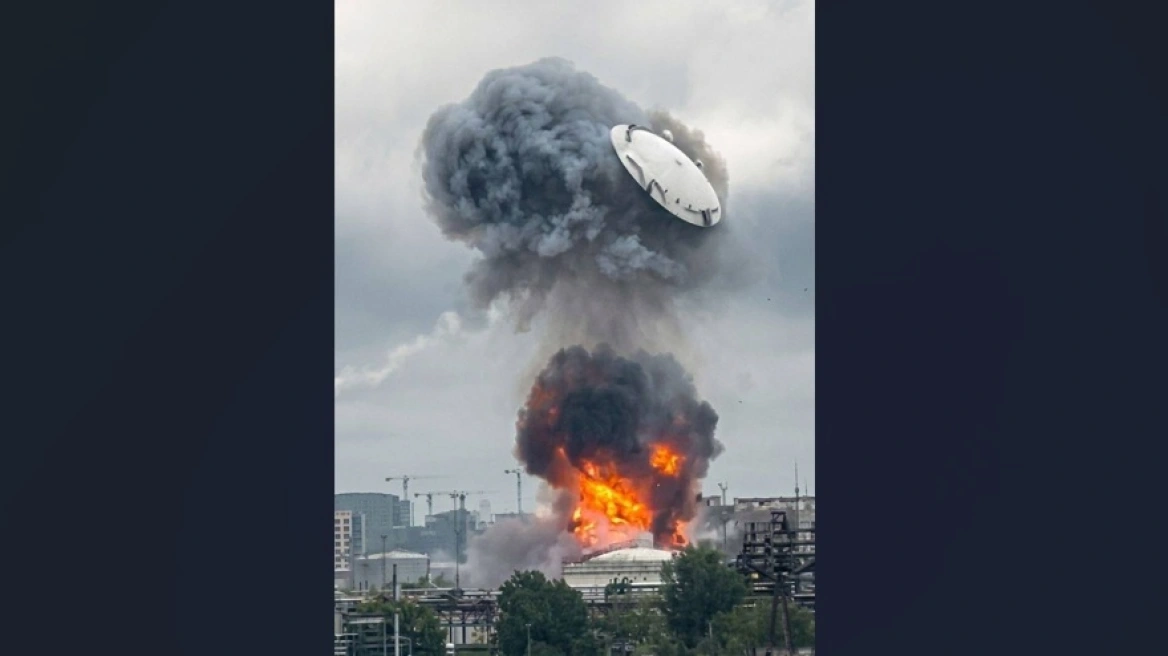
Ukraine launched what officials say was its largest-ever drone attack on Moscow in the early hours of Thursday, striking, among other targets, the Russian capital’s largest oil refinery and causing major fires. According to Russian authorities, nearly 200 Ukrainian drones took part in the operation, highlighting Kyiv’s growing capability to strike deep inside Russian territory.
Moscow Mayor Sergei Sobyanin said air defence systems shot down at least 194 Ukrainian drones on Thursday morning, marking the third consecutive day of attacks on the Russian capital.
Images circulating on social media showed massive flames and thick smoke rising over southern Moscow in one of the most striking attacks the capital has faced since the beginning of the invasion of Ukraine.
At the same time, videos show “rain” of burnt oil falling across several parts of the Russian capital.
The attack is seen as evidence of Ukraine’s steadily increasing ability to carry out long-range operations using domestically produced drones, targeting critical military and energy infrastructure far from the front line.
According to local authorities, at least 16 people were injured, including two children.
Target: Moscow’s largest refinery
Several drones struck the Moscow Oil Refinery in the Kapotnya area, in the south-eastern suburbs of the city. It is the largest refinery in the metropolitan area.
The same complex was targeted by Ukrainian attacks on Tuesday, and had also been hit roughly a month earlier.
Videos published online capture the moment the lid of a large oil storage tank was thrown hundreds of metres into the air following a powerful explosion, while fires broke out in other parts of the facility.
Sobyanin confirmed that multiple drones hit the refinery and said emergency crews were working to extinguish the fires.
Damage to homes and shopping centres, airports shut down
The Ukrainian strikes also caused damage to apartment buildings in southern Moscow and the city’s suburbs. According to Russian authorities, two of the largest shopping centres in the wider Moscow region were also hit.
The attack had significant consequences for air transport. All four Moscow airports temporarily suspended operations, while Aeroflot cancelled 170 flights.
Pressure on Russia’s energy industry
Ukrainian strikes on energy infrastructure have already significantly affected Russia’s fuel production capacity.
Earlier this week, major Russian fuel retail chains imposed limits on the quantities of petrol customers can purchase. Particularly significant are the attacks targeting supply lines to Crimea and the occupied regions of south-eastern Ukraine.
Ukrainian operations have already caused fuel shortages in Crimea, with local authorities introducing strict rationing earlier this month.
Zelensky’s response
According to the Ukrainian military, the operation used long-range Liutyi and FP-1 drones, as well as special units of the Security Service of Ukraine (SBU) and the military intelligence agency (HUR).
Ukrainian President Volodymyr Zelensky described the operation as an “absolutely justified response” to Russian bombardments that systematically strike Ukrainian cities. “If Putin does not want to end this war and wishes to continue it, we will not remain idle. We will respond,” he said.
The SBU stated in a release that each such operation forces Russia to spend additional resources on repairs, strengthening air defences and restructuring supply chains.
Ukrainian Foreign Minister Andrii Sybiha also addressed Russian citizens in a post on X: “Now that you know what is happening, ask Putin when he intends to end the war,” he wrote.
G7 support
The attack took place while G7 leaders were meeting in France, where they pledged support for what they described as “new momentum” in favour of Ukraine, providing more anti-aircraft ammunition and defensive systems.
Zelensky said Ukraine’s allies recognised the effectiveness of its medium- and long-range strikes. “All our partners noted the precision and effectiveness of our operations,” he said in a post.
At the same time, despite continued Russian advances on certain parts of the front line, the pace of their progress has slowed significantly in recent months, while Ukrainian forces have regained ground in some sectors.
Ask me anything
Explore related questions




