





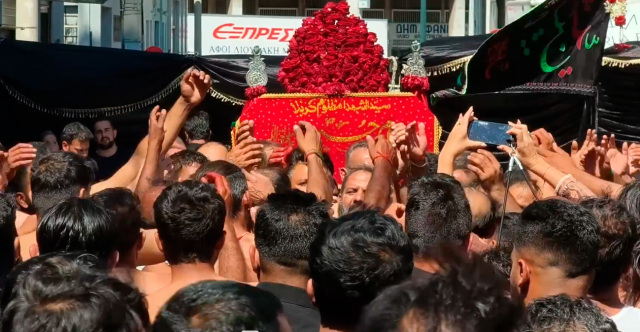
Disturbingly, once again this year, the Piraeus, the harsh and bloody custom of Ashura was revived. On Dimitra Street, where their makeshift place of worship is located, the Shiite Muslims revived the ancient custom.
The ceremony, which carries profound religious symbolism, took place in an atmosphere of intense emotion but also under conditions of extreme heat.
Road closed
For the purposes of the ceremony, the street had been closed off early on, while large fabric curtains were raised on both sides, shielding the area from the view of passersby.
The piercing sound of wailing and the beating of chests
Before the bloody part began, the area was filled with rhythmic, anguished prayers. Under the scorching sun, the piercing sound of the believers’ repeated, coordinated chest-beating echoed for a long time throughout the narrow street.
This practice caused many participants to sustain severe bruises and serious hematomas and bleeding on their chests, reflecting the physical intensity of their mourning.
Self-flagellation with blades as an act of atonement
The culmination of the ten-day period of mourning came with the traditional self-flagellation, a practice that serves as a means of spiritual purification and atonement for the faithful. The scenes that unfolded were extremely harsh, as the bodies of Muslims were covered in wounds from the lashes of the whips. To endure the physical strain, those who took part had prepared themselves properly, having consumed protein-rich meals after a long prayer.
Throughout the ceremony, specially appointed members of the community closely monitored the proceedings, intervening to stop the flogging whenever the wounds on a believer’s back became too deep. At the same time, they splashed water on the participants to help them cope with the stifling heat, while handing out bottles of water and juice both to the participants and to the few non-Muslims who were there to watch the tradition.
Ask me anything
Explore related questions




