





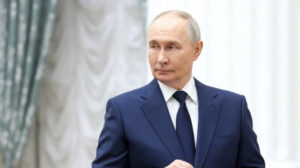
Vladimir Putin is going through one of the most difficult — perhaps the most difficult — periods of his entire 22 years (14 of them consecutive) as Russia‘s president.
Pressure has mounted significantly in recent months. Since Russia launched its invasion of Ukraine in February 2022 and through to the end of 2025, Ukraine has learned, in the most painful way possible, the lessons it needed to learn and has now gone onto the offensive.
Strikes have hit Moscow and its surrounding areas, close to the Kremlin, as well as St Petersburg and Crimea. Critical energy infrastructure has gone up in flames, energy production has ground to a halt, and motorists have been queuing at filling stations in a bid to refuel before supplies run out.
At the same time, Putin has acknowledged the difficulties, admitted the severity of Russia’s energy problems and sent signals to Washington — preoccupied with Iran — urging it to return to the negotiating table.
Questions over the resilience of the 74-year-old Russian president are growing louder, and his political future now appears to be attracting the attention of the gambling world as well.
Against this backdrop, an anonymous user is reported to have wagered $400,000 on the cryptocurrency prediction platform Polymarket, predicting that Vladimir Putin will no longer be Russia’s president by the end of 2026.
The bet, first reported by NBC News, was placed by an anonymous Polymarket account using the username “ZnotluvuiSamez” and displaying the Ukrainian flag as its profile picture.
The user has placed numerous bets relating to Russia and Ukraine, but by far the largest is worth $409,000, backing the “Yes” option on the question: “Will Putin be removed from the presidency of Russia by 31 December 2026?”
The latest wager alone amounted to $50,000 and was placed early on Thursday morning.
The bet runs counter to prevailing market sentiment, with traders assigning only a 12% probability that Putin will lose the Russian presidency before 2030 despite current developments.
According to NBC News, the mysterious bettor could win as much as $2.5 million if the prediction proves correct.
The user’s second-largest wager, worth $61,000, predicts that Ukraine will retake Crimea by the end of the year — another outcome that the market currently prices at just a 12% probability.
The mysterious bettor appears to have joined Polymarket in April this year, while the linked X account contains no posts.
According to Forbes, however, Putin is heading towards his downfall
Putin is facing existential challenges on multiple fronts.
The current state of the war is becoming increasingly damaging for the Kremlin, undermining the Russian president’s legitimacy. At the same time, domestic discontent is growing, as illustrated by the viral video of a Russian military blogger warning of a mutiny.
Public anger is mounting over forced mobilisation and widespread shortages, while historical parallels with previous regime changes triggered by failed wars are once again coming to the fore. Elites, increasingly fearful for their own safety, could turn against him, even raising the prospect of an internal confrontation between Putin’s own security forces.
In its analysis, Forbes outlines scenarios for Putin’s downfall ranging from a swift assassination to a show trial, with possible catalysts including further Ukrainian attacks, internal unrest or China withdrawing its support. The publication predicts that Putin could fall within the next three years.
Putin is in a critical position on several fronts. Following months of sustained Ukrainian drone strikes, Crimea has been almost completely cut off from fuel supplies. Images showing traffic queues stretching for miles as people attempt to leave the peninsula during the height of the tourist season present an especially damaging picture for Moscow.
Russia now has one remaining key supply route: the Kerch Bridge, a structure of enormous symbolic importance that has repeatedly come under attack but, for now, remains standing. Fuel tankers crossing the bridge are considered highly vulnerable targets, as a successful strike could trigger a massive explosion. According to sources within Ukraine’s intelligence services, this possibility is being actively considered.
The military campaign launched by Moscow in Ukraine four and a half years ago may increasingly come to be seen as a disaster. Putin cannot escape the political damage, and once he is no longer able to control the negative images circulating everywhere, the consequences multiply and the countdown begins.
Viral videos and a veteran’s threats
A few days ago, Russian military blogger Alexander Lunin, a veteran of the invasion of Ukraine, released a video warning of a mutiny and calling for a personal televised meeting with Putin.
He claimed senior figures had revealed secrets to him that he needed to pass directly to the Russian president. The video attracted around 11 million views.
He later released a second, more conciliatory video. However, this was followed by another video featuring a group of soldiers backing him and threatening to turn their weapons against officers whom they accused of abusing them.
Lunin’s fate was, in all likelihood, sealed the moment he chose to publish those videos. He has since been arrested and is now in prison. Nevertheless, the case has revived vivid memories of Yevgeny Prigozhin’s mutiny.
Meanwhile, videos of Ukrainian strikes on military installations, energy infrastructure and fuel facilities near Moscow, as well as in more remote parts of Russia, continue to circulate widely. At the same time, images are spreading of female influencers complaining that they cannot find fuel for their cars, alongside videos allegedly showing men being forcibly conscripted into the Russian military.
As Forbes notes in its analysis, history shows that regime change and the collapse of Russian imperial power occurred twice over the past century as a direct result of disastrous wars: the First World War and the Soviet invasion of Afghanistan.
As pressure on Putin intensifies, the elites surrounding him are increasingly focused on their own survival and are using figures such as Lunin to voice their fears. Society, for its part, may ultimately reach only one of two conclusions: either Putin is personally responsible, or those around him are isolating him from reality and preventing him from putting matters right.
The “Ceausescu scenario” and the prospect of a show trial
How Putin’s rule comes to an end will depend on what those who move against him hope to achieve.
According to Forbes, a swift assassination followed by a struggle for power would eliminate the risk of retaliation from his loyalists, but it would remove another possible option: a staged show trial in which Putin would shoulder all responsibility for the failures of his rule. Such an outcome would allow the existing system and the remaining elites to preserve their positions.
This could be described as the “Ceaușescu scenario”, referring to the Cold War-era Romanian dictator who was swiftly executed alongside his wife by the military, while many figures from the old regime retained influential roles within the new system.
Such scenarios have gained additional significance following the recent mysterious death of Sergei Ivanov, a long-time ally and friend of Putin, on 26 June at the age of 73.
Ivanov had long been regarded as a possible successor to Putin. He was one of the few figures at the highest levels of power with sufficient influence to criticise the president from time to time.
The Kremlin announced his death quickly but did not disclose the cause. Ivanov, who had known Putin since the 1970s, had periodically stepped away from official positions of power but remained well connected within the FSB.
Incidents such as these create problems for Putin. When potential rivals disappear, others may conclude that they too are at risk and choose to act against him before it is too late.
With paranoia reportedly growing around him, almost anything could trigger a chain of events: spectacular new Ukrainian strikes on Moscow, food shortages, separatist uprisings in regions such as Tatarstan, Bashkortostan or Chechnya, or a Ukrainian operation in Crimea.
The China factor
Above all, however, stands China’s position.
If Beijing concludes that a weakened Putin has become a liability to its interests, it could contribute to his downfall in a number of ways, including reducing its support for Russia’s war effort or altering its stance towards Siberia.
China has already significantly scaled back its support for the Russian economy and has refused to finance the Power of Siberia 2 pipeline, which would directly connect it with Russia.
Putin’s days, Forbes concludes, are numbered, and if the current trajectory continues — or deteriorates further — he could be overthrown within the next three years.
Ask me anything
Explore related questions




