





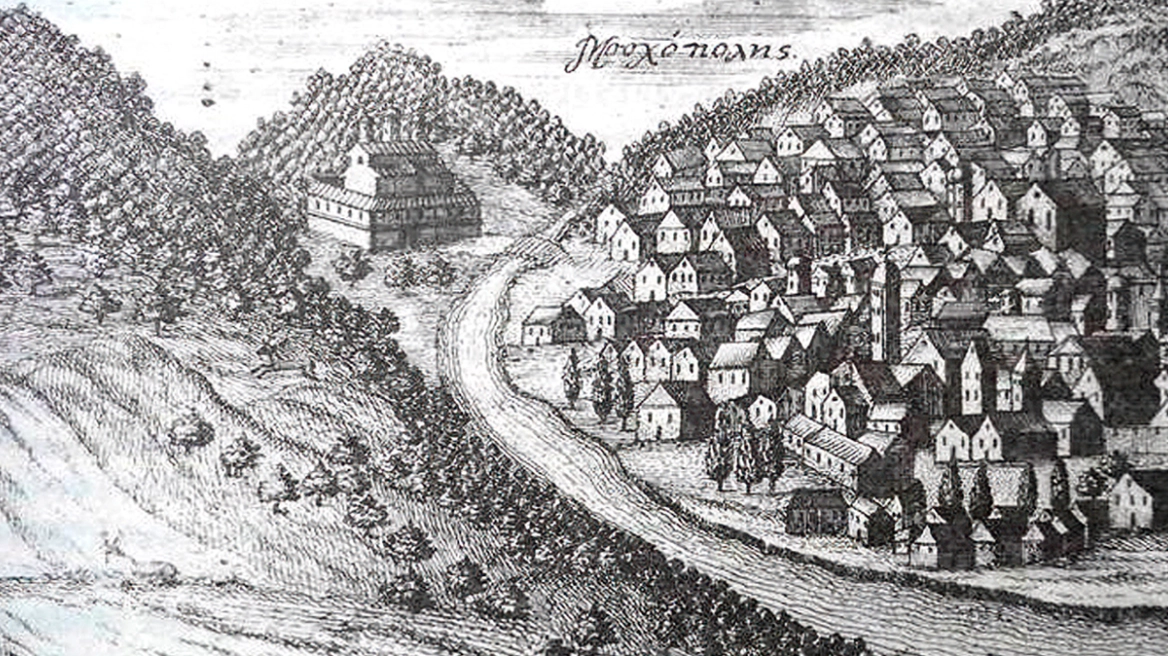
One of the most challenging subjects we have examined is today’s. It concerns Moscopole, a town in Northern Epirus which had a population of at least 40,000 in 1769 before being reduced to desolation in just three days that same year.
We have consulted at least six or seven encyclopaedias and books dedicated to the town, each of which in turn cites dozens of additional scholarly works.
There are, however, many differing views regarding Moscopole, and it would take several articles to examine them all. Today, we will present what appear to be the most likely conclusions. The numbers in brackets throughout the text indicate the source from which the respective information has been drawn.
Where is Moscopole?
Moscopole is now part of Albania. It is located in Northern Epirus, approximately 20 kilometres northwest of Korçë. The town is built at an altitude of 1,115 metres and stretches between the Opar and Ostrovica mountain ranges, west of the Prespa Lakes and Lake Ohrid (1).
According to the 2021 census, it had a population of 1,058. Its current Albanian name is Voskopojë, while in Aromanian (Vlach) it is known as Moscopole (2).
Much has been written about how Moscopole should be classified geographically: as part of Epirus, Macedonia, or Albania. Considering its location on the map, its proximity to Korçë—which is universally regarded as belonging to Northern Epirus—and the views of distinguished earlier scholars including P. Aravantinos, P. Lampros, S. Voutyras, I. Vretos, Z. Molossos, H. Dassaritis, Th. Chavellas, I. Vogiatzidis, E. Kourilas and A. Keramopoullos, as well as Metropolitan Anthimos Alexoudis of Belgrade and K.A. Vakalopoulos in his 1992 book Epirus (1), we consider Moscopole to belong to Epirus.
The town enjoyed remarkable prosperity, particularly during the 18th century, when it developed into one of the most important urban centres in the wider region, experiencing significant economic, political and intellectual growth. It was no coincidence that F. Michalopoulos described Moscopole in 1941 as the “Athens of Ottoman rule“.
When was Moscopole founded?
Another major issue concerning Moscopole is the date of its foundation.
The French diplomat François Pouqueville claimed that Moscopole was founded by Quintus Maximus in the 11th century on the site of the ancient city of the Moschi (de Mosches). However, this theory is speculative and unsupported by evidence. It should nevertheless be noted that when Pouqueville describes events contemporary to his own lifetime, his accounts are generally accurate and his works remain an invaluable historical source.
A different theory, distinct from the others, was put forward by Socrates Liakos in his book The Origin of the Vlachs (Thessaloniki, 1965). According to Liakos, Moscopole’s first inhabitants were urbanised Vlachs originating from Deabolis (or Diabolis), now located in Albania’s Devol region.
Deabolis had been an important city, boasting a strong fortress and serving as the seat of a bishop. However, it declined after 1480, while Korçë emerged as the new administrative centre. The inhabitants of Deabolis, led by their bishop, subsequently settled in Moscopole.
The most authoritative source on Moscopole is generally regarded as MOSCHOPOLE 1330–1930 by Joachim Martinianos, Metropolitan of Xanthi (Thessaloniki, 1957), who himself was born in Moscopole.
Martinianos writes that the Monastery of St John the Baptist in Moscopole was founded in 1630 and that the town itself had been established 250 to 300 years earlier, placing its foundation between 1330 and 1380 (3).
This view is also accepted by the late Asterios Koukoudis in his book The Metropolitan Sees and the Diaspora of the Vlachs.
According to traditions recorded by William Leake, who visited Moscopole in 1796, the town’s first settlers were Vlachs who came from the nearby seasonal settlement (katouna) of Votskopi, which still exists today at a lower elevation to the east, on the road to Korçë.
Owing either to overpopulation or the Ottoman conquest, the large settlement at Votskopi eventually fragmented. Some of its inhabitants moved to what is now the village of Gjonimadhi, others settled in nearby Gjergjevica, while others relocated to Selasforo or Svesda, northeast of Korçë.
Finally, a number of families, most likely led by a man named Petros, settled in what had until then been the deserted site of Moscopole. It is possible that some Vlachs from Votskopi were already familiar with the area, as they traditionally grazed their flocks there during the summer months.
According to a native of Moscopole living in Vienna, this original settlement consisted of only 16 humble huts (4).
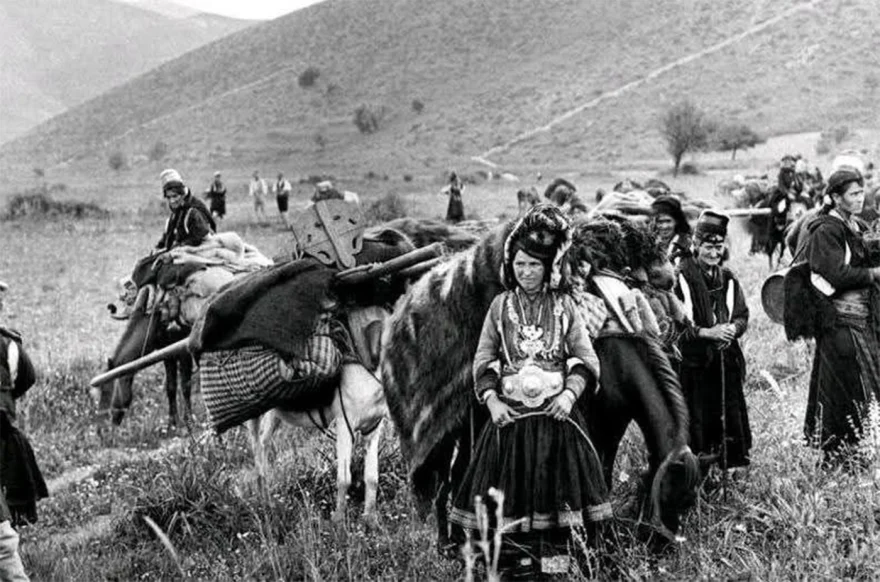
Gradually, during the turbulent years of Ottoman rule, the Vlach settlement of Moscopole began to flourish. The originally nomadic pastoral settlers established a permanent and secure community, far from the main transport routes and protected on an inaccessible yet fertile plateau.
There are also traditions suggesting that Moscopole was already a thriving settlement at the time of the Ottoman conquest of Constantinople in 1453.
According to another account, the settlement was founded in 1338 by Petros, a member of the prominent, most likely Albanian, Muzaka family.
Among the Moscopole community in Budapest, there was also a strong belief that refugees from Constantinople had reached their homeland following the fall of the city.
These refugees were reportedly transported there by the Albanian renegade Ilyaz Panariti, also known as Hoxha-Imbrohori, who had provided substantial assistance to the Ottomans during the conquest of Constantinople in 1453. As a reward, he received families from Constantinople as “spoils of war”. These families are said to have made a major contribution to Moscopole’s later intellectual flourishing.
According to Asterios Koukoudis, this possibility cannot be ruled out. However, it may also represent an attempt to explain the remarkable economic and intellectual development that Moscopole experienced in the years that followed (4).
Were the Inhabitants of Moscopole Exclusively Greek?
Joachim Martinianos, regarded by modern scholars as the foremost authority on the history of Moscopole, is unequivocal in stating that his birthplace was inhabited exclusively by Greek-speaking Vlachs (Vlach-speaking Greeks). Nowhere does he mention the presence of Slavic-speaking or Albanian-speaking residents, emphasising instead that Moscopole was “an exclusively Christian settlement”.
The same view had been expressed by earlier researchers. Johann Thunmann, who studied both the Vlachs and the Albanians, states in his work Untersuchungen über die Geschichte (p. 178) that all the inhabitants of Moscopole spoke Vlach. Austrian Consul Johann Hahn likewise refers to the Vlach inhabitants of the “wealthy Christian town”.
In his work Examinations Concerning the Romans (p. 143), Georgios Rozias writes that the town “is inhabited only by Romans”—that is, Romioi, meaning Greeks. Lambros Koutsonikas also stresses Moscopole’s Christian character, although he provides no further ethnological or demographic details.
Thomas Paschidis does mention the presence of Christian Albanians in Moscopole. However, he emphasises that the Vlach inhabitants of the town had never, up to his own time, “married sons or daughters to the Christian Albanians living among them, although they knew the Albanian language” (4).
The Population Growth of Moscopole
Much has been written about the population of Moscopole, with estimates varying considerably. During its period of greatest prosperity, figures range from 10,000–15,000 to as many as 80,000 inhabitants.
One reliable source is the Ottoman tax registers. It should, however, be noted that the figures quoted below exclude those exempt from taxation, such as priests, certain armed men, people with physical or intellectual disabilities, the elderly and children.
Moscopole was originally known as Voskopole, most likely because its inhabitants were livestock breeders. It first appears in the historical record in 1519 as a village (karye) under the name Viskopoli, belonging to the kaza of Viglista (Vilkasin). At that time, it had 95 households (hane), 40 unmarried men and 25 widows, while its annual revenue amounted to 1,659 akçes.
By 1530, Viskopoli is estimated to have had around 1,200 inhabitants.
The overwhelming demographic dominance of Christians in the wider Korçë and Viglista region is reflected in an Ottoman document (tarihinde) dating from 1530. According to this record, the kaza of Viglista contained 218 Muslim households, 3,569 non-Muslim households and a further 58 non-Muslim households exempt from taxation for various reasons.
It should be noted that Christians even paid taxes on the pork they consumed.
The name Voskopoli first appears in 1537. By then, the number of households had increased to 308, with 41 unmarried men and six widows. Revenue had risen dramatically to 10,168, representing enormous growth compared with previous years.
An Ottoman register from 1559–1560 refers to Uskopoli and its various neighbourhoods, including the Mahalle-i Arnavud (“Albanian Quarter”). It is worth noting that Arnavud is the origin of the modern Greek term Arnaoutis. Thus, in 1560, the Ottomans referred to Albanians as Arnavud, rather than Arvanites, Albanians or Shqiptars. The reference to Mahalle-i Arnavud appears in Konstantina D. Karakosta’s book From Moscopole to Miskolc in Hungary.
The town’s population continued to grow steadily. By 1678, Moscopole had around 3,000 Christian inhabitants, rising to approximately 4,900 by the end of the 17th century. It continued to be referred to as Uskopoli. The name Moscopole came into use around 1720.
According to Joachim Martinianos, the new name derived either from a man named Moschos, who led one of the clans that settled in the town, or from the aromatic musk plant that flourishes in the town and surrounding area.
In August 1889, Gustav Weigand observed that “there still grows there in spring a strongly fragrant flower which the inhabitants call moschos” (3).
However, in a document sent in 1774 by the mutesellim (tax collector) of Korçë to the Grand Vizier in Constantinople, Moscopole is referred to as Iskopol and classified as a nahiye—an administrative district with a relatively small population. This is understandable, given that the town’s first major destruction, which led to its abandonment, had taken place in 1769, while the Muslim population remained extremely small or virtually non-existent.
How many people lived in Moscopole in 1769, when it was destroyed?
What is considered almost certain is that it remained a “Vlach-inhabited town” (Konstantinos Koumas, 1832). Joachim Martinianos estimates that the town contained 12,000 houses and around 60,000 inhabitants.
This estimate was based on the once widely accepted assumption that each household (hane) comprised five people, an approach also adopted by Turkish historian Ömer Barkan in 1940. More recent research suggests that this multiplier was too high, with most scholars now favouring figures between 2.72 and 4.31. For the 17th century in particular, a multiplier of three is considered closer to reality (1).
Accordingly, if Moscopole did indeed have 12,000 houses, its population would have been closer to 36,000.
Nevertheless, Martinianos’ estimate is supported by Konstantinos Skenderis, Charalambos Karmitsis, Dimitrios Kallimachos, Evgenios Kourilas, Theodoros Vellianitis and Alexandre Rubin.
Mario Ruffini also refers to a population of 60,000, citing Theodor Capidan and François Pouqueville, with whom he agrees.
P. Aravantinos, L. Koutsonikas, S. Voutyras, I. Vretos and G. Vafeiadis speak of 12,000 families, rather than 12,000 houses, estimating that Moscopole had between 50,000 and 60,000 inhabitants in 1769.
Kosmas Thesprotos and Athanasios Psalidas do not estimate the population but instead state that the town contained 10,000 houses before its destruction.
Nikolaos Lorentis and William Martin Leake estimated Moscopole’s population at around 40,000, while Gustav Weigand suggested between 40,000 and 60,000 inhabitants (if our opinion carries any weight, we consider this the most accurate estimate).
Spyridon Lampros and Socrates Liakos placed the population at 85,000—a figure regarded as highly exaggerated—while the Russian historian Grigorii Arsh estimated that Moscopole had between 15,000 and 20,000 inhabitants in the mid-18th century, figures that appear excessively low (1).
Moscopole as a Center of Greek Education
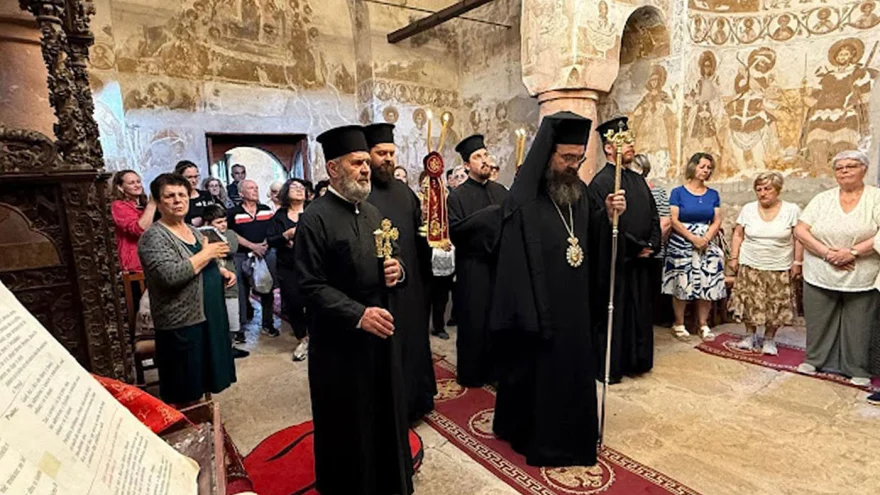
The cultural movement that developed in Moscopole from the mid-18th century played an exceptionally important role in the intellectual development of the Greeks and other Balkan peoples, particularly the Albanians.
From the 17th century onwards, one or more Greek schools operated in Moscopole, funded by wealthy natives of the town living in Venice, Austria and Hungary. Officially, however, the first Greek school in Moscopole was founded in 1700.
Its first teacher and headmaster was Chrysanthos the Epirote, who was succeeded in 1724 by Nikolaos Sygnis (or Stignis) from Ioannina.
Around 1730, the distinguished Moscopole scholar Ioannis Chalkeias taught at the school. He had previously served as professor and director of the Flanginian School in Venice.
In 1738 he was succeeded by Sevastos Leontiadis of Kastoria, a pupil of Methodios Anthrakites.
Leontiadis collaborated with the Moscopole scholar Grigorios Konstantinidis, who established the Balkans’ second printing press in Moscopole in 1730, following the one in Constantinople, which had begun operating in 1672.
In 1744, an advanced level of studies was added to the curriculum. The institution became known as the New Academy and developed into one of the Ottoman Empire’s most important centres of education.
The establishment of the New Academy owed much to Archbishop Joasaph of Ohrid (1660–1745).
The abolition of the Archbishopric of Ohrid in 1767 would later prove decisive in the destruction of Moscopole.
In 1748, Theodoros Kavalliotis, a pupil of Eugenios Voulgaris, became head of the New Academy. Influenced by Leibniz, Kavalliotis introduced new ideas and subjects into the curriculum.
Following the destruction of Moscopole, he left the town, returning during the rule of Kurt Pasha, who will be discussed later. His work was continued by Daniel of Moscopole (5).
How the People of Moscopole Became Wealthy Through Trade
Thanks to Moscopole’s highly developed livestock farming, wool processing was the first industry to flourish.
Over time, the inhabitants began trading their own products, giving rise to the merchant class.
Craftsmen organised themselves into guilds. Goldsmiths, tailors, grocers, butchers, armourers, shoemakers, blacksmiths, coppersmiths and many others prospered, using part of their wealth to finance the education of poor children from Moscopole, including studies at European schools.
Trade links with Venice—established around 1537—and with Ancona through the port of Durrës were particularly important.
In 1537, Venice saw the establishment of the first Greek church and the first Greek school.
Gradually, merchants from Moscopole settled in the Danubian Principalities, Zemun, Novi Sad, Warsaw, Leipzig, Budapest, Vienna and other cities of the Habsburg Empire, as well as throughout the Greek lands—including the rest of Epirus, Macedonia and Thessaly—and present-day Albania.
Between 1715 and 1760, nine magnificent churches were built in Moscopole.
By the middle of the 18th century, enormous wealth had accumulated in the town.
Some, however, believed they were entitled to a share of that wealth despite having no legitimate claim to it.
They were the Albanians living in the regions bordering Moscopole (4).
The First Destruction of Moscopole (1769)
The Albanians living around Moscopole had begun converting to Islam in the early 17th century.
They believed that they had ceased to be rayahs and had become members of a privileged class.
They therefore began demanding a share of Moscopole’s wealth.
Ottoman administration in the area was weak.
The people of Moscopole were forced to pay money to buy off their Turco-Albanian neighbours in order to continue their commercial activities without interference.
Gradually, these “ostensible protectors” (Asterios Koukoudis)—who, in many respects, differed little from today’s organised crime bosses—became borxhilis: ruthless moneylenders, usurers and extortionists.
In 1766, the Russians encouraged uprisings in the unconquered regions of Himara and Montenegro.
The commanders of the Ottoman forces sent towards Epirus imposed extraordinary levies on the inhabitants of Moscopole because of their commercial links with Europe.
By 1769, the borxhilis were threatening to enter Moscopole with the intention of plundering it.
This occurred in May 1769, when Turco-Albanians from Kolonja, Skrapar, Opar and Tomorrica entered the town, seized the wealthy and fortified Monastery of St John the Baptist and destroyed the Postenika quarter, which had been established in the early 18th century.
In June, another group of Turco-Albanian borxhilis from Kolonja entered Moscopole, looting, destroying property and killing anyone who resisted or failed to hand over the money they demanded.
In desperation, the inhabitants appealed for protection to the Vizier of Berat and the bekyar guard.
However, once stationed in Moscopole, these forces themselves descended into looting and destruction.
Meanwhile, the borxhilis continued their threats.
At the beginning of September, rumours spread that even more violent Turco-Albanian attacks were imminent (4).
On 2 September 1769, the inhabitants began fleeing the town, an exodus that lasted just three days (1).
“And not even a dog remained in the town” (3).
The borxhilis entered unopposed and took whatever they wished.
Moscopole Between 1770 and 1789
In 1770, 200 families returned to Moscopole.
By 1779, another 300 families had returned.
Nevertheless, the town was never the same again.
Until 1786, under the protection of Kurt Pasha, Moscopole enjoyed a relatively peaceful period.
His successor, his son-in-law Ibrahim Pasha, proved unequal to the task.
It was then that Ali Pasha emerged.
After defeating Ibrahim, Ali Pasha entered Moscopole in June 1788 and demanded the submission of its inhabitants.
Still traumatised by the events of 1769, they abandoned the town once again.
This second exodus, however, was not comparable to the catastrophe of 1769.
By 1790, around 2,000 Albanian brigands were ravaging the regions of Korçë, Ohrid and Debar.
In 1794, Ali Pasha gained control of the entire Ohrid region, while his son Muhtar controlled the Korçë area.
Even so, during Ali Pasha’s rule, the people of Moscopole lived in relative peace (1).
Conclusion
The abolition of the Archbishopric of Ohrid, internal disputes within Moscopole’s community—which had begun in 1735—and, above all, the Orlov Revolt were the principal factors that led to the town’s destruction.
It should not be forgotten that, acting on Ottoman orders, between 60,000 and 120,000 Albanians swept through Greece between 1770 and 1779, killing, looting and destroying settlements—including Aigio, Spetses and many others—primarily in the Peloponnese, Roumeli and the islands.
Eventually, they ceased distinguishing between Greeks and Ottomans alike, provoking outrage among the Ottoman authorities themselves.
In 1779, the Kapudan Pasha (Commander of the Ottoman Fleet), assisted by Greek klephts, forcibly drove them out (6).
This has been an introduction to the history of Moscopole.
In closing, it would be a significant omission not to mention that Moscopole was also the birthplace of the Sina family, the great national benefactors whose legacy includes the Academy of Athens, the National Observatory of Athens and many other institutions.
Sources:
Konstantina D. Karakosta, From Moscopole to Miskolc in Hungary, Papazisis Publications, 2021 (1)
Wikipedia (2)
Joachim Martinianos, MOSCHOPOLE 1330–1930, Thessaloniki, 1957 (3)
Asterios Koukoudis, The Metropolitan Sees and the Diaspora of the Vlachs, Zitros Publications, Thessaloniki, 2000 (4)
Konstantinos A. Vakalopoulos, History of Northern Hellenism: Epirus, Kyriakidis Brothers Publishing House, Thessaloniki, 1992 (5)
Internet sources (6)
Additional material was also drawn from the volume Epirus: 4,000 Years of Greek History and Civilisation, Ekdotiki Athinon S.A., 1997.
Ask me anything
Explore related questions




