





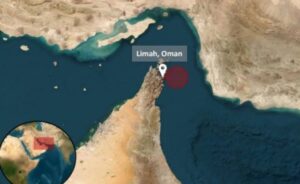
A fully loaded liquefied natural gas carrier (LNG) was struck by a missile off the coast of Oman as it was exiting the Strait of Hormuz, heightening concerns among shipowners and testing the U.S.-Iran agreement aimed at ending attacks in this critical maritime chokepoint.
The vessel Al Rekayyat was struck in the early hours of Tuesday morning, according to sources familiar with the matter who requested anonymity due to the sensitivity of the issue. A warning from the security consulting firm EOS Risk Group confirmed the attack, which occurred approximately 8 nautical miles (15 kilometers) east of the city of Limah in Oman, causing a fire; the incident was described as a strike by either a drone or a missile.
The vessel, which belongs to Qatar’s state-owned shipping company, Nakilat, is the country’s first LNG tanker to be attacked since the start of the war. This incident is a significant blow to Qatar’s efforts to revive its exports after months of relative stagnation. The ship had earlier loaded its cargo at the port of Ras Laffan in Qatar, according to the same sources.
As ship tracking data shows, the Al Rekayyat appeared to be sailing with its transponder turned off, a common measure taken to avoid being targeted. The United Kingdom’s Maritime Trade Operations (UKMTO) had earlier issued a warning about the attack, though it did not name the vessel.
Reactions and Concerns in the Shipping Market
The incident has already sparked a new wave of concern among shipowners. The Al Areesh, another LNG tanker that had loaded in Qatar and was heading out of the Persian Gulf, appeared to change course on Tuesday before reaching the straits and began circling, according to shipping data. The ship had declared the port of Kasim in Pakistan as its destination.
However, other shipping traffic continued as usual. A supertanker (supertanker) flying the Japanese flag and another registered in Singapore were seen crossing the strait via the route approved by Iran, along with a liquefied petroleum gas (LPG) carrier heading toward China. Further south, a convoy of at least six ships, including three very large crude carriers (VLCCs), appeared to be approaching the Omani coastline as it exited the Persian Gulf.
European prices for natural gas rose by as much as 6%, while futures contracts for Brent crude oil edged slightly higher following the news. Oil prices had plummeted in recent days, as the prospect of more ships being able to pass through the strait had reassured the market about a potential oversupply.
The Geopolitical Context in the Strait of Hormuz
The Strait of Hormuz has been a focal point for all sides since the U.S. and Israel launched strikes against Iran in late February, with shipowners constantly assessing the safety of transit in order to send ships in and out of the Persian Gulf. Even after the signing of the interim peace agreement last month, Tehran continues to seek to assert its dominance in the region.
Although shipping traffic has improved since the agreement, it continues to face challenges and disruptions, as Iran periodically blocks passage on routes it has not approved or attacks ships. On Monday, a group of Japanese-flagged ships appeared to be crossing the strait, strictly following the route approved by Iran.
However, there is still no clarity on a permanent solution for managing this strategic passage, amid talks aimed at achieving a lasting peace.
Divergent shipping routes
The Iran-approved corridor along the northern side of the strait accounted for two-thirds of all transits in recent days, according to data from the analytics firm Kpler Ltd., while the rest used the Omani route, which is managed by the U.S.
Of the 25 ships that crossed the Strait of Hormuz on Monday alone, only three did so via the Omani side with their position transponders active, according to the same data —despite a notice from regional naval forces reminding shipowners that the U.S.-controlled Oman route remained available for use.
“The continued use of different shipping lanes suggests that traffic through the straits remains functional, but it is fragmented, as shipowners adopt different navigation strategies based on their own risk assessments,” said Muyu Xu, senior crude oil analyst at Kpler.
International Political Developments
The attack occurred as Donald Trump was heading to the NATO leaders’ summit in Ankara. The U.S. conflict with Iran is expected to be a major topic of discussion, with Trump having expressed his anger toward several members of the North Atlantic Alliance for not doing more to support the U.S. against the Islamic Republic.
Talks between the U.S. and Iran have been suspended, as Tehran began a public mourning period for the late Supreme Leader Ali Khamenei, who was killed on the first day of the war in late February. Qatar stated that the next meeting will be scheduled as soon as possible after the funeral ceremonies. Khamenei is scheduled to be buried in his hometown of Mashhad on July 9.
Earlier, Axios reported that two commercial ships were struck by Iranian missiles, without naming them. Both ships sustained significant damage, but there were no casualties.
Ask me anything
Explore related questions




