





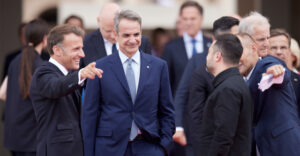
From the closed-door meeting beneath the golden dome of the Hôtel des Invalides, the former military hospital in central Paris that now houses Napoleon’s tomb, to the leaders’ dinner at the French Presidential Palace, and from there today to the grand military parade on the Champs-Élysées, French President Emmanuel Macron set the stage for a Europe attempting to move from declarations to action on Ukraine, seeking to cap the final Bastille Day of his presidency with a display of political and military unity.
Greek Prime Minister Kyriakos Mitsotakis attended Monday’s meeting of the Coalition of the Willing, the Franco-British-led group coordinating military support for Ukraine, was present at the dinner hosted by Macron, and today takes his place on the VIP stand at the Place de la Concorde.
The Greek presence, however, has two distinct aspects: Athens is part of the political coalition backing Kyiv, but is not included in the founding group of the new anti-ballistic missile initiative announced in Paris, although the scheme remains open to new participants.
The closed-door meeting was chaired by Macron, British Prime Minister Keir Starmer and German Chancellor Friedrich Merz, with the participation of Ukrainian President Volodymyr Zelenskyy and roughly 25 other leaders. Also present were European Commission President Ursula von der Leyen, European Council President António Costa and NATO Secretary General Mark Rutte.
Leaders’ remarks were made without television coverage, and shortly after 8pm the delegations moved to the French Presidential Palace, where dinner began at 8.30pm. The French Presidency disclosed neither the menu nor the seating arrangement, keeping the more informal part of the talks away from the cameras.
While the leaders dined, Paris had already shifted into a festive mood: at 11pm the sky around the Eiffel Tower was lit up by fireworks and 1,600 drones forming twelve images centred on the theme “Liberty, Equality, Fraternity.”
The most tangible outcome of the summit was France’s decision to allow Ukraine to produce French weapons systems on its own soil for the first time. Macron announced that Kyiv will be able to manufacture interceptor missiles for the Franco-Italian SAMP/T air defence system, along with guided bombs and SCALP long-range missiles.
The same package includes the delivery of 16 French Rafale fighter jets, with the goal of having them operational in Ukrainian airspace by 2028 or 2029. Starmer, meanwhile, announced Britain’s participation in the 90 billion euro European funding programme for Ukraine’s defence and fiscal needs in 2026 and 2027, an agreement that also opens the door for British defence firms to secure contracts funded through the European mechanism.
A second major announcement concerned the multinational force planned for deployment, at Kyiv’s request, once a sustainable ceasefire is in place. According to the leaders’ joint statement, the force is now ready to operate on land, in the air and at sea, with the aim of helping rebuild Ukraine’s armed forces and deter any renewed Russian offensive.
The leaders also set two clear red lines: no peace agreement without Ukraine’s full participation, and no decision on European security without the Europeans. Frozen Russian assets will remain frozen until the invasion stops and an agreement on reparations is reached.
The summit’s most ambitious plan followed the announcements on arms and the multinational force: the creation of a joint European ballistic missile defence capability, dubbed the “Shield of 10.” Its founding group comprises Ukraine, France, Germany, the United Kingdom, Italy, Spain, Denmark, Sweden, Norway and the Netherlands, with Greece not among the ten founding states.
The goal is a more cost-effective, mass-produced system that will not replace the American Patriot or existing European systems, but will complement them. About a dozen European and Ukrainian defence firms took part in the talks, including Eurosam, Leonardo, Thales, Saab and Ukraine’s Fire Point.
Today, diplomacy gives way to a display of deterrence. The parade, presided over by Macron, is built around the theme of Europe’s “strategic awakening,” with Ukraine playing a central role. The procession moves from the Arc de Triomphe along the Champs-Élysées to the Place de la Concorde, where the leaders’ podium stands between the Champs-Élysées and the Jardin du Céramique, with the Egyptian obelisk towering at its centre.
Mitsotakis and the other guests will be welcomed by French Prime Minister Sébastien Lecornu, Finance Minister Roland Lescure, Minister for Europe and Foreign Affairs Jean-Noël Barrot, Minister of the Armed Forces Catherine Vautrin, and Brigitte Macron.
Nearly 6,800 military personnel are taking part in the parade, led by around 500 officers from Coalition of the Willing member states, with national flags setting a European tone from the outset. Close to 100 aircraft will take to the skies over Paris: the French Air Force’s aerobatic team opens the show, followed by two French Mirage jets flown by Ukrainian pilots trained in France.
A Greek fighter jet will also join the formations alongside aircraft from Germany, the United Kingdom, Croatia, Denmark, Spain, Italy, Norway, Poland and Sweden. The parade closes with the flags of all participating countries honoured, followed by a group photograph of the leaders at the Place de la Concorde.
Ask me anything
Explore related questions




