





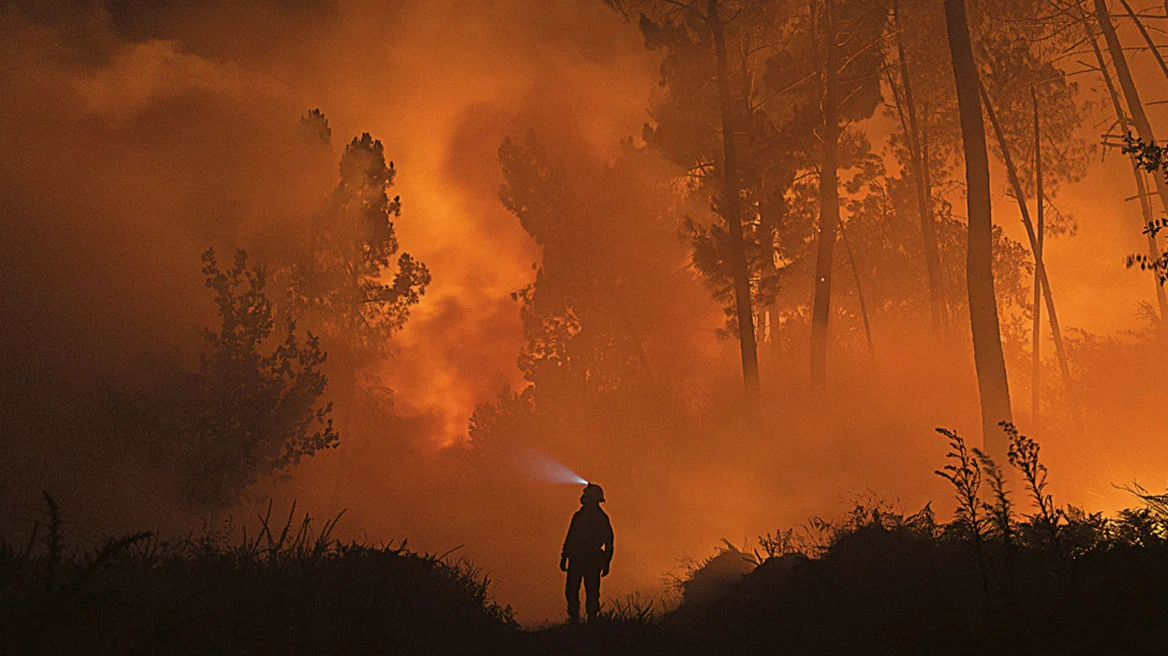
The finiteness of the forces available to the human community today in the face of natural disasters was highlighted, in a fatally painful way, by the wave of fires sweeping Greece as well as Europe. First of all, the limit of self-protection, even of people who by profession or in any case consciously deal with firefighting, was underlined by the tragic loss in the line of duty of the three firefighters in Rethymno and Gythio. Seasonal firefighter Pantelis Diamantakis, five-year obligation Emmanouil Stratidakis and second lieutenant Konstantinos Laimodetis were lost while trying to save the lives of others, properties, the natural environment itself which is always the first victim of every fire.
At the same time, however, the existing technical capabilities of the firefighting forces – and indeed pan-European – also proved finite. Firefighting aircraft and helicopters are unable to operate when winds reach 12 Beaufort, with gusts of speed of 120 km/h and more, which dangerously destabilise every aerial means.
But even the floating rescue craft had to struggle with waves of unprecedented size and power in order to approach those trapped by the fire on the southern coastline of Crete. There where, usually, the natural relief of the area creates leeward points. It is precisely this “usually”, however, that has passed irreversibly: the climate crisis is the obvious perpetrator of a huge change in the intensity of fires and the destruction they cause.
In the era of megafires, which humanity is now going through, the only factor that seems to have no limits is the ferocity and fury of the destructive phenomena. Fires are larger and stronger than ever, to such a degree that, instead of simply being affected by climatic conditions, they exploit them and surpass them. Megafires create their own climate, to their own measure – an inconceivable hell of fire and smoke that rises vertically, instead of covering only horizontally the burning area, and has the power to self-sustain itself against every attempt at extinguishing, but also to reproduce.
The black record of Evros
The paradox with the case of Greece, as perhaps with the whole of Europe, lies in the lack of megafire incidents. A type of gigantic fire, which has been identified with the USA, Australia, etc. Nevertheless, the worst megafire on European soil remains the one that in August 2023 burned Evros, including a very large section of the virgin and protected forest of Dadia, over a total area of 966.1 sq km.
The gigantic fire that broke out a few days ago in France, before it subsided and was contained, shot the annual total destruction very close to that of Dadia. Indicatively, until the last wave of fire broke out, France had lost 43,660 hectares to fire. Within a few days, larger areas burned than had been destroyed in the previous six months, proportionally four times more than the area of Paris. Today the toll of the destruction from the latest megafire raises the burned land to 91,024 hectares or 910.24 sq km, with a reference period from the beginning of the year until about a week ago. And while no one wants to imagine what August holds, the hottest month of the year for the Old Continent.
Spain, similarly to France, is also a confirmation that the epidemic of wildfires is now hitting Europe as well: more than 75,000 hectares are estimated to have burned this year, while three of the five worst fires in Spain’s modern history occurred in the last two years, a fact that in itself almost tells everything one needs to know about the trajectory that European megafires are tracing.
Flames give birth to flames
The population that was forced to immediately evacuate the burning areas – permanent residents as well as passers-by, since the fires broke out in the middle of the tourist season – in southwestern France, together with central and eastern Spain, amounted to 330,000 people. The agony and the upheaval at the macro- as well as the micro-level are terrifying in scale, even if they are not accompanied by the pain for the loss of lives of loved ones or property assets.
Fires of this magnitude were an extremely rare phenomenon for Europe, at least until 2017. That year Portugal found itself at the centre of a maelstrom of multiple fiery blows that surprised and burned the country. Since then, however, the rate of all-out attacks by fire intensified spectacularly, as in 2021 there were 13 major fires in Europe, almost double (22) in 2022, while 2023 saw a decline, with 9, which increased to 11 in 2024 and 18 in 2025. Unfortunately, Greece was a long-suffering protagonist, regardless of the total number of oversized fires. In fact, two of the three worst megafires that occurred in the Mediterranean region happened in our country. The third was in Zamora, Spain, in 2022. The other two were in Evros in 2023 and in Evia in 2021.
Seeking the why behind the violent change in the profile of fires recently, as well as an answer to the instinctive question of whether the future looks even more bleak, one of the most authoritative voices, with international recognition as an authority, is the speech of pyrometeorologist Dr Theodoros Giannaros. In successive interviews with media inside and outside Greece, Dr Giannaros points out certain critical elements.
Such as that fires of such a large scale should not be confronted head-on, because neither the aerial nor the ground firefighting forces are in a position to subdue the colossal thermal load, in combination with the momentum and the opening of the fiery onslaught. “It is a matter of physics,” observes Dr Giannaros, who has also introduced into the public discussion the dimension of the formation of a bleak microclimate by the fire itself. In this context, Dr Giannaros speaks of phenomena such as the pyrocumulus and the pyrocumulonimbus (PyroCb). Specifically, as the Greek pyrometeorologist explains, “the strong upward movement of the hot air produces a cloud that will release its energy in a storm.
This cloud causes changes in the characteristics of the winds, with gusts of extreme speed – even lightning. Thus, the fire itself triggers new outbreaks, possibly at a distance of many kilometres away from the original front.”
As he himself observes, the fires of the scale of France and Spain belong to the megafires and escape the usual measures. “They constitute a ‘coupled atmosphere-fire system’, where essentially the fire produces such high heat that it may create its own weather, which ultimately manifests itself through a cloud that resembles a storm. It has the same structure as the normal clouds that produce storms, but this one is born by the fire. When this happens, the start of a feedback loop between the fire and the atmosphere begins, as the fire alters the atmosphere and subsequently the atmosphere feeds back the behaviour of the fire on the surface. Truly a vicious cycle, with very serious consequences for the ground firefighting forces, as well as for the aerial ones, since the very strong upward currents of hot air prevent the aircraft from approaching at the appropriate height in order to carry out water drops.”
Clouds of fire
The pyrocumulus is predicted to become the form of the new nightmare for the entire planet, as a side effect of its overheating. Those who try to popularise this specific pyrometeorological phenomenon start from its external characteristics. In a first phase it is described as a “dust devil”, that is a dust whirlwind, resembling externally the relatively harmless sand demons that occasionally appear in arid areas, in Africa, Australia, the USA, etc.
In a subsequent stage, the pyrocumulus “swells”, acquiring a very high density of smoke and hot air, resembling externally a cauliflower. Then, however, things are already very difficult, as a firestorm is imminent.
According to Dr Giannaros, “the pyrocumulus is a dust devil, only it is not made of sand, but of fire. And we cannot say that it is created at a certain temperature.”
The conditions that favour the creation of pyrocumulus and pyrocumulonimbus clouds are similar to those that generate dry thunderstorms, that is very hot, dry winds at a low height from the ground, with more humid and cold upper layers in the atmosphere. The scorching air, together with the smoke, rises at high speed from the flames of the fire. As it ascends and its temperature falls, the water vapour condenses around the ash. Subsequently the droplets turn into crystals, which collide with each other, creating an electric field and discharges, approximately as happens in a usual thunderstorm. From this moment the reverse course begins, with the phenomenon tracing a downward trajectory, in the manner of an additional reinforcer of the raging fire.
A characteristic example concerns France. After the fire broke out on 22 July near the village of Saumos, about 40 km from Bordeaux, in the Gironde region, at the southwestern edge of France. Saumos, better known now as the “cursed village”, is considered the starting point of the fire that devastated the surrounding area for days and nights, forcing 220,000 people to flee in order to escape the flames.
Two days after the start of the fire, approximately after sunrise, the firefighters and the meteorologists reported the formation of a pyrocumulonimbus. During the evening hours, the phenomenon subsided slightly, possibly thanks to the increase in humidity in the atmosphere. Afterwards, however, it recovered, following a cycle of intensity and relative remission that was repeated several times.
The role of overheating
World Weather Attribution is an observatory of climate change, which since 2014, when it was founded by the late Dutch physicist and meteorologist Dr Geert Jan van Oldenborgh and the German meteorologist Dr Friederike Otto, publishes scientific analyses of phenomena almost in real time. As it combines experience, knowledge and observation from a group of specialists who work in various centres around the world, it tries to give analytical and valid answers to fundamental questions. The specialists try to explain both what is happening now with the megafires in relation to the causes that lie behind the dramatic deterioration of the extreme outbreaks, and the connection of the colossal fires with the climate crisis.
In the present case and on the occasion of the megafires in France and Spain, worldweatherattribution.org sets out a series of conclusions. Picking out the most important of these, one learns that “during the weeks that preceded the fires, there was a series of extreme heatwaves and mild rainfall, in a large part of Western Europe, weather phenomena rather unusual for the season. Recent studies have shown that anthropogenic climate change increased the probability of occurrence of these hot and dry characteristics of the weather, which played a catalytic role in the genesis of the extreme weather conditions, which in turn accelerated the outbreak of the fires.”
A second observation deepens into the meteorological data: “The winter rainfall, which exceeded the average, created increased moisture in the soil, enhancing the vegetation. However, unusually dry and hot conditions followed, which exhausted the soil moisture, especially on the surface, a fact of critical importance for the drying of the grasses and other natural fuel materials. Furthermore, the drought and the heat increased the pressure for securing the necessary moisture in the spontaneous vegetation, including the shrubs and the pines. Overall, these conditions worsened the probability of fire ignition and its rapid spread, providing more immediately available fuel. More generally, the abrupt alternation from a wet winter to a dry spring constitutes an increasingly important risk factor for fires in Western Europe.”
The forecast
Ultimately, the general verdict of the scientists on the one hand is not particularly optimistic, on the other hand it points to the climate crisis as the main culprit of the megafires. “Both in France and in Spain, our observations show strong trends of increase in the probability and the ferocity of fires, in relation to the overheating of the Earth. It is characteristic that the individual data of our measurements from central Spain in July 2026 are correlated with an increase in the probabilities for fires at least 20 times higher than what would apply under the climatic conditions of the pre-industrial period,” concludes worldweatherattribution.org. Emphasising that “limiting the further increase in fire risk requires the rapid abandonment of fossil fuels.”
Dr Giannaros adds moreover that “not even a year has been completed since we experienced the worst fire period ever recorded, with more than 1 million hectares of land having burned. So, the situation is definitely getting much worse.
However, climate change prepares the scene for the fire, but it does not light the fire. Human activity and land management choices are those which, for decades now, create these images today. Unfortunately, our climate predictions and all the research that has been conducted not only throughout Europe but also worldwide show that the conditions will get worse and worse every year. We will have more heat, harder trials from drought and in all the components that will allow a fire to grow and possibly become catastrophic. We should say that this is the new normality in Europe.”
Ask me anything
Explore related questions




