





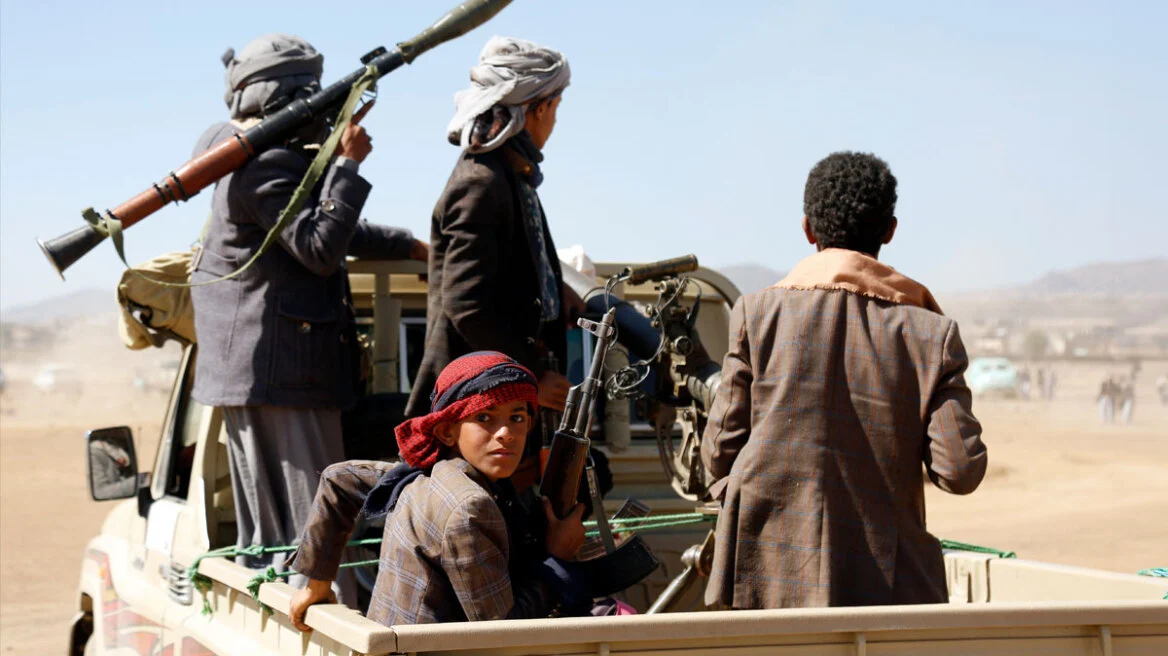
For more than a year, the Houthis have faced three of the most powerful military forces operating in the Middle East. The United States launched more than a thousand strikes within a few weeks. Britain took part in joint operations against drone and missile facilities. Israel bombed ports, airports, power stations and fuel facilities, and even reached the top of the Houthi leadership in Sana’a.
And yet, in August 2026, the Houthis are back again, targeting locations across the Middle East and creating serious problems in a situation that is not moving toward de-escalation, but rather toward a new escalation. They are launching missiles and drones, threatening Saudi Arabia, striking the forces of Yemen’s internationally recognized government, and above all demonstrating that they can still turn the Bab el-Mandeb Strait into a choke point for the global economy.
This is also the biggest problem for the Middle East. The Houthis have suffered enormous military costs, but no one has yet found a way to neutralize them strategically.
In recent days, the warning has become clear. The Houthis have announced attacks on Saudi oil tankers, brought the war back to Najran, attacked government forces in Marib and Hadramaut, and claimed to have struck Aramco facilities in Jizan. At the same time, traffic through Bab el-Mandeb has fallen dramatically, as ships have once again begun avoiding the route and choosing to sail around Africa. The strait does not even need to be officially closed for there to be an impact. After what has happened in the eastern passage of the Strait of Hormuz, the threat alone is enough.
A missile, a drone or an attack on a tanker can increase insurance premiums, force shipping companies to change routes and add weeks to the journey of a cargo. At a time when the Strait of Hormuz also remains a major source of geopolitical tension, the risk is now twofold: two of the world’s most important energy arteries are under pressure simultaneously. That is precisely why the Houthis’ reappearance is different this time.
A Thousand US Strikes Were Not Enough
In March 2025, Washington decided that limited retaliation was not enough. Operation Rough Rider developed into the largest US campaign against the Houthis. Over the course of 52 days, the United States carried out more than 1,100 strikes.
Targets included military camps, command centers, missile depots, drone facilities and infrastructure in Sana’a, Al Jawf and western Yemen. In April, the Ras Isa oil terminal was hit, followed by further attacks on facilities Washington considered critical to the Houthis’ military and economic operations.
On April 29, Britain also took part in a joint strike against a facility south of Sana’a which, according to London, was being used to manufacture drones. It was the last confirmed British participation in a bombing operation in Yemen.
The American campaign inflicted significant losses and put serious pressure on the organization. It did not, however, achieve its main strategic objective: eliminating the Houthis’ ability to recover and return to the fight.
The agreement reached through Oman in May 2025 limited attacks on American ships. But the Houthis were not disarmed, their supply lines were not dismantled, and their leadership was not disrupted. A few months later, it became clear just how temporary the result had been.
Israel Went Even Further
Israel followed a different strategy. When the United States halted its major campaign, the Israeli Air Force continued striking Yemen. Hodeidah, Ras Isa and Salif were repeatedly bombed. Sana’a airport was temporarily put out of operation. Runways were destroyed, aircraft were hit, and energy facilities and power stations became targets.
In August 2025, a year ago, the Israeli strategy moved to a different level: decapitating the political and military leadership.
An Israeli strike on Sana’a killed the prime minister of the Houthi government along with several ministers. Further attacks followed against military and political infrastructure. Yet again, the organization survived. The ports were repaired. Missile launches continued. The drones returned.
This is perhaps the most worrying conclusion from the past eighteen months. Military power can destroy Houthi infrastructure much faster than it can eliminate their ability to fight.
They Are Not Simply Another Iranian Militia
One of the biggest mistakes in understanding the Houthis is treating them as just another proxy force of Tehran. Iran is their most important external supporter. It provides expertise, equipment and political backing. But the Houthis have acquired something that several other pro-Iranian organizations do not possess: a genuine territorial and political base. For some observers, it is even more significant than Hezbollah’s base in Lebanon.
They control Sana’a and the densely populated areas of northern and western Yemen. They have an administrative apparatus, taxation, recruitment networks, ports and a society that has learned to function amid perpetual war. They also have more than a decade of conflict with Saudi Arabia behind them.
They did not survive because no one tried to defeat them. They survived precisely because many people tried.
The Most Dangerous Scenario
The biggest question now is not whether the Houthis can launch another missile. It is whether the new escalation will bring Saudi Arabia directly back into the war.
Since 2022, Riyadh had chosen de-escalation. The war had proved costly without succeeding in eliminating the Houthis. Today, however, the equation — and the circumstances — have changed.
The Houthis are once again threatening Saudi oil facilities, ports, airports and shipping. At the same time, military deployments are increasing again on Yemen’s fronts, and the United Nations is warning that the risk of a wider war is at its highest level since the 2022 ceasefire.
If Riyadh decides that restraint is no longer working, the Yemen front could reopen at full intensity. And then the problem would not be confined to Yemen. It would involve Saudi Arabia, Iran, Israel, the United States, the Red Sea and the international energy market.
This is ultimately what makes the Houthis one of the most difficult actors in the Middle East. They do not need to defeat anyone. They only need to remain capable of launching missiles, sending drones and forcing governments, warships, airlines and commercial fleets to consider their next move every time.
The United States bombed them. Britain took part. Israel struck all the way to the top of their leadership. And yet, the front remains open.
Perhaps this is also the most dangerous reality. In the case of the Houthis, the Middle East has so far found many ways to fight the problem — but none to solve it.
Ask me anything
Explore related questions




