





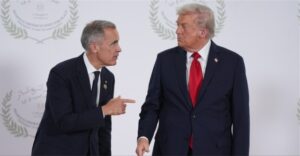
The already strained relationship between the United States and Canada has taken a new turn, after US President Donald Trump signed an executive order that, he says, renames Lake Ontario “Lake America” with immediate effect.
Canadian Prime Minister Mark Carney noted the lake’s name dates back more than 400 years, and said Washington’s decision carries no international legal weight
US President Donald Trump has opened a new front in the already strained relationship between the United States and Canada, signing an executive order that, he says, renames Lake Ontario “Lake America” with immediate effect.
The move drew an immediate response from Canadian Prime Minister Mark Carney, who made clear the lake will be called Ontario “today and forever,” as the two countries remain locked in a bitter trade dispute and continue trading new tariffs.
Carney: “Lake Ontario, today and forever”
The Canadian prime minister responded to Trump’s decision in a post written in French on X, stressing that the lake’s name does not change for Canada.
“We know the United States is changing. Its trade relationships, its foreign policy, its national monuments, its hydronyms,” Carney wrote.
“Canadians also know that things must be called by their name, and this lake is called Lake Ontario, today and forever,” he added.
Carney also pointed out that the name of the lake, which lies on the border between the United States and Canada, “dates back more than 400 years, long before the Canadian Confederation and the United States Declaration of Independence.”
The name Lake Ontario comes from the Wendat word Ontari’io, which, appropriately, means “the lake is beautiful, the lake is big”.
— Mark Carney (@MarkJCarney) August 27, 2026
The name is more than 400 years old, predating both the Confederation of Canada and the Declaration of Independence of the United States of America.…
The map in the Oval Office
Trump signed the executive order changing the name on Thursday, with a map displayed in the Oval Office for the occasion already showing the lake, one of the Great Lakes along the border region, labelled “Lake America” in large red letters.
“The United States is the largest protector of the Great Lakes,” the executive order, later published by the White House, states.
The same document states that “the United States claims most of the lake’s volume, as its deepest sections lie within American territory.”
Trump’s decision, however, does not imply any international recognition of the new name.
“We might change the name of the Atlantic or the Pacific”
Trump accompanied his decision with a comment about the possibility of further renamings.
“We have a gulf and we have a lake. All we’re missing is an ocean. So we might change the name of the Atlantic or the Pacific. We might change both,” he said.
Earlier, at the start of his second term, Trump had already ordered the renaming of the “Gulf of Mexico” to the “Gulf of America.”
Before signing the new executive order, he had repeatedly referred to the Lake Ontario name change on social media. He has also said several times that Canada should become the 51st US state.
The name “Ontario,” also borne by the Canadian province of the same name, comes, according to an etymological explanation from the Canadian government, from the Iroquois word “kanadario,” meaning “sparkling” water.
This historical dimension was a key part of Carney’s response to Trump.
New tension amid trade war
Trump’s move comes as Washington and Ottawa are already locked in a fierce trade dispute.
Trump accuses Canada of taking advantage of the United States, and on Wednesday launched a fresh attack on Canadians.
“Canadians have treated us very badly. They are bad people,” he said.
The Republican president’s latest move risks undermining the hopes Ottawa expressed on Thursday for a resumption of trade talks between the two countries.
Washington is due to impose new tariffs on a range of Canadian products from Saturday, following the breakdown of trade negotiations by Ottawa.
Trump described the order as “official, effective immediately” when he signed it in the Oval Office, saying he had “filed all the necessary papers, documents, everything else” and notified all the relevant parties. He later posted a letter from the director of the US Geological Survey confirming the change had gone through and would begin appearing in printed documents over the coming days.
Some US outlets quote Carney tracing the lake’s name to a Wendat word, “Ontari’io,” said to mean “the lake is beautiful, the lake is big,” a slightly different account from the Iroquois etymology cited above.
The trade war has escalated further since the order was signed. Fifty percent tariffs on some Canadian imports, including wine and dairy, took effect on Saturday, and Trump has announced 50 percent tariffs on all Canadian steel and automotive imports from January. Carney has responded by announcing that Canada will impose matching tariffs of up to 50 percent on billions of dollars of US goods from 8 September.
Trump also used the same push to try to revert Alaska’s Denali back to “Mount McKinley,” part of a wider pattern of place-name changes that began with the Gulf of Mexico order.
Ask me anything
Explore related questions




