





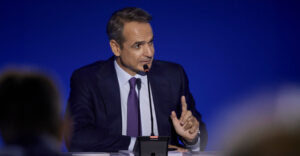
With the Thessaloniki International Fair (TIF) approaching and New Democracy and government officials gradually arriving in Thessaloniki, Kyriakos Mitsotakis is focusing his attention on announcing a major economic package based on the logic that practically every social group will have something to gain. Some will benefit from a specific measure, while others will benefit from several, with the broader aim of increasing disposable income and reducing the tax burden.
It is clear that, in shaping the package, the Prime Minister’s Office is seeking to appeal to as many citizens as possible and rebuild its relationship with former New Democracy voters who have moved away from the party or remain among the undecided. This comes at a time when New Democracy is likely to face challenges both from the right — from Samaras’ party — and from the left, with several proposals from PASOK and Alexis Tsipras’ political movement.
In any case, Mr. Mitsotakis will proceed independently and, as protothema.gr has previously reported, will speak from a broader perspective, also looking toward Greece in 2030. This means his announcements will have greater long-term depth.
A characteristic example is the minimum wage. An increase to €960–970 in 2027 is expected to be announced, together with an indication that it will reach or even exceed €1,000 in 2028 (gross).
The government knows that workers are expecting to hear something positive, since an increase in the minimum wage also pushes up benefits and seniority bonuses. On the other hand, it recognizes that it cannot be overly generous with money that ultimately comes from elsewhere, since businesses will be required to shoulder the cost.
Workers could nevertheless benefit, even slightly, from a reduction in social-security contributions. The central scenario currently under consideration by the government is a 0.5-percentage-point reduction benefiting employees, without a corresponding adjustment to the non-wage labor costs borne by businesses.
Relief for the Market
The business community should also expect favorable measures.
A reduction in the tax presumptions (“tekmiria”) for sectors of the economy that demonstrate high tax compliance and are closely connected with the tax authorities is considered effectively agreed and has largely been announced in advance.
Liquidity will also receive a significant boost from a reduction in the corporate tax prepayment for businesses and legal entities. At this stage, however, a further reduction in the corporate tax rate from 22% to 20% is not favored, particularly since the European average is around 21.9%.
On the other hand, the abolition of the business levy (“telos epidevmatos”) for legal entities is considered highly likely, although it remains unclear whether it will happen all at once or in two installments. In any case, this would remove a financial burden from businesses.
Special Measures for Farmers
Farmers represent a special category. Many will benefit from the reduction in the tax-presumption burden, while from November they will also receive tax-free agricultural diesel at the pump. Through a special card, the fuel excise tax will be deducted directly at the filling station.
However, for farmers — who, together with livestock breeders, gave 48% of their vote to New Democracy — there will also be a special tax-relief measure that the government team is keeping under tight wraps for now.
Expanded Support for Pensioners
Pensioners are a crucial social group for New Democracy, as they have traditionally been highly consistent in turning out to vote.
In addition to pension increases and the abolition of the personal difference mechanism, which will allow many pensioners to receive increases for the first time, the government is preparing to increase the benefit paid to pensioners every November to approximately the level of the national pension — more than €400.
There is also a strong possibility that eligibility will be expanded, effectively turning the payment into something resembling a 13th pension for citizens who are particularly vulnerable to the wave of rising prices, since they have limited ability to increase their income in other ways.
“Fire” at Tsipras
In any case, the government was ready to respond to Alexis Tsipras’ appearance in Thessaloniki on Wednesday evening, accusing him of having “blown the budget sky-high” with his proposals.
Government spokesman Pavlos Marinakis estimated the cost of the program outlined by Mr. Tsipras at €13 billion for the year of implementation.
“Fake promises, without any costing, and ‘patriotic taxes,’ which bring back the worst memories, especially for the middle class. He has once again started making unlimited promises of new benefits, ignoring every European spending-cap rule, using exactly the same recipe as the unforgettable Thessaloniki Program of 2014,” the government spokesman said.
Marinakis accused Tsipras of failing to engage in self-criticism and of trying to convince Greeks that they were better off before 2019 than they are today.
It is clear that the government intends to confront Mr. Tsipras on equal terms, as demonstrated by its eagerness to respond to his speech.
“The packaging may change, but the content remains the same. However, everyone now knows that the more Mr. Tsipras promises, the larger the bill he wants to pass on to taxpayers,” Marinakis said in the same statement.
Ask me anything
Explore related questions




