





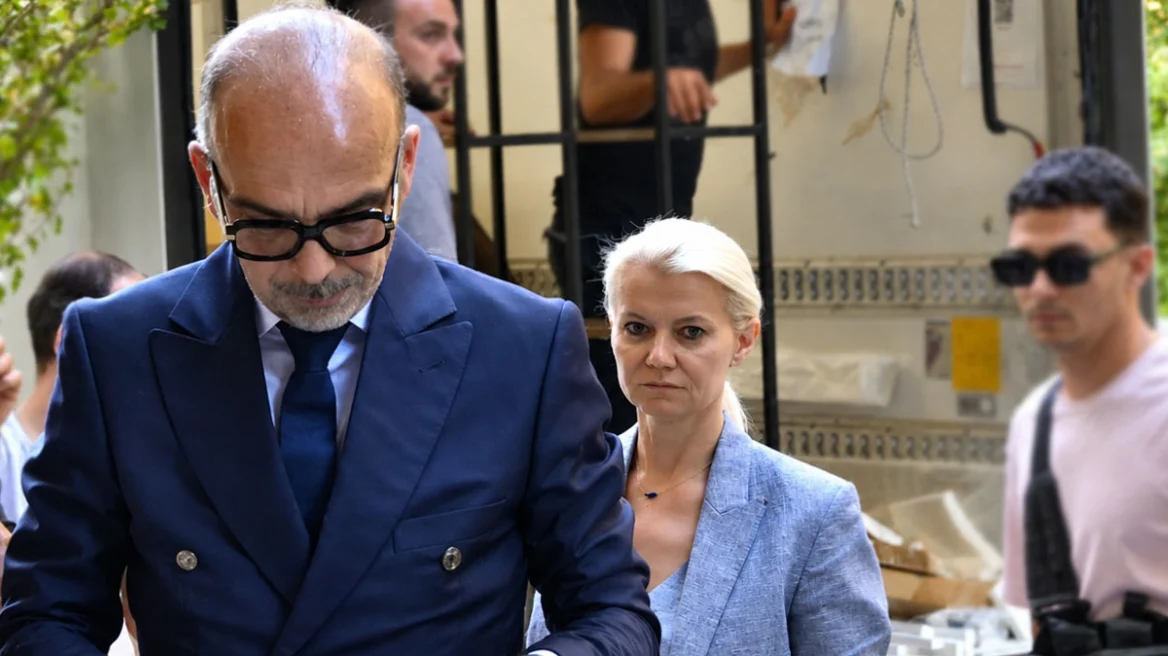
The two doctors facing charges over the death of George Mazonakis are expected to appear before the investigating magistrate today to give their accounts of what happened inside the clinic in Kolonaki, where the singer suffered cardiac arrest during plasma exchange treatment.
Their statements are considered crucial to the progress of the investigation, as authorities seek to piece together, minute by minute, what happened in the run-up to the cardiac arrest and establish who was present, what medical procedures were carried out and what condition the singer was in during those critical minutes. According to revelations that have emerged, however, the two doctors were not even in a position to help a patient suffering cardiac arrest. Indeed, even the adrenaline injections administered in desperation, according to the claims of Ilias Theodoropoulos, may have been given too late and entirely in vain, merely to maintain appearances rather than save Mazonakis, who had already died.
What authorities are trying to establish from the photograph taken on Ioanna Gaka’s mobile phone
The photograph of George Mazonakis recovered from the mobile phone of doctor Ioanna Gaka is also under close scrutiny by the authorities and has now emerged as one of the key pieces of evidence in the investigation.
In the photograph, George Mazonakis is seen lying on the clinic bed while the machine is operating. He is wearing a yellow short-sleeved T-shirt, is covered with a blanket from the waist down and has his head turned to the right, with his eyes closed.
A venous catheter can be seen in his right hand, while a corresponding connection also appears to be present in his left.
Investigators are now attempting to establish as precisely as possible when the photograph was taken, why it was taken and, above all, what condition the singer was in at that moment.
The results of the lifting of telecommunications privacy are also awaited, in order to establish whether the photograph was sent to another person.
Among the scenarios being examined is whether it was sent to the doctor’s husband, who is reportedly believed to have been at a restaurant at the time, or whether it was transferred to a computer or another device.
The technical analysis of the photograph itself is also of particular interest. Authorities are examining every detail of the photographic material, seeking to determine whether, at any point or from any angle, the screens of the machines located near the singer can be seen.
The aim is to identify, if possible, indications relating to his vital signs that could provide answers about the condition George Mazonakis was in when the photograph was taken.
The four contradictions in the doctors’ accounts
According to the evidence included in the case file, the couple of doctors who are expected to give their accounts before the investigating magistrate today must address the key contradictions that have been identified:
1. What time did George Mazonakis arrive at the clinic? Gaka claimed that the singer arrived at Karneadou at 4pm, in contrast to witness statements from clinic employees who say that he arrived half an hour earlier.
2. How long was the singer in the treatment area? Gaka claims that he remained there for a very short period and that the plasma exchange machine had not even been switched on, as she was the only person who operated it. A female clinic employee, however, stated in her testimony that George Mazonakis had been there for at least 45 minutes.
3. What is Gaka’s medical speciality? She stated that she is a doctor specialising in gynaecology, while Theodoropoulos is an internist, in contrast, however, with the licences of the co-located medical practices and the services they provided to their patients.
4. What happened to the defibrillator at Stem Cell? Gaka claimed that Theodoropoulos used the defibrillator in an attempt to revive George Mazonakis. However, the EKAV ambulance crew confirmed that the defibrillator at the premises was not functioning.
A crucial element in assessing how the two accused doctors acted, however, is also the fact that they did not accompany the singer to hospital in the EKAV ambulance in order to brief the doctors who received him on what had happened beforehand. Instead, they remained at the clinic on Karneadou, where the premises were thoroughly cleaned by the employees. At the same time, the details of the singer’s appointments were removed from Gaka’s electronic diary.
New allegations against doctor: “She told my wife she had cancer when she didn’t”
Meanwhile, new testimonies and allegations concerning the operation of the clinic in Kolonaki have come to light, just hours before the two doctors are due to appear before the investigating magistrate tomorrow.
One of the new allegations concerns Ioanna Gaka personally and was broadcast by Alpha. A man claimed that the doctor had made an incorrect diagnosis concerning his wife, telling her, according to his account, that she had cancer, which, he claims, was not the case.
“She told my wife she had cancer when she didn’t,” the complainant said.
At the same time, a patient from Russia who had previously visited the clinic said that she had undergone “stem cell” treatment, as had other members of her family.
“I had undergone ‘stem cell’ treatment and many members of my family had undergone the same treatment,” she said.
The “popular vigil” continues until midday, with the funeral at 1pm
It is recalled that the “popular vigil” for George Mazonakis has been under way since yesterday afternoon at the Church of the Holy Trinity in Nikaia. Large numbers of people are arriving to bid him farewell in person.
The Holy Trinity in Nikaia was the church and parish that George Mazonakis particularly loved, and it was there that his family chose to give the public the opportunity to say their final goodbye.
His funeral will take place today at the Third Cemetery of Athens at 1pm, in the presence of close family members only.
Ask me anything
Explore related questions




