





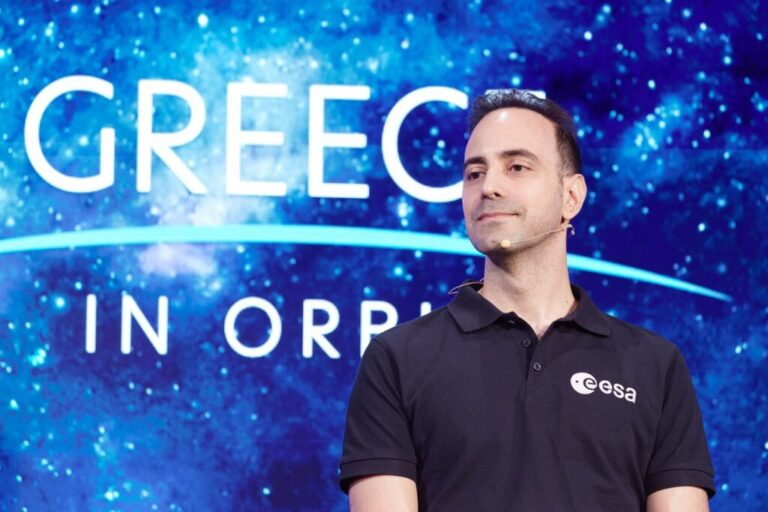
A Greek innovation successfully tested on the International Space Station could pave the way for new international partnerships and jobs in Greece. It is this tangible legacy, beyond the powerful symbolism of the historic first, that Adrianos Golemis, ESA spaceflight surgeon who is training to become the first Greek astronaut, is hoping for.
Research proposals and technology demonstrations from Greek universities, research centers and businesses are already being assessed by the Hellenic Space Center and the European Space Agency. Mr Golemis confirmed during yesterday’s online press conference that among the submissions are Greek innovations that could be tested in a microgravity environment.
“Yes, there are,” he replied when asked by newmoney whether Greek patents or technologies had been submitted that could travel to the International Space Station. He avoided singling out any particular one, however, before the assessment is completed. “I don’t know whether it would be wise to mention anything specific, because we might do an injustice to the others. I think the right thing is to wait for the official assessment.”
The Greek proposals
On 1 July, the Hellenic Space Centre issued an invitation to universities, research centers, businesses and other organisations to submit proposals that could make use of the International Space Station. The process covered scientific experiments, technology demonstrations, educational programs and outreach activities, while the submission deadline expired on 26 July.
The invitation was exploratory and non-binding, with no funding implied and no guarantee that any proposal would fly. The proposals are now being assessed in cooperation with the ESA.
As Mr Golemis explained, the selection will depend not only on the scientific merit of each proposal, but also on its level of readiness, the time required to adapt it to the conditions of space and the priorities of the mission.
“There may be a highly innovative experiment that is ready to be carried out on Earth, but we need to adapt it for space. We do, however, have ESA’s expertise, which will guide us through this.”
Responding to newmoney on how his participation could leave a tangible legacy in Greece, Mr Golemis focused on linking research with innovation, creating partnerships and employing scientists in the country.
“The primary reason is the meaningful Greek contribution to the research that Europe is conducting in space and all the positive knock-on effects,” he said. “A Greek innovation that is tested and performs well could generate a new partnership. This matters to us because it gives Greeks the opportunity to pursue jobs in our country and produce innovation for our country, from our country.”
Having worked as an ESA astronaut physician since 2018, Mr Golemis identifies Greek capabilities in space medicine, telemedicine, human physiology and pharmaceuticals. He stresses, however, that the domestic footprint is broader, with activity in robotics and robotic space exploration.
“We have companies in Greece that build robots that can help people explore, for example, the Moon. We have companies that manufacture wheels for exploration vehicles, in cooperation with NASA as well,” he said. “If we look at every field, we can find examples in which Greece has already made some contribution. Our goal is, with this mission as an opportunity, to maximise it.”
The mission
Adrianos Golemis’s flight is part of PAM-6, NASA’s sixth private crewed mission to the International Space Station. It is scheduled for the second half of 2027 and will be carried out by US company Vast in cooperation with NASA and the ESA. The launch will take place from Florida on a SpaceX Falcon 9 rocket, while the crew will travel aboard a Dragon spacecraft and remain at the station for up to two weeks.
His participation was officially announced on 9 September in Paris, in the presence of Prime Minister Kyriakos Mitsotakis and French President Emmanuel Macron. This followed an agreement signed by the ESA with Vast on behalf of Greece.
The crew will consist of four members. The commander will be French ESA astronaut Thomas Pesquet, who has completed two missions and spent almost 400 days in space. The pilot will be Czech military pilot and ESA project astronaut Aleš Svoboda, while the fourth crew member has not yet been announced.
Mr Golemis has been designated mission specialist, with his main task being to carry out the intensive research program. The crew composition must be approved by the multinational body in which the five partners of the International Space Station are represented: the United States, Europe, Russia, Japan and Canada.
“We will all participate in the research, but my role is somewhat similar to the one I had in Antarctica. Essentially, you are the hands and eyes of the researchers who are in Greece and Europe, and you carry out the experiments in this unique weightless environment with as much accuracy and efficiency as possible,” he explained.
The mission also has broader significance for Europe, as, according to Mr Golemis, it will be the first of its kind with three ESA astronauts. It comes at a time when Europe is discussing the acquisition of autonomous access to space, while the private sector is taking on an increasingly important role in crewed flights.
Research and the economy
For Mr Golemis, the biggest misconception about space is that related spending constitutes waste. According to him, international studies examined together with the Hellenic Space Centre show that in Europe, every euro invested in astronaut missions, robotic missions, research and technology generates approximately four times its value in return.
“There are people who say, ‘Why are we building satellites or sending an astronaut instead of investing a little more in another sector?’ The answer for me is very simple: one complements the other,” he noted.
In his view, the value of research is not always immediate or easily visible, but is gradually translated into new technologies, practices and applications. As he noted, research does not deliver results overnight, but investment in it almost always brings benefits in return.
The body in space
A large part of the research conducted on the International Space Station concerns human health. Remaining in microgravity conditions, Mr Golemis explained, acts as an accelerated model of ageing.
The absence of gravity causes changes in the distribution of blood and fluids, loss of muscle mass and bone density, as well as changes to the very architecture of the bones. In the first few hours, disorientation, nausea and vomiting may occur, while on long-duration missions astronauts exercise for around an hour and a half each day to limit the deterioration of their bodies.
“Being in space is a small model of ageing,” he noted. “By finding solutions to some of these issues, we can certainly improve our lives on Earth.”
He cited as an example the discovery in 2018 of blood clots in completely healthy astronauts. Decoding the mechanisms involved could provide new knowledge for people who remain bedridden or are hospitalised for long periods and face an increased risk of thrombosis.
According to him, space medicine places particular emphasis on prevention. In space, where the ability to deal with an emergency is limited, doctors seek to identify and address every potential problem in advance.
“The ideal for me would be for similar care to be available to every person on Earth,” he said, linking space medicine with exercise, proper nutrition, mental health and an appropriate workload.
The other side
Adrianos Golemis’s journey to space began at the Aristotle University of Thessaloniki’s Medical School and took him to Antarctica, where he spent a year in conditions of extreme isolation, participating in research programs.
Since 2018, he has provided medical support for European crewed missions, having been alongside astronauts during quarantine, launch, splashdown and rehabilitation. Among those for whom he had served as a physician was Mr Pesquet, now the commander of the mission in which he will participate.
“He told me that now I would see the other side,” he said. “There is the ground side and the space side. Both are equally important. One cannot do anything without the other.”
Mr Golemis went through the ESA astronaut selection process in 2021–2022 and joined the astronaut reserve. He has already completed parts of his basic training, and from today his intensive, specialised preparation for PAM-6 begins. The program will take him to centers in Europe and the United States, where he will train on the Dragon and Falcon 9, use the spacesuit and deal with technical and medical incidents.
“Yes, I am afraid”
Asked directly by newmoney whether he was afraid, his first answer was equally direct: “Yes, that is the answer.”
He spoke about the unknowns of launch, the high acceleration forces and the body’s adaptation to microgravity. He believes the return will be psychologically easier, despite the high temperatures around the capsule and the forces acting on the body, because he will be returning “to his planet and his people”.
His experience as an astronaut physician has also given him a way to manage this anxiety. “Because other astronauts have gone before me and because I have provided medical support on these missions, knowledge is somewhat of an antidote to fear,” he said.
He spent the final evening before beginning his intensive preparation behind a telescope. As an amateur astronomer, he went out to observe and photograph the night sky, knowing that for a long period the demanding training schedule might not allow him to do it again.
For children who may be inspired by his journey, his advice is not to seek to become the next astronaut. “First and foremost, don’t become an astronaut, but become yourself,” he said. “We have to pursue our own path. We all have a particular inclination, and it is important, as far as circumstances allow us, to move towards what fulfils us and makes us happy.”
Ask me anything
Explore related questions




