





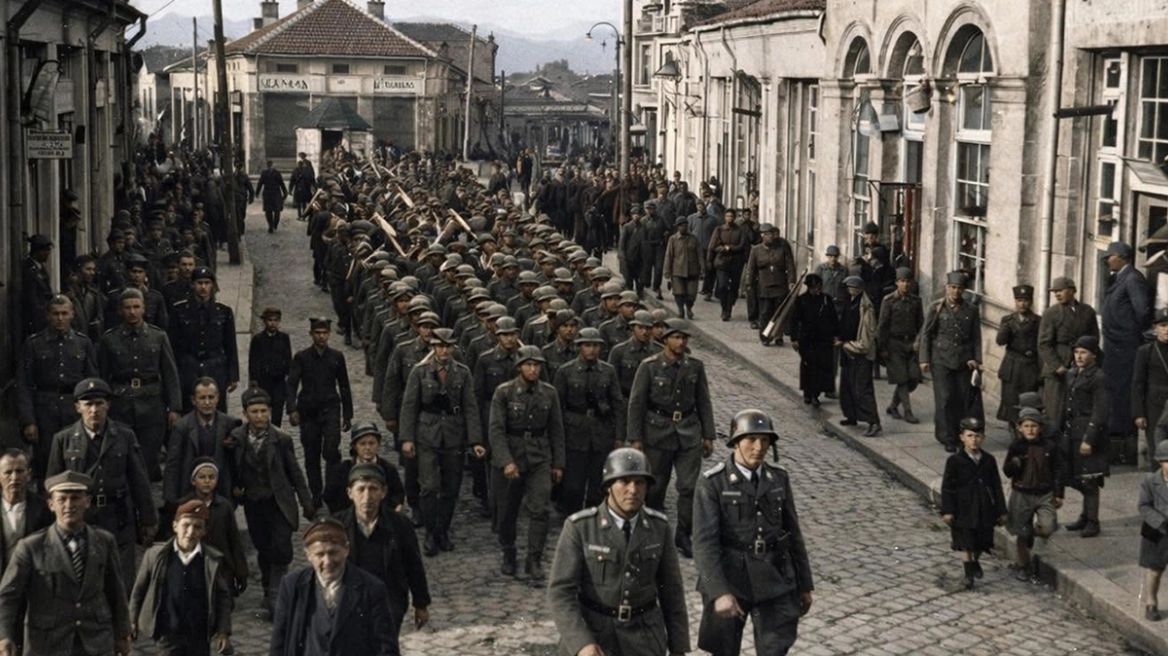
One of the lesser-known aspects of the Bulgarian occupation of Greece was the continued presence of troops from the neighbouring country in Eastern Macedonia and Thrace for almost two months after the “change of sides” and Bulgaria’s declaration of war against Germany, until September 1944.
During this period, various suspicious manoeuvres were carried out to Greece’s detriment, as the defeated Bulgarians of the Second World War sought to remain in Greek territory which, moreover, they had not conquered themselves but had been handed over to them by the Germans. The role of the Soviet Union and the other Allies was peculiar, while the involvement of local KKE officials also raises questions. Let us look at more details of this issue, which has not received particular attention.
The Bulgarian occupation of Eastern Macedonia and Thrace
Bulgarian forces entered Eastern Macedonia and Thrace on 21 April 1941 (according to the Hellenic Army General Staff), while according to X. Kotzamanis, three Bulgarian brigades had entered the above areas as early as 9 September 1941. The Bulgarians occupied the territories east of the Strymon River. Bulgaria declared war on Greece on 24 April 1941, but our ambassador in London, Stamatopoulos, announced that Greece was in a state of war with Bulgaria only on 2 July 1941…
Turkey was concerned by the Bulgarian presence next to the Evros. Invoking the Treaty of Lausanne, under which the Evros zone was supposed to remain demilitarised, it requested that German troops be stationed there. Indeed, German troops were deployed from the area east of Apalos to Ormenio, covering approximately 2,800 sq km, under Major von Kleist, whose headquarters were in Didymoteicho.
Germany received concessions in return from the “cunning neutral”, Turkey, which supplied the German war industry with chromium and iron ore. According to a report by the US State Department, Turkey’s supply of chromium to the Germans prolonged the Second World War by seven months (see Kathimerini, 7 June 1998, p. 17).
The area ceded to Bulgaria, including Thasos and Samothrace, amounted to 14,168 sq km. When the Italians capitulated, the Germans handed over military control of Visaltia in Serres and the prefectures of Halkidiki, Pella and Kilkis, Florina and Kastoria to the Bulgarians. Although they also asked for Thessaloniki, the Germans did not allow them to approach the city to within less than 20 kilometres. The Bulgarians also attempted to establish themselves in the Evros Neutral Zone, without success.
The Bulgarian occupation is considered harsher than the German and Italian occupations. More than 100,000 Greeks left the Bulgarian-occupied areas between 1941 and 1944. Some put the number as high as 170,000.
Around 70,000 were sent to Bulgaria for forced labour, becoming known in history as the “dourdouvakia”. Of these, only 15,000 returned, and even they were in poor health. The Bulgarians intended to transfer 250,000 settlers to Greece, but they did not have enough time.
Ultimately, around 100,000 were sent, mainly Roma or adventurers who settled in the homes of Greeks who had been expelled. The Church also paid a heavy price. Of the 584 priests in Eastern Macedonia and Thrace, 44 were executed and 253 were tortured and expelled. A total of 482 monasteries and churches were looted and completely destroyed. Most of the relics that were stolen were never returned…
The political shift in Bulgaria and the attempt to retain Greek territory
In 1943, Bulgaria’s King Boris died under strange circumstances, which bore considerable similarities to the death of Ioannis Metaxas. From August 1943, the country was governed by a three-member regency council, as the heir, Simeon (prime minister of Bulgaria after 2000), was a minor.
The council consisted of Prince Kyril, B. Filov and Nik. Mikhov. D. Bozhilov became prime minister in September 1943. He was succeeded in June 1944 by Ivan Bagrianov. At the end of 1943, Bulgarian minister Musanov (1872–1951) went to Egypt to negotiate an armistice. By January 1944, the negotiations had made no progress, as Bulgaria was attempting to retain the occupied territories or the largest possible part of them.
A Bulgarian minister stated in March 1944: “… Bulgaria considers that the territorial issue has been settled in a fair and definitive manner. The Government’s efforts are directed towards maintaining the borders as they are now established” (IMXA, The Bulgarian Occupation, p. 239).
Negotiations with the Bulgarians were conducted by a three-member committee headed by British Minister for the Middle East Harold Macmillan and the US and British ambassadors to Greece, Mac Veagh and Leeper. Georgios Papandreou and the Greek diplomatic service were unaware of them, as Churchill had not informed them.
On 24 August 1944, Soviet troops under Marshal Tolbukhin crossed the Pruth. On 26 August, the Bulgarian government proposed capitulation. Prime Minister Bagrianov conveyed indirect and vague proposals to the Allied Headquarters in Cairo, under which his government agreed to reach an agreement with the Allies, evacuate the occupied “non-Bulgarian territories” while maintaining a neutral stance, and conclude an armistice.
On 1 September 1944, Bagrianov resigned and was succeeded by Muraviev, who severed diplomatic relations with Germany.
Until then, the USSR had not declared war on Bulgaria, nor had Sofia declared war on Moscow. A state of war between the USSR and Bulgaria therefore had to be created so that the USSR could play a leading role in Bulgarian affairs under the terms of the Peace Treaty. On 5 September, when the Germans withdrew from Bulgaria, the Soviet Union declared war on the Balkan country.
Within six hours, Bulgaria declared war on the USSR. This created the following paradox: Bulgaria had declared war both on the Allies and on the Germans. This lasted for three days. On 9 September, the political change took place in Bulgaria. Negotiations with the USSR were undertaken by the communists Georgiev, Petkov and Stoyanov.
As part of Bulgaria’s accession to the Allied camp, units of the Bulgarian army and the EAM marched simultaneously in Kavala. At government level, however, there was intense concern. On 9 September, Georgios Papandreou and Alexandros Svolos visited the Commander of Allied Forces in the Mediterranean, General Wilson.
They made him aware of their concerns about the consequences of the Bulgarians’ change of sides and asked for the evacuation of Greek territory by the Bulgarians to be included among the terms of the armistice that was due to be signed. They also asked for military action to be undertaken in Greece. The fighting in Italy, however, prevented Wilson from sending forces to Greece.
Political change in Bulgaria and Bulgarian communists in Greece cause serious incidents
On 8 September 1941, the Red Army of the USSR crossed the Romanian-Bulgarian border. Bulgarian communist partisans, with the help of the army, seized Sofia and arrested members of the regency and all senior state officials. Georgi Dimitrov had returned to Bulgaria from the USSR, having been well known for his activities since the 1920s and having served as General Secretary of the Comintern from 1934 to 1943, when it was dissolved.
Now the de facto leader of Bulgaria, he forced Muraviev and the members of his government, whom he considered incapable, to resign. A Communist government of the Fatherland Front was thus formed.
Kimon Georgiev (1882–1969), who, as military governor of Serres during the First World War, had been responsible for horrific crimes against Greeks (1916–1918), became prime minister on 9 September 1944.
A day earlier, Bulgaria had declared war on Germany. Of course, the “cunning neutral”, Turkey, declared war on Germany on 23 February 1945, while Albania never did so. At the end of the Second World War, the unbelievable happened: Greece, a country that had been fighting fascism since 28 October 1940 and Nazism since April 1941, had suffered thousands of deaths and injuries and sustained enormous damage, not only had to wage a titanic struggle to secure territorial compensation, but also faced the risk of losing territory to Nazi allies or neutral countries.
The Fatherland Front, which had formed a government in Bulgaria, sent officers loyal to the new regime to occupied Macedonia and Thrace, as well as partisans to serve as popular commanders of military units. There were, however, clashes between Bulgarians who remained loyal to the old regime and the revolutionaries. Indeed, when ELAS fighters attempted to enter Greek towns, the Bulgarians prevented them, saying that “the Bulgarian army was the guardian of Bulgarian territorial claims in the region” (IMXA, The Bulgarian Occupation, p. 229).
The most serious incidents took place in Alexandroupoli, where Bulgarian soldiers and sailors, led by Koinov, turned their weapons against the garrison while simultaneously raising the USSR flag on the mast of the Alexandroupoli Port Authority. The Bulgarian garrison commander and several of his men opened fire. Clashes between the Bulgarians followed, with many remaining stationed in their barracks and inactive.
From Antheia, Athinodoros Katsovounidis (1911–1975), the main organiser of the EAM resistance in Evros, together with the Karagianov brothers, officers who had established links with other communists at the Bulgarian outpost, learned of the events, went to Alexandroupoli and succeeded in winning over the inactive soldiers to the Revolutionary Committee.
In Komotini, events were held on 9 September to mark the political change in Bulgaria. On 10 September, the “Yane Sandanski” unit took command of the Bulgarian force in Sidirokastro. On 11 September, Bulgarian ministers Dobri Terpeshev and Dimitri Neykov arrived in Kavala, together with Colonel Ivan Radev. Radev was of Greek origin (Rodopoulos was his surname).
He had, however, taken Bulgarian citizenship and was an internationalist and communist by conviction. He was responsible for the clandestine communications between the KKE and the Bulgarian Communist Party and was the de facto commander of the 2nd Army Corps. On 12 September, Bulgarian communists seized Xanthi. Two days later, the 26th Regiment of ELAS also entered the city. On 15 September, units of the regiment advanced towards Sidirokastro. On the same day, the Bulgarian partisan unit “Anton Popov” entered Serres.
The Bulgarian presence in Greece and the ‘invitation’ to the Red Army
From the beginning of September 1944, the Germans had begun withdrawing from the rest of Greece, with the exception of Crete, where, as we have seen, they remained until July 1945. The Bulgarians, however, remained in Eastern Macedonia and Thrace. The government of Georgios Papandreou was particularly concerned because, in a single night, the Bulgarians had transformed themselves from a German occupation force into part of the Red Army fighting against the Germans.
Although Eastern Macedonia and Thrace lay outside the Soviets’ operational field, the Bulgarians, who should normally have withdrawn into their own country, claimed that they had been placed under the orders of the Red Army and remained in Greece on the basis of the following flimsy arguments: a) their presence in Eastern Macedonia and Thrace was necessary in view of the civil conflicts, as they were maintaining order in the region; b) they were remaining for military operations against the Germans; c) they were awaiting orders from Soviet Marshal Tolbukhin, head of his country’s forces stationed in Bulgaria; and d) the civil authorities had withdrawn and handed over power.
Chris Woodhouse, in his book The Apple of Discord (p. 301), writes that many believed that EAM had agreed for the regions of Eastern Macedonia and Thrace to be annexed to Bulgaria. This belief appeared to be well founded, as on 15 September 1944 an order was issued in Xanthi stating that the right to carry weapons belonged to the Bulgarian army, the Greek Civil Guard and those equipped with a certificate from EAM-ELAS or the KKE.
On 16 September, Soviet troops entered Sofia. On 21 September, the Allied Middle East Headquarters ordered the Greek resistance organisations to halt operations against the Bulgarians, stressing that an armistice was imminent and that the same order had also been given to the Bulgarians.
Meanwhile, a delegation from the party organisation of the KKE in Macedonia and Thrace, led by G. Erythriadis and N. Kanakaridis (Lambros), together with Koinov, the leader of the Bulgarian communist movement in Alexandroupoli, met in Sofia on 20 September with Marshal Tolbukhin (1894–1949) and asked for the Soviet army to enter Greece as well. Tolbukhin replied that “this matter can only be decided by the Centre, the Supreme Soviet Command” (M. Partsalidis, Avgi, 15 April 1978).
A little later, Erythriadis and Kanakaridis, in a telegram to the Secretary of the Central Committee of the Bulgarian Communist Party, Traicho Kostov, requested “…a large number of weapons and ammunition” (Jordan Baev, The Balkans, the First Cold War Flashpoint in Europe, Filistor Publications, 1996).
The Bulgarians refused, fearing a confrontation with the British. They did, however, send military forces to EAM-ELAS under General Shirakov. Meanwhile, a mounted unit of the Soviet army reached Kavala and immediately afterwards returned to Bulgaria. Soviet prisoners who were being released and soldiers discharged from hospitals in their country with travel orders arrived in Eastern Macedonia to report to supposed Soviet units.
ELAS officials informed them that there were no Soviet units in Greece. Some 250 Soviet officers and soldiers arrived in Komotini, Xanthi and Drama, stating that they had orders to wait there for their units, in case they were called upon to undertake operations against Thessaloniki (Vasileios Kontis, The Policy of the KKE and the Soviet Union on the Eve of Liberation, IMXA, 1998, No. 267, p. 347).
George Papandreou, who had been informed of the above developments in a confused manner, telegraphed King George II and Churchill on 18 September:
“The situation is rapidly deteriorating in the Balkans and Greece, and I am here (i.e. in Italy) with my hands tied. The complete abandonment is incomprehensible to me. EAM is gradually taking over the whole of evacuated Greece. Bulgarian ministers are travelling to Thrace and Macedonia to negotiate with EAM. A Reuters report from Constantinople has also been published, which I am unable to believe, saying that the Bulgarian army is marching towards Thessaloniki. I feel that I am betraying our Country. My only remaining hope is London. Only the British Government, and especially Prime Minister Churchill, can change the situation by finding and ordering forces elsewhere to act immediately in Greece.”
Churchill replied reassuringly from Quebec, but George Papandreou insisted that Britain send troops to Greece. In a new telegram (22 September), he stressed:
“… the regions being evacuated by the Germans are being occupied by EAM supposedly in the name of the Greek Government. I do not know the reasons for the British absence. But I consider it my duty to inform You of my conviction that, in view of the situation that has developed, political means of dealing with it are no longer sufficient. Only the immediate presence of imposing British forces in Greece and as far as the Turkish coast can change the situation…”
Meanwhile, a British military mission went to Sofia and asked Tolbukhin for Allied troops to land at Kavala. Tolbukhin refused, saying that such a move was not necessary. The British departed for Turkey. From that point onwards, they were also obliged to keep the Soviets informed, so as not to disrupt the balance among the Allies (F. Oikonomidis, The Protectors, 1986).
According to the testimony of G. Erythriadis:
“Following an agreement with the KKB and the government of the Fatherland Front, EAM took over the authority, with the stipulation that the Bulgarian army, as part of General Tolbukhin’s forces, would remain temporarily… We accepted this… During this period Papandreou (sic) and the English were making a great fuss demanding that the Bulgarians leave, etc. During this period we received a telegram from the Central Committee of EAM, addressed to me. It condemned our stance. It asked us to demand that the Bulgarians leave… it recommended that we go as far as taking up arms. The telegram bore the signature of Partsalidis” (G. Farakos, Aris Velouchiotis, 1997, p. 308).
The withdrawal of the Bulgarians from Greece
From 16 September 1944, Molotov had agreed that Bulgaria should be asked to withdraw its troops from the Greek and Yugoslav territories they occupied. This, however, had not become known to the Greek Government. Stalin was delaying the signing of an Armistice Agreement between the Allies and Bulgaria because he was seeking concessions: that the Bulgarian army not be disarmed by the British and that the Agreement be signed by Tolbukhin rather than Wilson.
Tolbukhin’s troops in Bulgaria safeguarded Soviet interests. Greece was once again the victim of the “Great Powers”, which were playing dirty games at its expense, behind its back… Finally, on 16 October 1944, the Bulgarians were ordered to leave Greece within 15 days. Their withdrawal was completed on 25–26 October, while on 28 October 1944 the long-awaited Armistice was signed.
Until the Paris Conference, Bulgaria sought to avoid the imposition of sanctions, but also demanded that it be granted Greek Thrace! The USSR, Poland, Czechoslovakia and Yugoslavia supported this demand (!), which was nevertheless rejected, as was the Greek request for an adjustment of the borders with Bulgaria in favour of our country.
The main source for this article is the book by Nikolaos P. Soilentakis, HISTORY OF THRACIAN HELLENISM, Volume B, Papazisis Publications, 2nd edition, 2004.
Ask me anything
Explore related questions




