





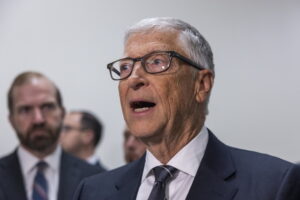
No government in the world is truly prepared for the changes Artificial Intelligence is set to bring to society, Bill Gates said in an interview with Reuters, while warning of the dangers that lie ahead.
The Microsoft co-founder had until recently been optimistic about the potential of Artificial Intelligence. However, he has now changed his stance, warning about its impact on the labour market, the risks posed by potential attacks and the dependence that could develop on digital AI “companions”.
“I don’t think any government is dealing with this to the extent that it should,” he said.
At the same time, however, he stressed that the technology has enormous potential to help the world’s poorest people, provided it is used properly and access to it is equitable.
The Gates Foundation announced on Tuesday that it plans to allocate at least $1 billion over the next two years to expand access to Artificial Intelligence.
Gates said he had discussed his concerns with national leaders, including US President Donald Trump and his team, while he also said he was seeking to meet Chinese President Xi Jinping later this year.
“Governments are very far behind on this issue,” he added.
The potential of Artificial Intelligence in healthcare
Despite his fears, Gates and his foundation believe that Artificial Intelligence could help reduce inequalities between rich and poor countries, rather than widen them.
The $1 billion programme is part of the Gates Foundation’s broader plans, under which it has announced that it will provide around $9 billion annually. The new funding will go to partners working in education, healthcare and agriculture.
The aim is also to create the necessary datasets on which Artificial Intelligence relies, including by ensuring that large language models can operate in all the languages spoken by people.
“In healthcare, it’s hard to overstate the magnitude of the potential,” Gates said, referring to everything from supporting frontline healthcare workers to discovering new drugs and vaccines. However, he stressed that governments must work together to avoid serious problems, comparing the arrival of Artificial Intelligence to the plot of a disaster film.
“There are all kinds of movies where some aliens come and, magically, the US, China and everybody else get together to solve the problem,” he said. “Artificial Intelligence is somewhat like that alien intelligence. It’s here, and we’d better do what we see them doing in those movies.”
Has the Epstein case affected his reputation?
In June, Gates testified before Congress about his relationship with convicted sex offender Jeffrey Epstein, who has since died.
Gates has not been accused of any wrongdoing and has repeatedly said that he regrets his relationship with Epstein, from whom he had hoped to secure donations for global health causes.
According to Gates, however, the financier attempted to blackmail him using information about extramarital relationships.
The case led the Gates Foundation to commission an external review. The investigation found no payments to Epstein and no involvement in criminal activity.
Gates argued that, despite the revelations, his relationship with Epstein has not caused significant damage either to his own reputation or to that of his foundation.
“As far as my access to government leaders or, you know, the willingness of journalists to interview me, I don’t see any decline,” he said, adding that interest in the Gates Foundation’s expertise, aimed at reducing child deaths and eradicating malaria, had not diminished “in the slightest”.
Ask me anything
Explore related questions




