





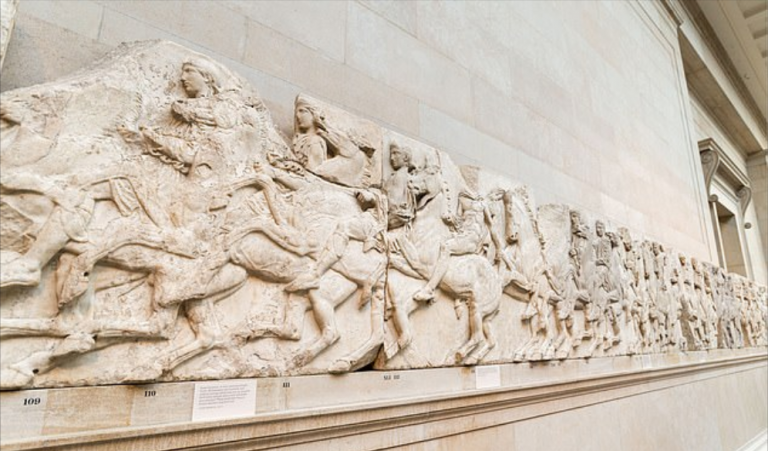
After years of discreet contacts, political manoeuvring and personal diplomacy between officials, and a growing belief that a historic deal was closer than ever, the question of ownership of the Parthenon Sculptures has moved to the centre of the dispute. At issue is whether it is lawful, or even moral, to treat the integral parts of a mutilated monument as freestanding museum objects.
The Daily Telegraph reported on Wednesday that no talks were under way and that Athens did not expect them to resume soon, though communication channels remained open. The British Museum responded that its position and its willingness to reach an agreement were unchanged, a stance Athens would welcome if the museum moved beyond its insistence on a loan.
Greek Prime Minister Kyriakos Mitsotakis then set out his government’s position in an article for The Guardian. He said Greece could not accept any arrangement that required it to recognise the museum’s ownership of the sculptures, or one that meant Athens would “borrow” parts of its own monument. He also turned to the Bayeux Tapestry, which is currently on loan from France to the British Museum and which the museum has suggested could serve as a template for a Parthenon deal. Mitsotakis wrote that nobody would seriously consider cutting the surviving Tapestry in two and displaying one half in London and the other in Bayeux.
It is now clear that the talks foundered not for lack of dialogue but over the legal form a return could take. That is the point at which diplomatic flexibility meets the red lines Greece has drawn on ownership.
A change in the political climate in Britain has contributed to the impasse, in particular the stance of British Prime Minister Andy Burnham. Asked in 2023, when he was mayor of Greater Manchester, whether British Museum chairman George Osborne should return the sculptures, Burnham said yes. He later went further, saying they should be sent back without conditions, and argued that doing so would change the way the world sees Britain. In 2002 he was among the MPs who backed a private member’s bill to amend the legislation that binds the museum.
Since taking office on 20 July, however, Burnham has been markedly more cautious. He now refers the matter to the museum’s trustees, and has reportedly said he would not prioritise legislation to secure the sculptures’ return.
The shift appears to revive the mechanism that has kept the issue frozen for years. The British government points to the museum, and the museum points to the law. The new government still has no plans to change the British Museum Act 1963, which restricts the trustees from permanently disposing of objects in the collection, although it allows them to be lent. The mood has travelled from the optimism of 2024 to the first public reservations in 2025 and today’s impasse.
In November 2025, Mitsotakis acknowledged that the progress he had hoped for had not been achieved, while saying he remained optimistic that a solution could be found. In May this year, after a meeting of UNESCO’s Intergovernmental Committee, the Greek Culture Ministry said explicitly that, despite continuing efforts, the desired progress had not been made to date. It identified the museum’s insistence on a loan, and the limits of the British legislative framework, as the obstacles.
The deadlock therefore did not arrive suddenly. It matured within the talks themselves, as Greece held to its position that it would not accept a loan under any circumstances, while the British government appeared open to discussion but immovable on ownership.
Greece’s core case has barely changed since the late Culture Minister Melina Mercouri internationalised the demand in the early 1980s, and through repeated appeals to UNESCO since. Athens says the dispute is not about individual museum objects but about reuniting the surviving parts of a single architectural, artistic and symbolic whole. What has changed in recent years is the method.
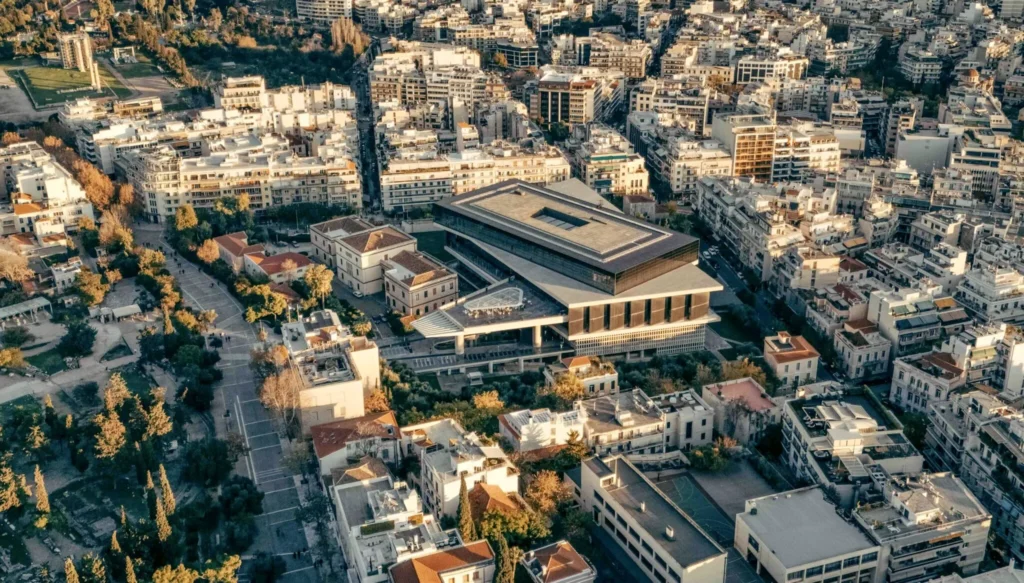
From 2021, the Greek government held discreet talks with Osborne, which gradually grew into the outline of a wider potential agreement. The sculptures would return to Athens, while Greece would send major antiquities to London on a rotating basis, including works that had never left the country. The formula was designed to move the debate from confrontation to cooperation, and towards a lasting cultural partnership from which both museums could benefit.
The British Museum itself was changing too. Its director, Nicholas Cullinan, has appeared far more receptive to restitution and international exchanges, and his relationship with Acropolis Museum director Nikolaos Stampolidis helped create a different atmosphere.
Behind all the inventive wording, however, the word “loan” remained the sticking point. The Greek side suggested a range of diplomatic solutions using other terms that would not offend the British side while still meeting Greece’s demand for a return.
Athens points to the case of the Fagan fragment as a precedent showing that other legal routes exist. The Parthenon fragment was returned to Athens from the Antonio Salinas Regional Archaeological Museum in Palermo in 2022, initially under a long-term deposit rather than a conventional loan. After the necessary institutional procedures in Italy, the return was made permanent.
The clearest illustration of Greece’s strategy, officials say, is a recent case in Frankfurt, which shows where Athens draws its red lines.
In early September, Greece’s Central Archaeological Council, the Culture Ministry’s advisory body on antiquities, unanimously advised against a request from the Liebieghaus Skulpturensammlung in Frankfurt to borrow nine Parthenon fragments from the Acropolis Museum. They were wanted for a major exhibition, “Athena, the Stage is Yours: The Parthenon Puzzle”, which opens on 18 November.
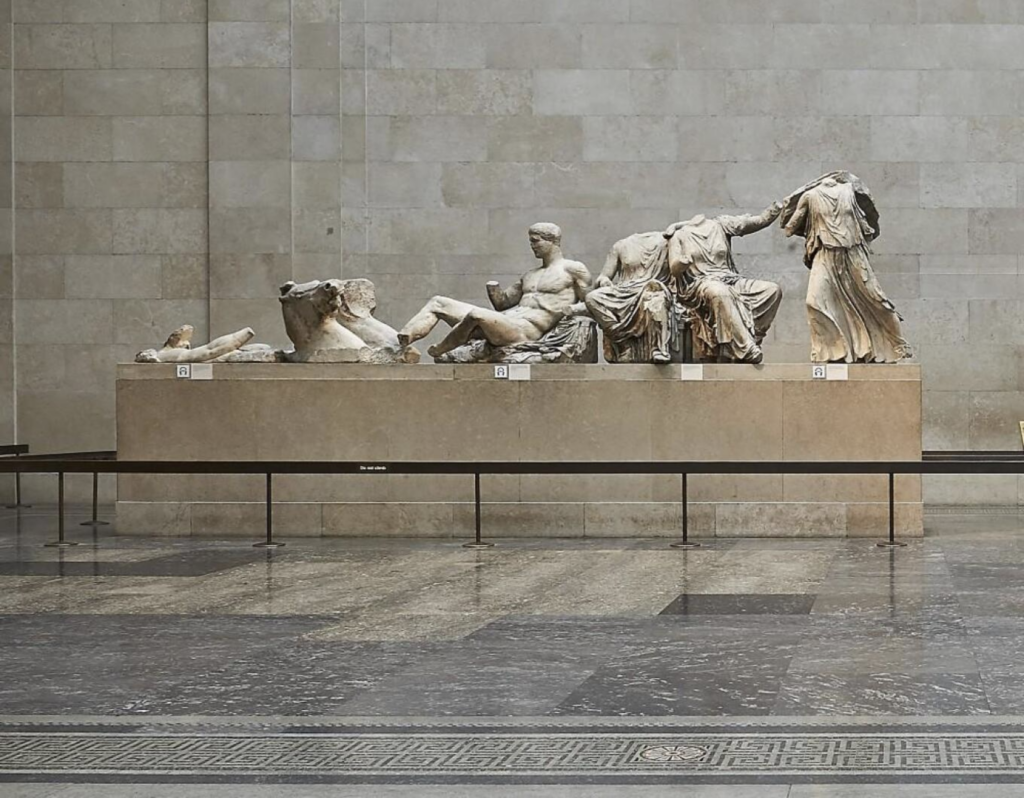
The decision carried weight because the show is curated by the archaeologist Vinzenz Brinkmann, who is attempting the first archaeologically documented reconstruction of the whole east pediment of the Parthenon. The pediment depicted the birth of Athena from the head of Zeus.
Under different circumstances, Greek participation would have been almost taken for granted. What was not initially clear was who would take part, and under what terms. The Liebieghaus had secured two fragments from the British Museum, also on loan, one from a pedimental sculpture and the other a section of pleated drapery.
Had Athens sent all nine of its own fragments, the two museums would have appeared as equal owners of parts of the same monument, lending them through the same mechanism to a third party. Greece refused to lend its support to that image. It declined a set-up that could, even symbolically, present the London sculptures as items in an ordinary British museum collection, which the British Museum is naturally entitled to lend.
In Athens, the arrangement is seen as a way of implicitly recognising the British Museum’s title and, in effect, sidelining the history of how the sculptures were acquired and removed.
A changing picture
The changing international picture is illuminated differently by the return this month of 15 Greek antiquities from the United States. The objects had been seized from the Metropolitan Museum of Art as part of criminal investigations into trafficking networks. They were handed to Culture Minister Lina Mendoni at the Manhattan District Attorney’s Office, in what Greek officials read as a willingness by the American side and the museum to accept the history of the illicit excavations that led to their acquisition.
They include two bronze helmets and three bronze belts from Afrati in Crete, linked to looting in the 1960s, which can now be reunited with finds of the same origin. Prosecutors value the 15 objects at almost $3 million. They say their cases have now led to the return of 175 antiquities to Greece, while the Greek tally puts the figure at 179 since 2022.
Against that wider backdrop, Greek officials argue that everything remains open and that the negotiations are not over. Osborne has invested political capital in the search for a deal, Cullinan appears receptive to a new model of international cultural cooperation, and the museum insists, even after the reports of a deadlock, that its willingness to reach an agreement has not changed.
It is paradoxical that the museum appears more willing than ever to discuss a solution seriously, at the very moment the British government does not want to change the law that limits what such a solution could be. Even so, the will exists.
The current crisis may not mark the end of the talks, but rather a moment that defines precisely what divides the two sides. It is not cultural exchange, and it is not a willingness to cooperate. It is the British demand that Greece accept the museum’s ownership of the Parthenon Sculptures.
Greece therefore cannot sign up to the idea that it is borrowing what it regards as an integral part of the Parthenon, nor legitimise it in practice, as it demonstrated in Frankfurt. Athens suggests the answer may lie in a formula clever enough to spare either side from explicitly abandoning its legal position, yet bold enough to allow the sculptures to return, and that the term “deposit” was once such a solution.
Behind the British Museum Act, the trustees, the deposits, the intergovernmental agreements and the loan protocols, one image still makes this everyone’s cause, since Athens argues that the Parthenon belongs to the whole world. The frieze was not designed as a series of independent masterpieces for the display cases of different museums, but as a single, continuous, democratic procession of the people of Athens around the city’s temple. The pediments were not collections of separate sculptures, but the beginning and end of one architectural narrative.
It is therefore deeply ironic that the Liebieghaus exhibition, the one Greece chose to stay away from in order to defend its position, is called “The Parthenon Puzzle”.
That is what the Parthenon remains two centuries after Lord Elgin removed its sculptures: a puzzle whose pieces are all accounted for, whose parent monument is known, and which can now even be reassembled digitally in its original arrangement. Athens argues that it is time for them to return to their natural setting, under the Attic sun and facing the monument from which they were taken.
Ask me anything
Explore related questions




