





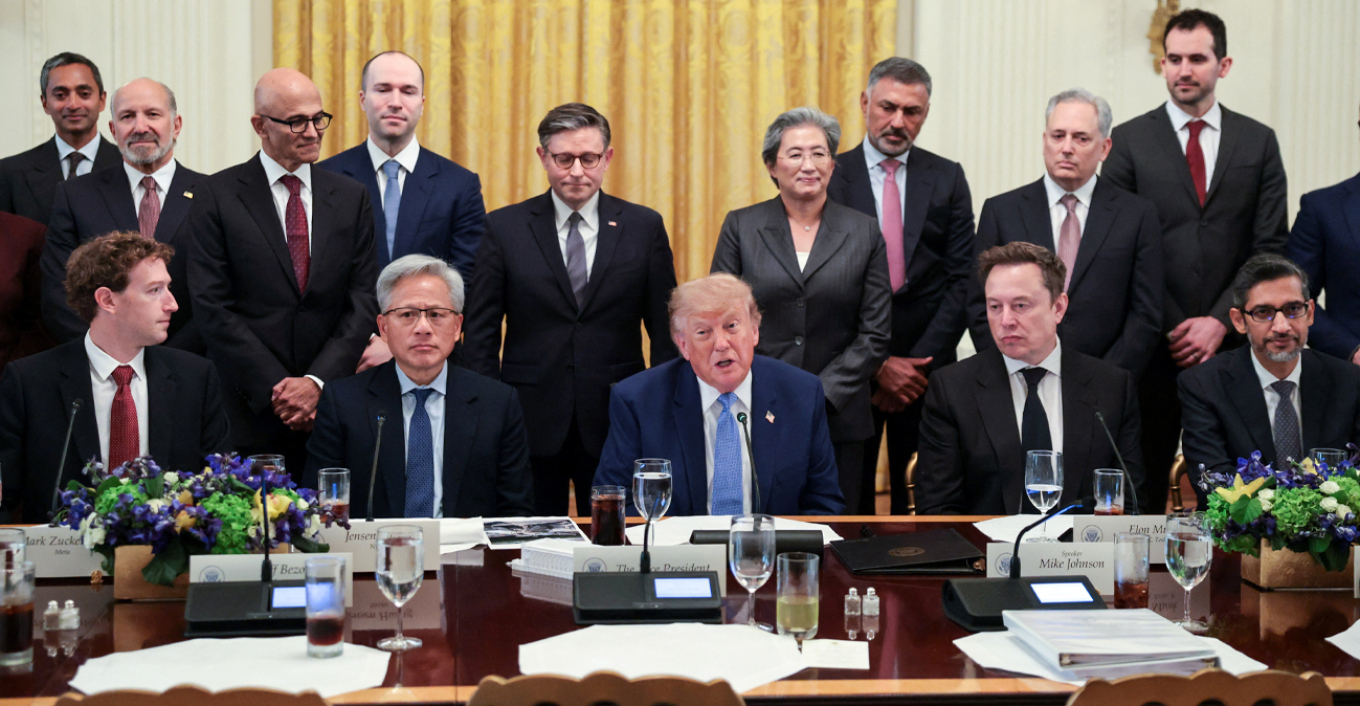
US President Donald Trump has announced that the heads of America’s biggest technology and AI companies have signed an agreement to regulate the industry themselves, with the aim of creating a safety framework for the development of new systems.
Trump made the announcement after hosting a luncheon for tech leaders at the White House on Tuesday. He presented the agreement, titled The White House Accord on Superintelligence: A Joint Commitment on Frontier SI Responsibilities, as an important step in protecting against the risks of the new technology. House of Representatives Speaker Mike Johnson described it as a statement of principles and commitments that are voluntary on the industry’s part, while Trump, asked whether it was binding, said it was “morally” so.
“It’s almost like a constitution. The biggest people in the world have signed it, and I signed it as president. It really is a form of protection,” Trump said.
However, international media outlets including the Guardian point out that the framework carries no legal obligations, penalties or direct involvement from state regulators. It is a voluntary pledge under which the companies agree to put in place their own mechanisms for testing and assessing the safety of their products. OpenAI and Anthropic have already committed to using third-party evaluators, and it is not immediately clear whether the accord asks anything different of them.
From artificial intelligence to superintelligence
Trump has also signed an executive order formally changing the terminology the federal government uses for AI. Under the order, all federal agencies must now use the terms “superintelligence” and “SI” in official documents, public statements and policy papers, and stop using “artificial intelligence” and “AI”. The move follows a similar reference by Trump at the UN General Assembly, where he spoke about the next phase in the development of AI systems.
Four layers of checks run by the companies themselves
The accord sets out four layers of checks and assessments for AI developers. The first is internal safety monitoring while models are being trained. The second is an in-house team to test whether those safeguards work effectively. Third, companies commit to allowing external evaluators to examine their safety procedures independently. Fourth, they will set up independent boards to review the resulting reports.
Despite this, the text does not oblige companies to publish the results of their assessments, and it leaves them free to choose their own external auditors and oversight bodies.
The agreement comes at a time of mounting pressure on AI firms after incidents that have raised concerns about the safety of their systems. Lawmakers, researchers and part of the industry itself have called for tougher state oversight, but Trump has repeatedly rejected the idea of sweeping restrictions, arguing that they could slow innovation and damage America’s competitiveness against China.
Zuckerberg: “a historic conversation”
Those attending included billionaire Elon Musk, Meta chief executive Mark Zuckerberg, Amazon founder Jeff Bezos, Google chief executive Sundar Pichai, Nvidia founder and chief executive Jensen Huang, OpenAI co-founder and president Greg Brockman and Anthropic chief executive Dario Amodei. Palantir’s Alex Karp was also present. Speaking outside the White House, Amodei reiterated his earlier concerns about AI and said rules to address the risks were “still under discussion”.
Johnson was the driving force behind the White House meeting. Speaking to CNBC, he said a “right balance” had to be found between safety and the goal of making the United States the world leader in AI.
Zuckerberg called the agreement an important first step towards strengthening public trust. “This is a start, and an accord that the whole industry could come to. It was a historic conversation,” the Meta chief said.
Ask me anything
Explore related questions




