





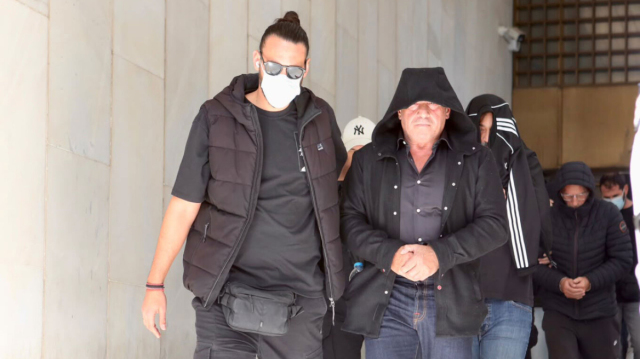
The lengthy questioning of defendants in the major tax fraud case involving Greek pizza chain Pizza Fan is continuing at the former Evelpidon court complex in Athens.
On the second day of proceedings, 13 defendants were scheduled to appear before the investigating magistrate, including Konstantinos Antaras, the company’s founder and alleged leader of the criminal organisation, and his close associate Dimitris Iliopoulos.
According to information obtained about his testimony, Antaras rejected allegations that his actions were connected to a criminal organisation, arguing instead that the case concerned tax offences.
“I deny the charge. All the acts concern tax offences and under no circumstances a criminal organisation. We have consented to the seized and frozen funds being handed over to immediately satisfy the state’s tax claims, without waiting for a final, irrevocable court ruling,” he reportedly told the magistrate.
He went on to defend the company’s business operations and economic contribution.
“It is unfair to describe as a criminal organisation a group of people who have built a successful business that provides employment to more than 2,500 people, pays €36 million annually in wages, contributes €15 million in VAT and taxes, and spends tens of millions of euros on suppliers,” he reportedly added.
What Antaras said about the controversial ‘treat’ system
During questioning, Antaras was also asked about the controversial practice known as kerasma, or “treat”, which is at the centre of the investigation.
He acknowledged that he knew some franchise operators were using the system unlawfully, but maintained that the company’s centralised ordering platform made it possible to monitor their revenue.
He also explained that the percentage collected by the company depended on the revenue declared by each individual outlet.
His account differed from that of his close associate, Dimitris Iliopoulos, described by investigators as the alleged second-in-command of the organisation.
According to information about his testimony, Iliopoulos also acknowledged knowing about the controversial practice but insisted that he had expressed his opposition to it.
“I was aware of the procedure involving the ‘treat’ system, I was opposed to it and I had made that clear,” he reportedly told the magistrate, apparently seeking to distance himself from the practice.
Antaras’s lawyer: Seized funds could be transferred directly to the state
Speaking about his client’s testimony, lawyer Stavros Georgopoulos said Antaras had reiterated his willingness to cooperate with the authorities to establish the extent of any tax violations.
“Our client repeated that he is available to cooperate with the authorities so that the scale of any tax violation identified can be determined in a mathematically reliable manner.
“He also stated that he consents to the immediate release of seized funds and money frozen in bank accounts, so that these can be handed over to the state to satisfy any tax liabilities.
“This is important because the state will immediately collect some money without having to wait for a final court judgment, a process which, as you understand, could take many years.”
Georgopoulos also challenged the criminal organisation charge, pointing to the company’s substantial legitimate turnover.
“We dispute the criminal organisation charge with evidence. It is inconceivable that a company with a declared turnover exceeding €70 million to €80 million, which is taxed and whose transactions pass through bank transfers, which pays up to €36 million in wages, millions of euros in VAT, millions in withholding taxes and, of course, millions to suppliers providing raw materials, consumables and other materials used in its legitimate operations, should be treated in this way.
“It is therefore legally and substantively unfounded to describe the people who work every day to run this company, which has, I repeat, a legitimate and declared turnover, as members of a criminal organisation.
“I believe what is happening at present runs counter to the state’s objective of collecting revenue.
“If the state’s objective is to collect money, the audit should be carried out while allowing the company to continue operating and paying its taxes. If a tax violation is identified in part of its operations, the company should be allowed to settle and regulate its liabilities. That is what we are working towards.”
Second defence lawyer disputes the scale and nature of the charges
Antaras’s second lawyer, Michalis Markoulakos, drew a distinction between the administrative and criminal aspects of the investigation.
“There is an administrative aspect to this case and a criminal one. The reality is that the entirety of the allegations against Konstantinos Antaras and the other defendants concern misdemeanours or acts that are not criminally punishable.
“We appear before the investigating magistrate and prosecutor with a case file referring to €35 million in unpaid taxes, yet the charge concerns €1.8 million, which does not even relate to Konstantinos Antaras but to the other franchise operators within the Pizza Fan network.”
Markoulakos stressed that his client’s main concern was the company’s future and the protection of its workforce.
“Mr Antaras’s primary concern is not so much his own fate, although naturally, as a defendant, he wants the best possible outcome for himself, but the survival and development of the company and the protection of its 2,500 employees.
“We are here awaiting the decision of the investigating magistrate and the prosecutor. As the proceedings continue, we will undertake the necessary administrative and tax restructuring to meet any obligations imposed upon us.”
Iliopoulos’s lawyer: My client had no access to the software
Meanwhile, Nikos Aletras, representing Dimitris Iliopoulos, said his client categorically denied the allegations and argued that his duties at the company were unrelated to its financial management.
“He completely denies the charges. Essentially, the main offences under investigation are tax evasion and failure to remit VAT.
“He is a man who has worked for the same company for approximately 30 years and has specific duties as an employee, which are unrelated to accounting or financial transactions.
“His responsibilities must therefore be assessed strictly within the scope of his particular employment duties, which are very clearly defined.”
Asked specifically whether Iliopoulos knew the kerasma system was being used unlawfully, Aletras said the issue had been extensively examined during questioning.
“He was asked numerous questions about this particular matter by the investigating magistrate and replied that the software in question does exist, but that he neither had access to it nor had any responsibilities connected with it.”
The defence statements highlight the different approaches adopted by the two defendants, with Antaras disputing the classification of the alleged offences as organised criminal activity and Iliopoulos seeking to establish that his professional responsibilities did not extend to the financial practices under investigation.
Both men deny the charges against them, while the judicial investigation into the alleged tax fraud continues.
Ask me anything
Explore related questions




