





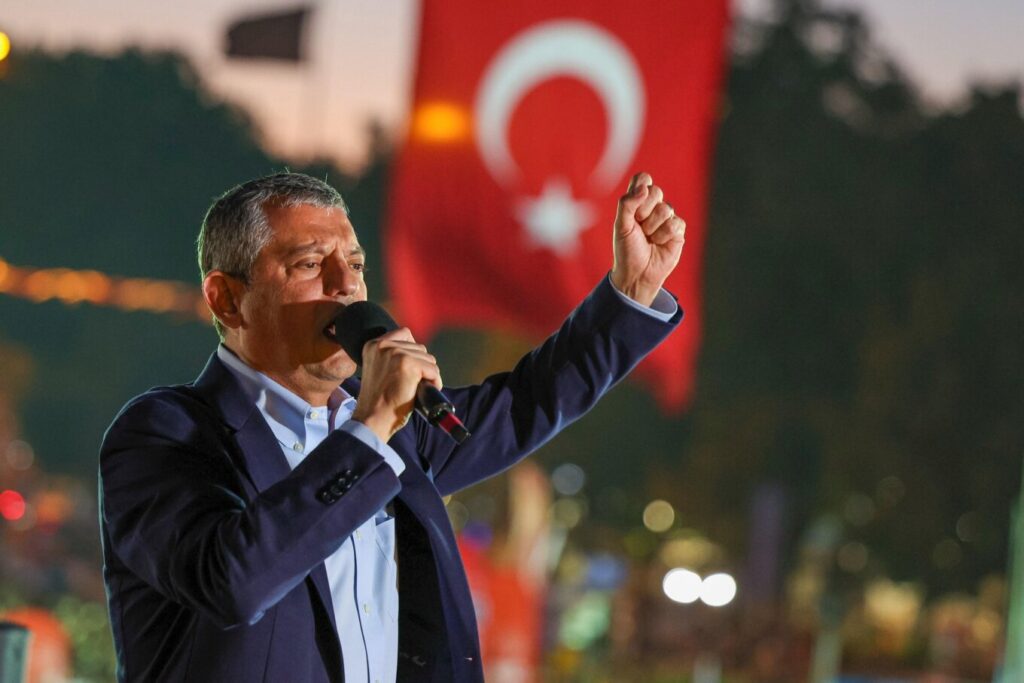
Turkey’s Foreign Ministry has rejected accusations that Ankara has made concessions to Greece in the Aegean and Eastern Mediterranean, responding to a fierce attack by opposition leader Özgür Özel against Turkish President Recep Tayyip Erdoğan and Turkish Foreign Minister Hakan Fidan.
In a statement issued late on Tuesday, the ministry insisted that Turkey’s longstanding positions on maritime disputes remained unchanged and that the government would continue defending what it considers its legitimate rights and interests in accordance with international law.
“The positions of Turkey, which it has consistently and resolutely defended in all forums in accordance with international law, remain unchanged,” the ministry said, adding that Ankara would continue protecting its interests in both regions “without concessions”.
The response followed extensive criticism from Özel, leader of the main opposition Republican People’s Party (CHP), who accused Erdoğan’s government of diplomatic miscalculations that had strengthened Greece’s position while leaving Turkey increasingly isolated from important European defence initiatives and US military programmes.
The opposition leader was particularly scathing about Fidan, whom he sarcastically described as a “TikToker”, accusing him of undermining Turkey’s established position on Greek territorial waters and the longstanding casus belli dispute.
Ankara denies Fidan gave an interview to a Greek newspaper
The Turkish Foreign Ministry also rejected Özel’s assertion that Fidan had made the disputed remarks during an interview with a Greek newspaper.
According to the ministry, the foreign minister had spoken at an event organised by a think tank in Brussels, and his comments had subsequently been distorted and taken entirely out of context.
Ankara maintained that its policy towards Greece remained consistent, implicitly accusing the opposition leader of exploiting sensitive foreign policy issues for domestic political purposes.
The disagreement centres on statements attributed to Fidan concerning Greece’s potential extension of its territorial waters and the meaning of casus belli, the Latin expression for an act considered grounds for war.
In 1995, the Turkish parliament adopted a resolution authorising the government to take necessary measures, including military action, should Greece extend its territorial waters in the Aegean beyond six nautical miles.
Özel accused Fidan of weakening that position by suggesting that an extension to 12 nautical miles did not automatically constitute a declaration of war.
Özel: Greece’s agreement with Egypt is accepted, ours with Libya is rejected
One of the opposition leader’s strongest criticisms concerned Turkey’s controversial maritime agreement with Libya, signed in 2019, and the competing agreement concluded between Greece and Egypt in 2020.
Özel maintained that the Turkish-Libyan memorandum remained strategically important but argued that Erdoğan’s handling of relations with Egypt had undermined Ankara’s wider interests in the Eastern Mediterranean.
“We attach great importance to the agreement with Libya. I was the MP who said at the time: ‘Bring it to parliament, ratify it and submit it to the United Nations so that we can seize the initiative,’” he said.
However, he argued that the agreement alone could not adequately protect the maritime rights claimed by Turkey.
“The agreement Egypt signed with Greece is accepted by everyone, while our agreement with Libya, signed by two sovereign states, is criticised, condemned and rejected by arrogant Europeans,” Özel said.
He blamed the situation on what he described as the Erdoğan government’s lack of foresight and its erratic foreign policy decisions.
His remarks come amid renewed diplomatic tensions over the Turkish-Libyan maritime memorandum, which Libya’s eastern-based parliament approved on 20 October.
Greece, Cyprus and Egypt have opposed the agreement, arguing that it disregards the maritime rights of other countries. Athens and Cairo have also been discussing a possible eastward extension of their existing maritime delimitation agreement.
F-35s, F-16s and the failure to secure US concessions
Özel also accused Erdoğan of failing to obtain meaningful concessions from US President Donald Trump, despite what he described as substantial commercial and diplomatic commitments made by Turkey.
He claimed that Ankara had agreed to purchase 250 Boeing aircraft, acquire expensive American liquefied natural gas, reduce tariffs on US products and increase duties on Chinese imports in an effort to improve relations with Washington.
According to Özel, the Turkish government had also offered access to the country’s rare-earth resources, particularly those in the Eskişehir region.
“And what did we get in return?” he asked.
“Your friend Trump, despite repeating it for two years, has been unable to lift the CAATSA sanctions.”
The sanctions were imposed on Turkey following its purchase of Russian S-400 air defence systems, a decision that also led to Ankara’s removal from the US-led F-35 fighter jet programme.
Özel accused Washington of retaining money Turkey had already paid towards the aircraft while supplying F-35s to other countries.
“They kicked us out of the F-35 programme, for which Turkey had paid. Six of those aircraft already had the crescent and star painted on them, and our pilots had been sent for training,” he said.
He contrasted Turkey’s position with the military capabilities of Greece and Israel.
“As if the F-35s sold to Israel and Greece were not enough, the most modernised F-16s are also in the hands of Greece and Israel,” he claimed.
Özel further criticised the government’s difficulties in obtaining engines for Turkey’s domestically developed KAAN fighter aircraft.
“No engine has arrived for the KAAN, and no F-35s have arrived either. Trump made promises about all these things. Not a single one has been fulfilled,” he said.
S-400 missile systems and continued American sanctions
The opposition leader questioned the value of Turkey’s acquisition of the Russian S-400 missile systems, which remains a major obstacle in Ankara’s defence relationship with Washington.
“Where are the S-400s? They opened their covers only once for testing, and they remain in storage,” he claimed.
Özel argued that the purchase had produced serious diplomatic and military consequences without delivering the strategic advantages promised by the government.
“Now they tell us: ‘Unless the S-400s are removed from Turkey, the CAATSA sanctions will not be lifted. Do not dream about it,’” he said.
He also criticised the US decision to lift restrictions on arms sales to the Republic of Cyprus while sanctions affecting Turkey remained in place.
Sharp criticism of Fidan over the Aegean and casus belli
Turning directly to the Aegean dispute, Özel accused Foreign Minister Hakan Fidan of making statements that departed from Turkey’s established position on Greek territorial waters.
“The foreign minister, Mr Hakan the TikToker, went and gave an interview to a Greek newspaper and said: ‘Extending to 12 miles does not constitute a casus belli, a cause for war,’” Özel said.
He argued that Turkey’s position had historically concerned any extension beyond six nautical miles, rather than simply the 12-mile threshold.
“We did not refer to 12 miles. We said anything beyond six miles,” he insisted.
According to Özel, Fidan’s interpretation effectively suggested that Turkey could tolerate an extension to 11.9 nautical miles.
“Think about it. Is it possible for someone who served as head of the National Intelligence Organisation to be unaware of this?” he asked.
He also criticised Fidan’s interpretation of casus belli, arguing that the foreign minister had adopted language more commonly used by Greek diplomats.
“I am not saying we should go to war. But that is different from our own foreign minister using the language of a Greek diplomat,” he said.
The Turkish Foreign Ministry subsequently rejected this interpretation, maintaining that Fidan’s statements had been misrepresented.
Electricity cable linking Greece and Cyprus becomes another point of dispute
Özel also attacked the government’s handling of plans for an electricity interconnection between Greece and Cyprus, questioning why Ankara had not promoted an alternative route through Turkey.
He argued that a connection across a much shorter distance would offer commercial and strategic advantages compared with a lengthy undersea cable.
“Why build a 2,000-kilometre cable? Let us supply the electricity over 70 kilometres,” he said, describing the proposal as a strategic opportunity that Turkish diplomacy should have pursued.
He also criticised Ankara’s position on the notification requirements for laying submarine cables.
“We say we are not asking for permission, only notification. And since then, Greece has said it is opposed even to notification,” Özel claimed.
He characterised the dispute as another example of what he considers concessions made by the Erdoğan administration.
EU defence programme and the threat to Turkish industry
Beyond relations with Greece, Özel accused the Turkish government of damaging the country’s economic and security interests through its handling of relations with the European Union.
He singled out the EU’s €150 billion Security Action for Europe (SAFE) defence financing programme, arguing that Turkey had failed to secure the participation it deserved.
“At every meeting abroad, we say: ‘Europe’s security cannot exist without Turkey.’ Yet because of their mistakes, we have been excluded from this enormous programme,” he said.
Özel pointed to Turkey’s contributions to NATO operations, including the deployment of Turkish F-16 aircraft to protect the airspace of the Baltic states.
He also expressed concern about European industrial policy and its potential consequences for Turkish manufacturers, particularly the automotive sector.
The opposition leader argued that Ankara had failed to modernise its Customs Union agreement with the EU and warned that proposed European measures could severely affect Turkish exports and supply chains.
“If the legislation passes through the European Parliament in its current form, the Turkish automotive industry will suffer a devastating blow,” he said.
“They are treating Turkey as though it were China.”
He accused Erdoğan’s government of allowing relations with European partners to deteriorate to the point where Turkish companies could face significant disadvantages in their most important export market.
Foreign policy becomes a domestic political battleground
The confrontation comes at a particularly sensitive moment for Turkey’s relations with Greece and the European Union, as disputes over maritime boundaries, defence cooperation and energy projects remain unresolved.
Özel’s intervention brought together several longstanding controversies, from the Turkish-Libyan maritime memorandum and the Greek-Egyptian agreement to Ankara’s exclusion from the F-35 programme and the future of its relations with Washington.
His central argument was that the Erdoğan administration had repeatedly failed to translate Turkey’s strategic importance into concrete diplomatic benefits, while Greece had strengthened its international partnerships and defence capabilities.
The Turkish Foreign Ministry, however, rejected the suggestion that Ankara had retreated from its established positions, insisting that its approach to the Aegean and Eastern Mediterranean remained unchanged.
The exchange highlights the extent to which relations with Greece, military modernisation and Turkey’s standing within Western institutions have become contentious issues in the country’s domestic political debate.
Ask me anything
Explore related questions




