





Israel faces a potentially prolonged political stalemate after exit polls in Tuesday’s general election put Israeli Prime Minister Benjamin Netanyahu’s Likud party in first place but suggested that neither of the country’s two main political blocs had secured the parliamentary majority needed to form a government.
The first projections, released after polling stations closed at 10pm local time, point to an exceptionally close contest, with Netanyahu’s right-wing and religious coalition falling short of the 61 seats required for a majority in the 120-member Knesset.
His principal challenger, former military chief Gadi Eisenkot, has already claimed that voters have delivered a decisive rejection of Netanyahu’s government and vowed to move quickly to establish an alternative administration.
Opposition leaders have begun celebrating what they describe as a political turning point, although the parliamentary arithmetic remains complicated. Arab-led parties are projected to secure between 16 and 18 seats, potentially giving them unprecedented influence over the next phase of Israeli politics.
The exit polls are not official results, however, and the counting of votes could still alter the balance between the rival blocs.
What the exit polls show
The projections from Israel’s leading television networks differ on the distribution of seats, but all point to a fragmented parliament in which neither main political camp can govern alone.
According to Channel 12, the Jewish opposition parties are projected to win 52 seats, compared with 50 for Netanyahu’s coalition. Arab-led parties are forecast to secure 18 seats.
Channel 13 presents a similar picture, with Likud winning 25 seats and Eisenkot’s centrist Yashar party taking 23. It puts the opposition bloc on 53 seats, Netanyahu’s coalition on 50 and the Arab parties on 17.
The i24News exit poll is more favourable to Netanyahu, projecting 27 seats for Likud and 20 for Yashar. It gives the prime minister’s bloc 55 seats, the opposition 49 and Arab parties 16.
| Exit poll | Netanyahu bloc | Opposition bloc | Arab parties |
|---|---|---|---|
| Channel 12 | 50 | 52 | 18 |
| Channel 13 | 50 | 53 | 17 |
| i24News | 55 | 49 | 16 |
The central question is therefore not simply which party wins the most seats, but which political leader can assemble a coalition capable of commanding the confidence of the Knesset.
Even if the projected opposition and Arab-party totals suggest that a majority of the new parliament could oppose Netanyahu, that does not automatically translate into a viable alternative government.
Eisenkot declares a vote of no confidence in Netanyahu
Eisenkot responded to the exit polls by claiming that Israelis had voted to remove Netanyahu from office.
“The initial exit poll results demonstrate an unequivocal vote of no confidence in Netanyahu and the government of 7 October, both from the Zionist majority and from the majority of Israeli citizens,” he said.
He described the projections, if confirmed, as a victory for what he called the country’s institutional and Zionist majority.
“I will act immediately to implement the people’s verdict, replace the Netanyahu government and establish a Zionist government of national service as soon as possible,” Eisenkot declared.
His remarks signal an intention to challenge Netanyahu for the initiative in coalition negotiations, even if Yashar finishes behind Likud in the final results.
Yair Lapid, another leading opposition figure, was equally emphatic.
“Do not let them confuse you: Netanyahu’s bloc has suffered a heavy defeat. This is a complete collapse, and the public has told them to pack their bags and go home,” he said.
Yair Golan, leader of the Democrats, also claimed that the election had created an opportunity for a change of government.
“The public has spoken and removed Netanyahu’s government. We have been given a historic opportunity to establish a genuine government of change in Israel, and we have no intention of letting it slip away,” he said.
Golan pledged to work with other opposition parties and bridge political differences to establish a new administration.
Nevertheless, the competing claims of victory come before the announcement of official results, and the ability of the opposition parties to agree on a common candidate and governing programme remains uncertain.
Historic gains for Arab parties could reshape the political balance
One of the most significant developments of election night is the projected increase in parliamentary representation for Israel’s Arab population.
Channel 12 forecasts a combined 18 seats for Arab-led parties, comprising 11 for the Joint List and seven for Ra’am. If confirmed, that would surpass the previous record of 15 seats won by the Joint List in 2020.
Channel 13 projects 17 seats for the Arab parties, while i24News puts their combined strength at 16.
Celebrations have already begun among Ra’am supporters, reflecting expectations that Arab voters could emerge as a decisive force in the new parliament.
The unusually high turnout in Arab communities appears to have played an important part in the result. Earlier figures showed participation reaching 70.1% in Umm al-Fahm, one of the country’s principal Arab-majority cities.
Yet the increased parliamentary strength of Arab parties does not necessarily provide Eisenkot with a straightforward route to power.
Both Netanyahu and Eisenkot have ruled out including Arab parties in a governing coalition during the campaign. The opposition, meanwhile, is divided over the extent to which it would accept outside parliamentary support from Arab lawmakers.
The central challenge for Eisenkot will therefore be to translate opposition to Netanyahu into a workable majority, a considerably more difficult task than simply demonstrating that the current prime minister’s bloc has lost seats.
Netanyahu prepares to claim victory as Herzog faces a difficult decision
Despite the opposition’s celebrations, Netanyahu is expected to argue that Likud’s position as the largest party gives him the strongest claim to form the next government.
According to Channel 12, his political team had been preparing a victory statement even before polling stations closed, anticipating that Likud could finish ahead of Eisenkot’s Yashar.
The prime minister’s argument rests on the distinction between winning the largest number of seats as an individual party and commanding the support of a broader parliamentary bloc.
Eisenkot, by contrast, is seeking to establish that the parties opposed to Netanyahu collectively represent a larger section of the new Knesset.
The dispute places President Isaac Herzog at the centre of the next stage of the political process.
Under Israel’s constitutional framework, the president is not obliged to give the first mandate to the leader of the largest party. Instead, after consulting the parliamentary factions, he must select the candidate he believes has the strongest prospect of forming a government.
Channel 12 has reported speculation that Herzog could turn to Eisenkot if the opposition’s parliamentary advantage is confirmed.
No decision has been announced, however, and the president is expected to avoid public commitments until the official political consultations begin.
The process itself could take several weeks. Reuters explains that the politician entrusted with forming a government can be given up to 42 days to assemble a coalition.
If that attempt fails, another candidate may be given an opportunity. Should all efforts prove unsuccessful, Israel could face another general election.
In the meantime, Netanyahu would remain in office as caretaker prime minister.
Record turnout as Israelis vote in first election since 7 October
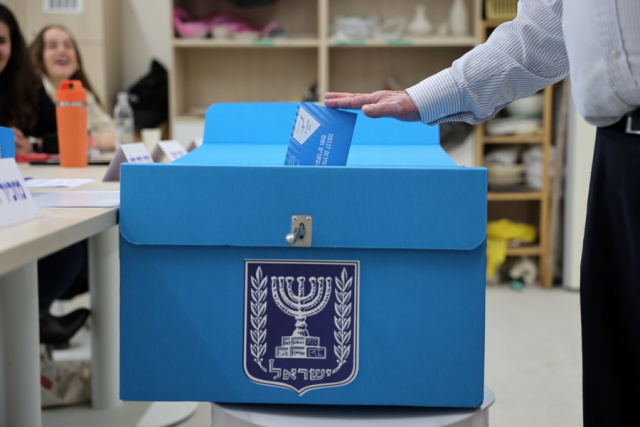
The dramatic exit poll projections followed an election day marked by exceptionally high voter participation.
By 8pm, turnout had reached 74.3% of registered voters, compared with 66.3% at the equivalent point in the 2022 election.
That represented the highest turnout recorded at that stage of an Israeli election since 1988.
In the country’s main urban centres, participation stood at 63.6% in Tel Aviv, 62% in Jerusalem and 59.8% in Haifa.
Even higher figures were reported in communities traditionally associated with strong political mobilisation. Turnout reached 72.5% in the ultra-Orthodox city of Bnei Brak and 70.1% in the Arab-majority city of Umm al-Fahm.
The high level of participation was widely interpreted as evidence of the importance voters attached to an election taking place after years of war, political confrontation and profound divisions over national security.
This is Israel’s first parliamentary election since Hamas’s attacks on 7 October 2023 and the subsequent war in Gaza, events that have transformed the country’s political landscape.
For Netanyahu, the election has become a contest over his leadership and his government’s record during one of the most turbulent periods in Israel’s history.
For Eisenkot and the wider opposition, it has been an opportunity to challenge the administration’s handling of national security, public institutions and the political consequences of the attacks.
Security incidents and disruption during election day
The election was also marked by isolated incidents of violence and disruption.
In Bat Yam, south of Tel Aviv, a group of young people allegedly confronted deputy mayor and Democrats party official Kati Piasecki outside a polling station, with one reportedly attempting to strike her.
Police questioned a 15-year-old suspect from nearby Holon in connection with incidents involving Democrats activists. He was subsequently released under house arrest conditions following the payment of bail.
Elsewhere, severe weather caused problems for voters in southern Israel.
Heavy rain and flash flooding forced police to close sections of Highway 90, leaving residents of communities in the Arava region unable to reach their designated polling stations.
Alternative arrangements were subsequently made to allow affected voters to cast their ballots at accessible polling stations in neighbouring communities.
The Central Elections Committee also approved a limited extension of voting hours in Hebron, although a broader request to extend polling nationwide was rejected.
In the final hours before polls closed, Netanyahu issued urgent appeals to his supporters to vote, warning against allowing his political opponents to take control of the country.
How the 7 October attacks shaped the election campaign
Tuesday’s vote followed a campaign dominated by the legacy of the October 2023 attacks, the wars that followed and public disagreement over responsibility for Israel’s security failures.
Netanyahu sought to present himself as an experienced leader capable of confronting threats to Israeli security, while appealing to his traditional electoral base of right-wing, nationalist and religious voters.
Eisenkot, a former chief of staff of the Israel Defence Forces, positioned himself as an alternative leader with extensive military experience, arguing that the country needed a different approach to national security and government accountability.
One of the campaign’s most contentious domestic questions concerned military service for ultra-Orthodox men.
Netanyahu has supported arrangements protecting religious exemptions, a position important to his ultra-Orthodox coalition partners. Eisenkot has pledged to end such exemptions, making the issue part of a wider debate over equality of national service and the distribution of responsibility for Israel’s defence.
The Associated Press has also highlighted divisions over an investigation into the failures surrounding the 7 October attacks, while noting that questions of Palestinian statehood and the humanitarian crisis in Gaza received comparatively limited attention during the campaign.
The election’s international implications extend beyond the future of Netanyahu himself.
US President Donald Trump has publicly backed Netanyahu, while the next Israeli government will inherit difficult diplomatic relationships, the continuing consequences of regional conflict and pressure over Israel’s conduct in Gaza.
For Israel’s European partners, the formation of a government will be closely watched for indications of possible changes in foreign policy and the country’s relations with its neighbours.
When will the official results be known?
Although the exit polls provide the first detailed picture of the election, the official count will determine whether the projections accurately reflect the electorate’s verdict.
Reuters reports that the counting process is expected to be completed by 30 October, with the official results scheduled for publication on 4 November.
Particular attention will be paid to smaller parties close to the 3.25% electoral threshold, as relatively small movements in their vote shares could substantially change the allocation of seats.
The stakes are especially high for both major blocs, neither of which appears capable of reaching a parliamentary majority without additional support.
Israel has experienced prolonged coalition deadlock before. Between 2019 and 2022, the country held five general elections as successive attempts to establish stable governments collapsed or failed to secure lasting parliamentary support.
Netanyahu himself remained caretaker prime minister for an extended period during an earlier cycle of inconclusive elections.
The possibility of another prolonged political impasse is therefore a familiar one to Israeli voters, even if the circumstances surrounding this election are unusually consequential.
For now, Netanyahu can point to Likud’s projected first-place finish, while Eisenkot and his allies claim that the wider parliamentary balance represents a mandate for political change.
The final distribution of seats, the position of the Arab parties and President Herzog’s decision on the government-forming mandate will determine whether Israel moves towards a new administration, a negotiated coalition or another period of political uncertainty.
Ask me anything
Explore related questions




