





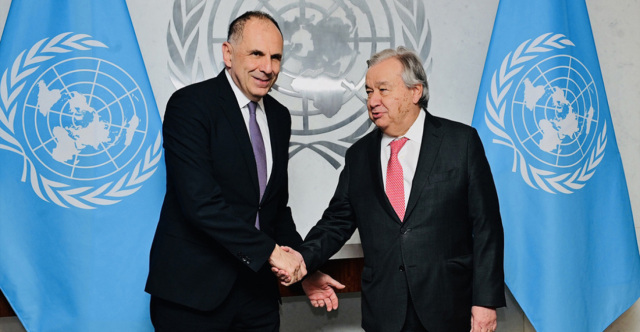
Greek Foreign Minister Giorgos Gerapetritis has sent a firm message to Turkey over its reported efforts to secure a maritime delimitation agreement with Egypt, declaring that maritime zones are not subject to bidding but must be governed by international law.
Speaking after his meeting with United Nations Secretary-General António Guterres in New York, Gerapetritis stressed that Greece would not tolerate any unlawful actions affecting maritime zones and remained committed to resolving disputes exclusively through international law.
Greece will not tolerate unlawful actions in maritime zones
Gerapetritis said maritime security had been among the issues discussed with Guterres, with particular emphasis on unlawful maritime delimitations.
“I made specific reference to issues relating to illegal delimitations. We must all understand that seas and oceans are neither anyone’s privilege nor anyone’s private property,” he said.
“There are rules governing relations between neighbouring maritime states, and those rules must be respected. It is no coincidence that the rules of international maritime law are those to which most United Nations member states have acceded. Respect for these rules is an indispensable condition for peace and prosperity.”
The Greek foreign minister reiterated Athens’ position that international law provides the only legitimate framework for resolving maritime disputes.
“Greece will not tolerate any illegality concerning maritime zones. We will remain committed to our belief in international law as the only means of resolving disputes,” he said.
“Greece has always maintained that neighbouring countries should work together to resolve their differences. However, this does not mean that aggressive actions contrary to international law can be tolerated.”
Turkey’s approach to Egypt and the Greek response
Asked about reports that Turkey was seeking to approach Egypt to negotiate maritime boundaries, Gerapetritis emphasised the strength of relations between Athens and Cairo.
“First of all, I would like to highlight the strategic, fraternal relationship we have with Egypt, which is developing across all areas,” he said.
He pointed to Egypt’s support for Greece at the United Nations over the Turkish-Libyan maritime memorandum, which Athens considers illegal and invalid.
“It is extremely important that Egypt’s Permanent Representative to the United Nations stood beside me here in New York when we announced the declaration concerning the illegal and invalid Turkish-Libyan memorandum,” Gerapetritis said.
“We share a very strong conviction with Egypt regarding the universal application of international law.”
The minister then delivered a direct warning against treating maritime delimitation as a matter of competing offers. “We must all understand that maritime zones are not up for auction. They are an area in which international law must prevail,” he said.
“Otherwise, we will reach an extreme situation that will be exceedingly damaging not only to countries bordering the Mediterranean or other seas, but also to global trade, food security and energy security.”
His remarks came amid reports of a renewed Turkish initiative to persuade Egypt to negotiate an exclusive economic zone agreement, with Ankara reportedly arguing that Cairo could gain an additional 15,000 square kilometres of maritime jurisdiction compared with its agreement with Greece.
Guterres meeting focuses on global crises
Gerapetritis also said his discussions with the UN Secretary-General had covered the major international crises currently unfolding, including the wars and instability affecting Ukraine, the Middle East and Africa.
“We had the opportunity to discuss Ukraine, the Middle East and Africa. Our shared assessment is that we are currently at the most critical turning point for global peace and prosperity since the Second World War,” he said.
The minister stressed the need for new international decisions aimed at reducing tensions, ending wars and addressing the consequences of energy and food insecurity.
“New decisions must be taken so that we can try to de-escalate crises, bring wars to an end, find a way out of the energy and food crises, and enable peoples to work together peacefully,” he said.
Cyprus talks must regain momentum
The Cyprus issue was also raised during the meeting, with Gerapetritis stressing the importance of advancing negotiations towards a substantive settlement.
He said the issue remained active and that conditions should now allow more formal discussions on the substance of the Cyprus problem to begin.
The foreign minister also underlined the need to preserve the diplomatic progress achieved during Guterres’ tenure as UN Secretary-General. “We must not lose the momentum that was built during António Guterres’ term,” he said.
Ask me anything
Explore related questions




