





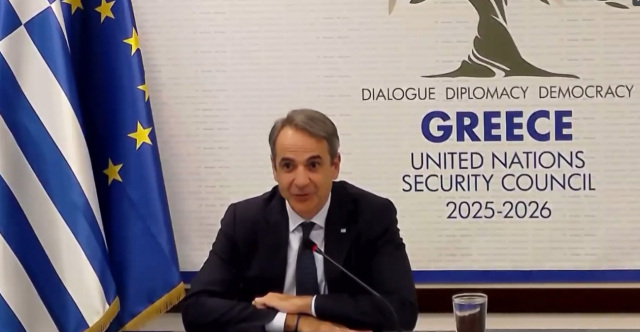
Prime Minister Kyriakos Mitsotakis has rejected the Turkey-Libya maritime agreement as “illegal and null and void”, warning that Athens will not allow major energy interconnection projects in the Eastern Mediterranean to be held hostage to geopolitical disputes.
Speaking remotely at the Manama Dialogue in Bahrain, Mitsotakis directly challenged Ankara’s maritime claims and stressed that Greece would not tolerate attempts to use regional energy infrastructure as leverage.
The prime minister focused on the maritime agreement signed by Turkey and Libya in 2019 and recently ratified, arguing that its proposed boundaries disregard the existence of Greek islands.
He illustrated his argument with the hypothetical example of Greece reaching a similar maritime agreement with Tunisia, explaining that drawing an arbitrary diagonal line across the Mediterranean would ignore geographical realities and violate fundamental principles of international law.
Mitsotakis contrasted the Turkey-Libya agreement with the maritime delimitation deal between Greece and Egypt, presenting the latter as an example of how disputes in the Eastern Mediterranean can be resolved through respect for international law.
Energy interconnections must not become geopolitical hostages
The prime minister delivered a firm message on the future of major energy infrastructure projects, insisting that regional interconnections should not be obstructed or exploited for geopolitical purposes.
“We will not accept this,” he said, making clear that Greece would oppose efforts to hold strategic energy projects hostage to political disputes.
He specifically referred to the Great Sea Interconnector, the planned electricity connection between Greece and Cyprus, as well as the proposed electricity link between Greece and Egypt.
Mitsotakis highlighted the strategic importance of these projects for regional connectivity and European energy security, underlining Greece’s commitment to developing energy infrastructure across the Eastern Mediterranean.
Mitsotakis confident of election victory
Turning to domestic politics, Mitsotakis expressed confidence about the outcome of Greece’s next general election.
“We will have elections, but we are optimistic that we will win them,” he said, presenting political stability as an important advantage for Greece in attracting investment and strengthening international partnerships.
The prime minister also described the Greek economy as a “European success story”, pointing to the country’s improved financial standing.
He noted that Greece is now able to borrow at lower interest rates than some G7 countries, a development he said would have been difficult to imagine just a few years ago.
Greece as a bridge between Europe and the Gulf
Mitsotakis called for greater European engagement with the Middle East, arguing that Greece is well placed to serve as a bridge between Europe and Arab countries.
He highlighted several major infrastructure initiatives, including the India-Middle East-Europe Economic Corridor (IMEC) and the East to Med Data Corridor (EMC), a project intended to strengthen digital connectivity between Asia, the Middle East and Europe.
The prime minister also emphasised Greece’s growing role as an entry point for liquefied natural gas (LNG) supplies to the Balkans and Ukraine.
He linked these developments to wider efforts to strengthen Europe’s energy security and diversify supply routes.
Belharra frigates and Operation Aspides
Defence cooperation was another central theme of the prime minister’s intervention.
Mitsotakis referred to the raising of the Greek flag aboard the country’s second Belharra-class frigate, Nearchos, and highlighted opportunities for deeper defence cooperation with Gulf states.
He noted that Greece spends approximately 3.5% of its GDP on defence, reflecting the importance Athens places on military capabilities and regional security.
The prime minister also discussed the European Union’s naval mission Operation Aspides, which aims to protect commercial shipping in the Red Sea and surrounding waters.
He argued that participation by countries such as Greece, Italy and France should be expanded, calling for stronger European engagement in maritime security.
Mitsotakis concluded that Europe needs a critical mass of countries willing to invest meaningfully in relations with the Arab world, not only through economic agreements but also through a tangible presence when regional partners face crises.
Ask me anything
Explore related questions




