





A major political and constitutional crisis has erupted in Poland after the suspension of the president of the Constitutional Tribunal triggered allegations of a “coup d’état”, a police deployment and the extraordinary decision by President Karol Nawrocki to turn his plane around while travelling to Senegal.
According to Reuters, Bogdan Święczkowski, president of Poland’s Constitutional Tribunal, was suspended from his duties on Friday, October 30, in a move whose legality has been challenged by the court’s leadership, which accused those responsible of attempting to seize control of the institution unlawfully.
The unprecedented developments are the latest escalation in a bitter confrontation between Polish Prime Minister Donald Tusk’s government and the presidency over control of the judiciary. The dispute, rooted in controversial reforms introduced by the previous government, has raised serious questions about the functioning of Poland’s constitutional institutions and the legitimacy of their decisions.
W takim momencie Prezydent musi być w Polsce. Przerywam lot do Senegalu. Wracam 🇵🇱
— Karol Nawrocki (@NawrockiKn) October 30, 2026
Przywracanie rządów prawa jest naszym obowiązkiem. Po latach pisowskiego bezprawia to proces trudny, czasem bolesny i wymaga zdecydowanego działania. Innej drogi nie ma.
— Donald Tusk (@donaldtusk) October 30, 2026
Nawrocki turns his plane around as tensions escalate
As the crisis unfolded, President Karol Nawrocki abruptly interrupted an official trip to Senegal, ordering his aircraft to return to Poland.
“At a moment like this, the President must be in Poland. I am cutting short my flight to Senegal. I am returning,” Nawrocki wrote on X.
Prime Minister Donald Tusk defended his government’s actions, presenting them as part of an effort to reverse years of political interference in the justice system.
“Restoring the rule of law is our duty. After years of lawlessness under PiS, this is a difficult, sometimes painful process that requires decisive action. There is no other way,” Tusk wrote on X, referring to the opposition Law and Justice party.
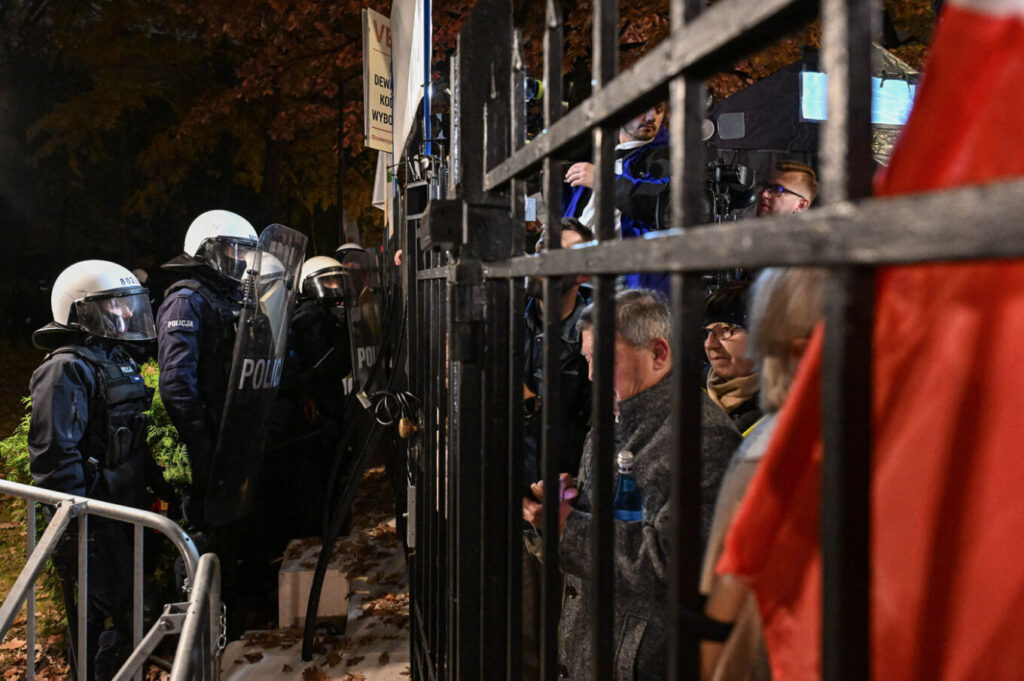
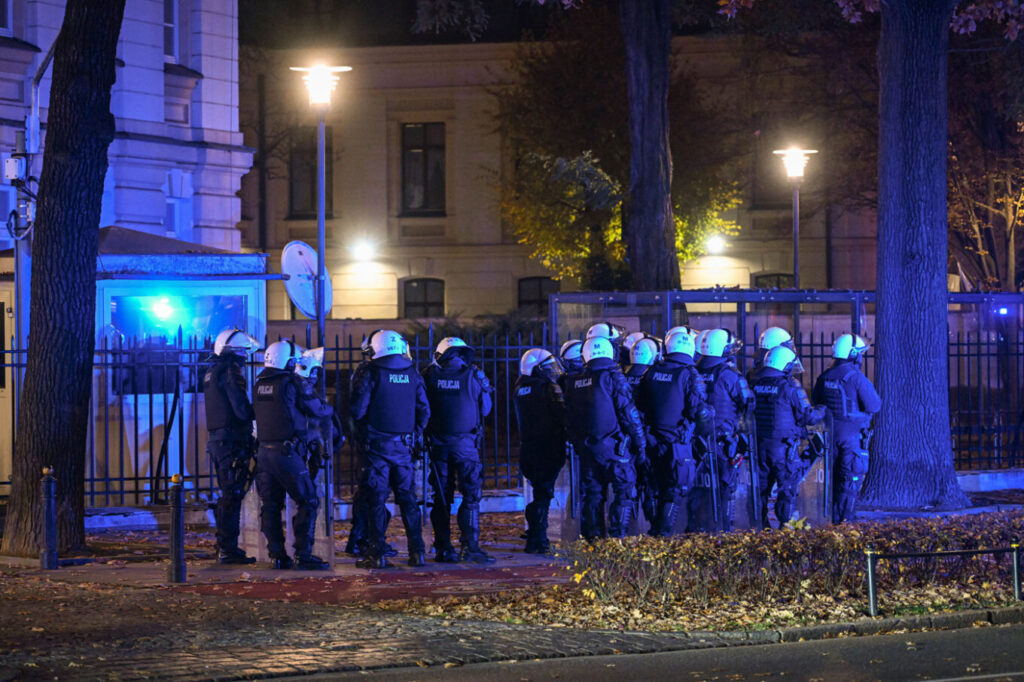
Police were deployed to the Constitutional Tribunal’s grounds in Warsaw following disturbances outside the court, including reports that dangerous objects had been thrown at officers.
Warsaw police said their operation was intended to maintain public safety and order and did not constitute interference in the Tribunal’s judicial functions. Officers also clarified that they had entered the institution’s grounds, not the court building itself.
🚨 KOMUNIKAT KOMENDY STOŁECZNEJ POLICJI W związku z pojawiającymi się w przestrzeni informacyjnej przekazami mającymi na celu dezinformację opinii publicznej w zakresie działań Policji na terenie przyległym do siedziby Trybunału Konstytucyjnego, przedstawiamy rzeczywisty przebieg tych wydarzeń: 1. Do Komendy Głównej Policji wpłynęła dzisiaj korespondencja Prokuratora Generalnego zawierająca prośbę o zwrócenie szczególnej uwagi na bezpieczeństwo Trybunału Konstytucyjnego z uwagi na trwające wokół budynku protesty. 2. Jednocześnie do KGP wpłynęło pismo sędzi Trybunału Konstytucyjnego, w którym informowano Komendanta Głównego Policji o tym, że w związku z planowanymi na terenie Trybunału Konstytucyjnego czynnościami istnieje możliwość wystąpienia zagrożeń dla życia i zdrowia sędziów oraz pracowników Trybunału Konstytucyjnego, a także ryzyko zakłócenia porządku publicznego. Wobec powyższego zwrócono się z wnioskiem o podjęcie działań mających na celu zapewnienie porządku i bezpieczeństwa osób. 3. Mając na względzie konieczność realizacji ustawowych zadań Policji, w szczególności prawny obowiązek zapewnienia bezpieczeństwa i porządku publicznego, informacja została przekazana do Komendy Stołecznej Policji z poleceniem podjęcia stosownych działań. 4. Stanowczo podkreślamy, że Policji nie ma wewnątrz siedziby Trybunału Konstytucyjnego, a funkcjonariusze znajdujący się na terenie zewnętrznym zostali tam wezwani przez osobę uprawnioną. 5. Działania Policji ograniczają się wyłącznie do terenu zewnętrznego, a także zapewnienia porządku i bezpieczeństwa w miejscu ogólnodostępnym, jakim jest Aleja Szucha. 6. W czasie prowadzonych działań doszło do incydentów, w których uczestniczyły osoby znajdujące się wówczas w Alei Szucha przed ogrodzeniem TK, w tym rzucania niebezpiecznymi przedmiotami w funkcjonariuszy znajdujących się w tym miejscu. 7. Policjanci podjęli działania mające na celu zapewnienie bezpieczeństwa i przywrócenie porządku publicznego. 8. Co istotne – wbrew pojawiającym się w niektórych mediach informacjom, powielanym następnie w przestrzeni publicznej przez różne osoby – Policja nie podejmowała żadnych działań wobec funkcjonariuszy straży TK. 9. Policjanci zatrzymali trzy osoby, które przeskakując przez ogrodzenie wtargnęły na teren Trybunału Konstytucyjnego. Czynności procesowe z zatrzymanymi prowadzone będą w kierunku art. 193 k.k. Ponownie podkreślamy, że Policja nie prowadzi żadnych działań w siedzibie Trybunału, ograniczając je wyłącznie do terenu zewnętrznego. Czynności funkcjonariuszy mają na celu realizację ustawowych obowiązków, w szczególności prawny obowiązek zapewnienia bezpieczeństwa i porządku publicznego. Nie stanowią one ingerencji w działalność Trybunału Konstytucyjnego jako instytucji.
— Policja Warszawa (@Policja_KSP) October 30, 2026
Constitutional Tribunal alleges an unlawful takeover
The crisis intensified when a statement published on the Constitutional Tribunal’s official X account alleged that the court’s website had been unlawfully taken over.
The statement insisted that Bogdan Święczkowski remained president of the Tribunal and Bartłomiej Sochański remained vice-president, rejecting the validity of their suspension.
“All those participating in these actions are committing the crime of a coup d’état,” the statement declared.
The allegations reflect the extraordinary depth of the institutional confrontation, with rival sides disputing not only who is entitled to lead the Tribunal but also which judicial appointments and administrative decisions carry legal authority.
According to reports from Polish media, the suspension also affected Vice-President Sochański, while the disputed decision was attributed to Judge Anna Korwin-Piotrowska.
Polish President Nawrocki cut short his flight to Senegal on Friday and returned to Poland after police entered the Constitutional Tribunal and its president, Bogdan Swieczkowski, was suspended. Police cited violent incidents outside the court, including objects thrown at officers. The crisis follows a prolonged political dispute over judicial appointments that has effectively paralyzed the tribunal. https://t.co/UkI7bBejFs
— Clash Report (@clashreport) October 30, 2026
A judicial battle that has paralysed Poland’s top court
The confrontation is the latest chapter in a prolonged dispute that has effectively paralysed Poland’s Constitutional Tribunal.
Earlier in 2026, Nawrocki, an ally of Poland’s former nationalist government, refused to swear in three of the six constitutional judges nominated by parliament.
Święczkowski, meanwhile, declined to allow judges elected by the current parliamentary majority to assume their duties.
The crisis dates back to the years when the national-conservative Law and Justice party, known as PiS, governed Poland between 2015 and 2023.
During that period, PiS introduced sweeping changes to the appointment and functioning of judges and judicial institutions, prompting widespread criticism from European Union institutions over concerns about judicial independence and compliance with the rule of law.
After taking office, Tusk’s pro-European government pledged to reverse those reforms and restore the independence of the judiciary.
However, its attempts to overhaul the justice system have encountered resistance from Nawrocki, who was backed by PiS and has accused the government of attempting to bring the judiciary under its own political control.
The confrontation escalated further when the governing parliamentary majority appointed new constitutional judges, only for the president to refuse to administer the oath to some of them.
Disputed swearing-in procedures followed, deepening disagreements over whether the newly appointed judges were legally entitled to participate in the Tribunal’s work.
Nastąpiło bezprawne przejęcie strony internetowej Trybunału Konstytucyjnego. Prezesem @TK_GOV_PL jest nadal Bogdan Święczkowski, a Wiceprezesem Bartłomiej Sochański. Pani Anna Korwin-Piotrowska nie jest sędzią Trybunału Konstytucyjnego. Wszystkie osoby uczestniczące w niniejszych działaniach popełniają przestępstwo zamachu stanu.
— Trybunał Konstytucyjny (@TK_GOV_PL) October 30, 2026
What is at stake in Poland’s constitutional crisis?
Friday’s developments are not an isolated incident but the culmination of a prolonged struggle in which the government and its opponents challenge the legality of each other’s actions.
For Tusk, the overriding objective is to restore what his government considers the independence and constitutional legitimacy of a judiciary reshaped during the PiS years.
For Nawrocki and the opposition, the government’s latest actions raise concerns about the limits of executive power and the constitutional procedures governing the judiciary.
The immediate question is who has the lawful authority to lead the Constitutional Tribunal, Poland’s institution responsible for reviewing the constitutionality of legislation.
The broader issue is whether its decisions will be recognised and respected across the country’s political and state institutions.
As Poland’s leadership remains divided over the legitimacy of the court’s administration, the confrontation threatens to deepen an already serious institutional deadlock.
Ask me anything
Explore related questions




