





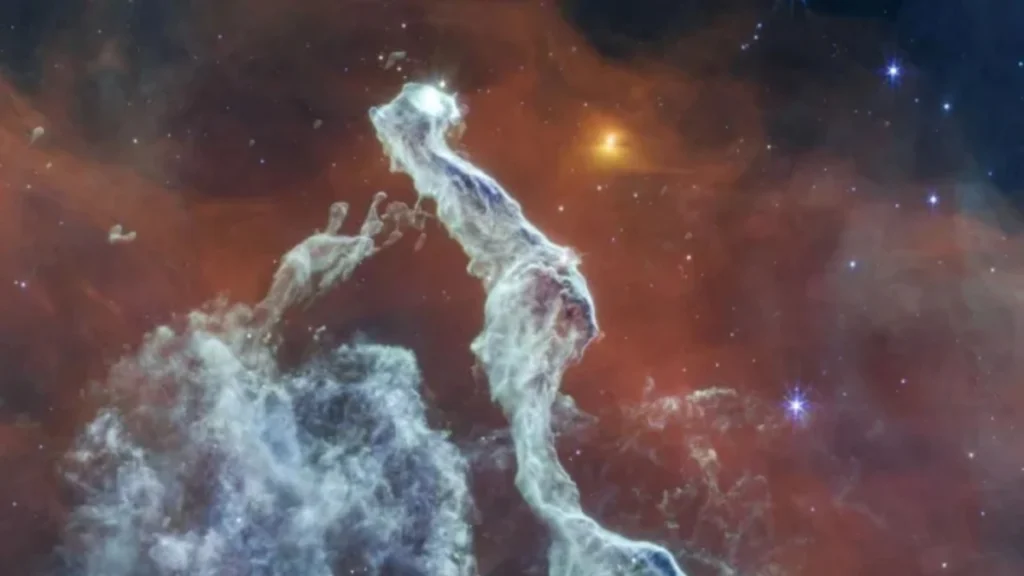
NASA has released striking new images of a nebula located approximately 7,500 light-years from Earth, which has a distinctive feature: it resembles a cat with one glowing eye.
This is the Cat’s Head Nebula, which lies within the much larger Carina Nebula. The new images were captured by the James Webb Space Telescope in the infrared spectrum, offering a different perspective from previous observations made by the Hubble Space Telescope in visible light.
Its name comes from its shape, which resembles a cat sitting with its back facing Earth. Its “head” appears to be turned to the right, revealing a distinctive bright spot that looks like an eye. According to NASA, the reddish glow resembling an eye may come from a young star that remains partially embedded within clouds of dust.
What the new James Webb images reveal
James Webb’s ability to observe in the infrared spectrum allows scientists to examine regions of space that remain hidden behind dense clouds of dust, which make observation with Hubble more difficult.
The new images show numerous stars both around and inside the nebula, as well as faint galaxies located much farther away in the cosmic background. Another image highlights the warm dust and intricate structures inside the formation, revealed through the radiation emitted by its material.
The nebula’s striking outline is no coincidence. It was most likely shaped gradually by intense ultraviolet radiation and stellar winds originating from massive stars in the surrounding region. Denser concentrations of gas and dust were able to withstand erosion for longer, helping create the distinctive shape we see today.
It is worth noting that the Cat’s Head Nebula is neither a new discovery nor an independent nebula. The name refers to a smaller formation within the Carina Nebula, which was first recorded in 1752 by French astronomer Nicolas-Louis de Lacaille.
However, this cosmic “cat” will not retain its present shape forever. As NASA points out, it is a temporary formation that will gradually disperse as stars continue to form and evolve. Its distinctive outline will eventually disappear.
Ask me anything
Explore related questions




