





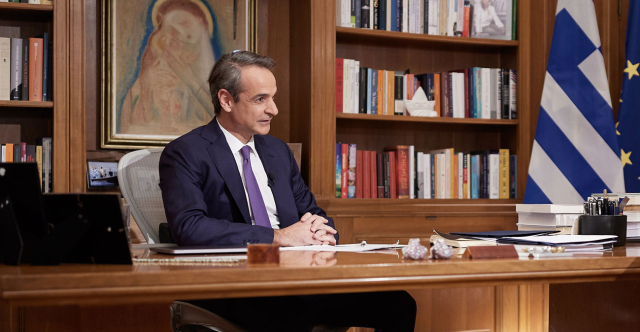
Prime Minister Kyriakos Mitsotakis has sent a clear message to Turkey in his Sunday post. He stressed that Greece and Cyprus are the countries responsible for authorising survey work for a project designated as a Project of Common European Interest, in which French companies are also participating.
“It is important to make absolutely clear that interconnection projects such as the GSI are strategic investments that strengthen energy self-sufficiency, regional co-operation and stability, contributing to peace and security across the wider region,” he added.
The prime minister also devoted considerable attention to the US midterm elections, pointing out that relations between Greece and the United States rest on strong foundations that transcend electoral cycles.
In particular, Mr Mitsotakis addressed the following issues:
Greece-Cyprus cable – NAVTEX
“On Friday, the permit for survey work and cable-laying operations for the Crete-Cyprus electricity interconnector (Great Sea Interconnector, GSI) was issued, along with the relevant NAVTEX. These are important steps towards advancing the implementation of the project.
“Greece and Cyprus are the countries authorising the survey work for a project that has been designated as being of common European interest and in which French companies are participating.
“It is important to make absolutely clear that interconnection projects such as the GSI are strategic investments that strengthen energy self-sufficiency, regional co-operation and stability, contributing to peace and security across the wider region.”
US elections
“Greek-US relations, however, rest on strong foundations and transcend electoral cycles.
“It is certainly encouraging that Greek-Americans have been elected or re-elected to Congress, and that individuals with whom the Greek government enjoys very good relations will serve on key defence and foreign policy committees. This is important for our country, particularly at a time of geopolitical instability in our region.”
Cost of living – Rising prices
“The cost of living was one of voters’ main concerns. This is, of course, an issue with which we are all too familiar. Rising prices continue to put pressure on households in our country, despite improvements in several economic indicators… That is why we are extending the National Price Reduction Initiative until the end of the year, with around 1,000 essential products being offered at lower prices, including food items found on every family’s table.”
The rule of law everywhere
“When, in 2023, we pledged to strengthen the rule of law in every aspect of public life and everyday life, we meant that the state would not back down in the face of organised crime, no matter how powerful the interests standing in its way might be.
“I want to be clear: there are no no-go areas, and no individuals are exempt from scrutiny. The law must apply to everyone, without exception.”
Agricultural subsidies – Payments
“I know that the transition to the new system has created difficulties for many farmers, particularly when submitting applications.
“Payments are already being made to around 40,000 beneficiaries. Advance payments will be made by 30 November, with final settlements to follow in December.”
Kyriakos Mitsotakis’ post in full
Good morning, everyone.
The US midterm elections were one of the most significant events of the week, as they changed the political balance in both chambers of Congress. Greek-US relations, however, rest on strong foundations and transcend electoral cycles. It is certainly encouraging that Greek-Americans have been elected or re-elected to Congress, and that individuals with whom the Greek government enjoys very good relations will serve on key defence and foreign policy committees. This is important for our country, particularly at a time of geopolitical instability in our region.
On Friday, the permit for survey work and cable-laying operations for the Crete-Cyprus electricity interconnector (Great Sea Interconnector, GSI) was issued, along with the relevant NAVTEX. These are important steps towards advancing the implementation of the project. Greece and Cyprus are the countries authorising the survey work for a project that has been designated as being of common European interest and in which French companies are participating. It is important to make absolutely clear that interconnection projects such as the GSI are strategic investments that strengthen energy self-sufficiency, regional co-operation and stability, contributing to peace and security across the wider region.
I would like to return to the outcome of the US elections, from which I draw another important point. The cost of living was one of voters’ main concerns. This is, of course, an issue with which we are all too familiar. Rising prices continue to put pressure on households in our country, despite improvements in several economic indicators. That is why we are extending the National Price Reduction Initiative until the end of the year, with around 1,000 essential products being offered at lower prices, including food items found on every family’s table. At the same time, market inspections are continuing to ensure that consumers can be confident that the announced price reductions are being implemented in practice.
The bill passed by Parliament this week also follows the same course of providing financial relief to citizens. It includes 16 favourable measures, to which we added two further significant interventions for borrowers. From 1 December, vulnerable and eligible debtors who restructure their debts through the out-of-court debt settlement mechanism will have a fixed interest rate of 3% for the entire duration of their arrangement, instead of a variable rate that could reach 5.67%. To give an example, on a debt of €100,000 repayable over 20 years, the saving could reach €20,200 if the debt is secured, and €28,000 if it is unsecured. At the same time, we are increasing tenfold the maximum fine that the Bank of Greece can impose on loan servicers for serious breaches, from €500,000 to €5 million. It is also significant that these measures received broader parliamentary support, extending beyond the governing majority.
I would like to recall here that, since 2019, we have introduced at least 27 measures affecting the banking system. Through the Hercules programme, we reduced banks’ non-performing loans from 48.5% in 2016 to 3.4% this year; established the out-of-court mechanism for debt restructuring; protected primary residences; and reduced bank fees and ATM charges, generating an annual benefit of around €150 million for citizens. As a result, private debt now stands at 96.6% of GDP, below the European average of 119.3%.
This week also marked the second anniversary of the “Greek FBI”, which has now been operating for two years. When, in 2023, we pledged to strengthen the rule of law in every aspect of public life and everyday life, we meant that the state would not back down in the face of organised crime, no matter how powerful the interests standing in its way might be. And today we have tangible results: over these two years, the Directorate for Combating Organised Crime has handled more than 1,500 cases, brought charges against more than 5,400 individuals and dismantled 259 criminal groups. These range from fuel and cigarette smuggling rings to corruption networks operating in tax offices, planning authorities and prisons.
Of course, this effort did not begin two years ago. Since 2019, dozens of criminal networks have been dismantled, ranging from schemes involving fictitious prescriptions and fraud against the National Organisation for Healthcare Provision (EOPYY) and the National Social Security Fund (EFKA), to the illegal issuance of driving licences, bribery in public services such as the Land Registry, and the unauthorised occupation of beaches. Public officials, including police officers, were involved in several of these cases. I want to be clear: there are no no-go areas, and no individuals are exempt from scrutiny. The law must apply to everyone, without exception.
One of the most striking examples of this effort is the crackdown on networks involved in fraudulent agricultural subsidy claims. I know that the transition to the new system has created difficulties for many farmers, particularly when submitting applications. The relevant services are working every day to resolve technical problems and complete payments. Payments are already being made to around 40,000 beneficiaries. Advance payments will be made by 30 November, with final settlements to follow in December. Meanwhile, producers who have not yet submitted an application can take advantage of the extension granted until Tuesday, 10 November.
I now move on to the other issues of the week:
1. At this week’s Cabinet meeting, we presented the government’s 90 priorities for the next six months, up to the elections. These range from a further increase in the minimum wage, with the aim of reaching €1,000 by early 2028, and housing measures, to improvements in healthcare and education and the completion of major infrastructure projects. We have a specific plan and timetable, but there is still a great deal of work ahead. Our aim is to deliver on our commitments so that citizens can judge us on the entirety of our record.
2. Ten major investment projects are moving forward under the Development Law in Macedonia, Central Greece, Thessaly and Crete. Their total value amounts to €226.2 million, with state support exceeding €104 million and more than 400 new jobs to be created. They cover sectors ranging from cement and aluminium to food, pharmaceuticals and data processing. At the same time, procedures for businesses are being simplified: minor changes to an investment project will no longer require separate approval, clear deadlines are being introduced, and businesses’ long-term obligations are being reduced from six years to three for small enterprises and to five for medium-sized and large businesses.
3. We are introducing rules governing the use of artificial intelligence in the workplace through a new bill presented by the Ministry of Finance – one of the 90 priorities I mentioned earlier. Specifically, for people working through digital platforms, the bill provides for transparency regarding the criteria used to make decisions affecting them, mandatory human oversight of significant decisions and protection of their personal data. It also clarifies their employment status.
4. Two changes are being introduced to improve services for EOPYY-insured patients. First, from 1 November, doctors, diagnostic laboratories and all contracted providers will be required to enter test results into the new Digital Repository. This will allow every citizen and their doctor to access a consolidated record of their test history, without having to search for previous results. Second, through the new myEOPYYapp, insured patients will be able to use their mobile phones to book appointments at EOPYY pharmacies, request home delivery of high-cost medicines and submit supporting documents for reimbursement.
5. At the Central Union of Municipalities of Greece (KEDE) conference in Kalamata, I announced six plus two initiatives to support municipalities: €300 million for recycling projects and €240 million in November to settle overdue debts to energy providers. We are increasing the municipal accommodation tax from 0.75% to 1% and doubling the annual state grant for the maintenance of school buildings. We are also providing for €200 million annually for local roadworks, once the fuel market has stabilised, and €50 million for the installation of batteries, enabling municipalities to use energy generated by local renewable sources for their own needs. In addition, in co-operation with the Public Power Corporation (PPC), we are moving ahead with arrangements for outstanding debts of up to €60 million. We have also committed to introducing a special electricity tariff for municipalities as soon as the current turmoil in the energy market begins to subside.
6. Kalamata was also the first stop on my tour of the Peloponnese, where I had the opportunity to visit the works on the Kalamata-Methoni road, the airport upgrade and the new Solar Sludge Drying Unit, which uses solar energy to process waste. In Megalopoli, the contract for the new correctional facility was signed, while in Tripoli the new student residence of the University of the Peloponnese was inaugurated. It will accommodate 96 students in a former hotel, bringing the university’s total student accommodation capacity to 426 places.
7. For the first time in its history, Greece is acquiring aerial refuelling aircraft, with the purchase of three Embraer KC-390s from Portugal and the option to acquire three more. This will enable our fighter aircraft to refuel in the air: initially the Rafale and Mirage jets, and the F-16s within a year, increasing the range and duration of their missions. Meanwhile, the Hellenic Navy has taken delivery of two more MH-60R Seahawk anti-submarine helicopters, with the final two of the seven in total expected by the end of the year.
8. With the support of the Armed Forces, an initiative that is pioneering on an international level is also getting under way: no journalist will go to a conflict zone unprepared again. In co-operation with the General Secretariat for Communication and Information, journalists’ associations and the Hellenic Red Cross, a training and certification programme is being established for those covering wars and high-risk missions. The first group will include 25 journalists from public media organisations, with training for those covering natural disasters to follow.
9. A special moment for the Rhodope region: after centuries, a blessing ceremony was held once again at the Byzantine church of Maximianoupolis, just outside Komotini. The church has been restored with €1.5 million in funding from the Recovery Fund and is now open to visitors. At the same time, plans are being drawn up to make use of the Imaret and Komotini’s old ice factory, with an exhibition dedicated to the history of the city and its communities.
10. Forty-eight valuable ecclesiastical artefacts are returning to Serres after 109 years. They were removed in 1917, during the Bulgarian occupation in the First World War, from the Holy Monastery of Timios Prodromos, the Holy Monastery of Panagia Eikosifoinissa and the Holy Metropolis of Serres and Nigrita, and have since been kept in Sofia. Their return, following an interstate agreement with Bulgaria, fulfils a demand that the local community has pursued for decades. I am therefore delighted and deeply moved to be in Serres today to attend this historic moment.
To conclude, I would also like to mention two initiatives by the private sector. Eurobank has announced a 5% salary increase for female employees who become mothers for the first time, and an additional 10% increase when they have a second child, following their return from maternity leave. It is also maintaining its one-off financial support of €25,000 for a third child and €30,000 for a fourth. For its part, Telekom is doubling or even tripling speeds, at no additional charge, across approximately 700,000 fibre-optic connections.
Two different initiatives that deserve to be followed by others.
Have a good Sunday.
Ask me anything
Explore related questions




