





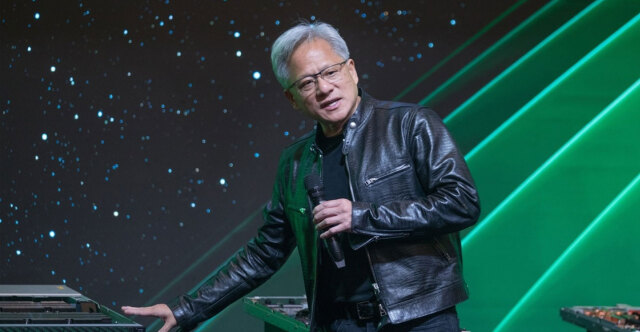
The scandal engulfing Nvidia has now reached the highest levels of the Trump administration, with the company’s former chief executive Jensen Huang and US Commerce Secretary Howard Lutnick facing congressional scrutiny over allegations of Chinese espionage and the sale of sensitive American technology to China. At the centre of the affair is 42-year-old Alice Huang, whose previously undisclosed business connections to Huawei, Nvidia’s biggest Chinese rival, have raised fresh questions about who she was really working for.
The latest developments come after Jensen Huang’s dramatic resignation from the company he founded 33 years ago, revelations of a third extramarital relationship, and allegations that Lutnick repeatedly blocked action against companies suspected of supplying Nvidia technology to China. Meanwhile, the turmoil has spread to global technology markets, although American retail investors have seized on the collapse in Nvidia’s share price to buy $111 million worth of stock in just 30 minutes.
The central question remains unanswered: was Alice Huang working for herself, for the Singapore-based technology company Megaspeed, or for Beijing? China denies that she was an intelligence operative, while investigators have so far found no evidence that Nvidia chips were illegally transferred to Huawei.
Congress turns its attention to Huang and Lutnick
Republican Senator Tim Scott, chairman of the Senate Banking Committee, has called for both Jensen Huang and Commerce Secretary Howard Lutnick to testify before Congress, citing national security concerns and the need to protect sensitive American technology.
“Recent reports raise serious concerns about our national security and the protection of sensitive American technologies. I am requesting that Nvidia President and Chief Executive Officer Jensen Huang and Commerce Secretary Howard Lutnick testify before the Senate Banking Committee,” Scott wrote on X.
Huang, one of the principal architects of the artificial intelligence revolution, resigned on Thursday from the leadership of Nvidia following the scandal surrounding his extramarital relationships, including one with a woman suspected of spying for China.
The board of the world’s largest AI chipmaker announced that Huang was stepping down as president, chief executive and a member of the board with immediate effect, without explaining the reasons for his departure. Chief financial officer Colette Kress has been appointed interim chief executive while the board searches for a permanent successor.
Huang has already agreed to testify behind closed doors before Thanksgiving on 26 November, according to Republican Congressman Brian Mast, chairman of the House Foreign Affairs Committee. He is expected to appear before the House Foreign Affairs and Intelligence Committees, as well as the House Select Committee on the Chinese Communist Party.
Mast has said that Huang has “very serious questions to answer”.
The investigation is also drawing increasing attention to Lutnick. According to Axios, the commerce secretary intervened on three occasions to prevent action against companies suspected of making Nvidia chips available to China. Among those companies was Megaspeed, where Alice Huang previously served as chief executive.
Axios also reported that Lutnick had been informed by US intelligence agencies about Jensen Huang’s relationship with a woman suspected of being a Chinese spy but failed to impose export controls on chip shipments despite pressure from within the administration and from Trump himself.
According to the same outlet, Treasury Secretary Scott Bessent confronted Lutnick in the White House Situation Room on 5 November, asking why Megaspeed had not yet been placed on the US trade blacklist. The Commerce Department denies that the exchange took place.
The New York Times, meanwhile, reported that a Commerce Department investigation into Megaspeed had been abruptly halted following intervention by Nvidia.
Lutnick’s spokesperson, Kristen Eichamer, told NBC News that the commerce secretary had volunteered to appear before the Senate Banking Committee to answer lawmakers’ questions.
The affair threatens to reopen tensions over US technology exports to China, particularly given Huang’s longstanding opposition to restrictions on the development of artificial intelligence. The former Nvidia chief executive had advocated open AI models, including Chinese systems, and argued for easing American export restrictions on advanced chips.
Alice Huang’s hidden business links to Huawei
As congressional pressure intensifies, new revelations about Alice Huang’s business interests have complicated the espionage investigation.
The trillion-dollar question surrounding the Nvidia scandal is who Alice Huang was really working for. Beijing maintains that the 42-year-old was not a spy seeking to establish a back door through which Nvidia chips could be supplied to Chinese companies. However, an investigation by CNBC has revealed that Huang held business interests in companies connected to Huawei, Nvidia’s principal competitor in China.
The connections were identified by private intelligence company Tesari, which traced a corporate network involving investment firms, data centres and Huawei’s cloud computing business.
The trail begins in 2016, when Alice Huang became a co-owner of Shanghai Hexi, an investment company with holdings in technology and data centres. In 2021, Hexi acquired a 27% stake in Shanghai Century Longteng, retaining that investment until 2024.
Longteng, in turn, controlled 50.1% of Shenzhen Yifeng Technology, a data centre operator whose principal customer was Huawei Cloud. Hexi had also guaranteed loans used to finance the facility.
The connections did not disappear when Hexi sold its stake. Alice Huang’s husband, Kang Wei, who founded Hexi, became an executive at Longteng in 2022 and was present when the company signed its agreement with Huawei.
The timing has attracted particular scrutiny. According to the documents examined by Tesari, businesses associated with Alice Huang were connected to the provision of Nvidia computing power to Huawei around December 2023, the same period in which she first appeared publicly alongside Jensen Huang.
Tesari analysts suspect that the corporate structure may have been designed to conceal the relationship between the parties. Crucially, however, their investigation found no evidence that Nvidia chips had been illegally transferred to Huawei.
The Megaspeed connection and the $7.5 billion question
Another part of the investigation centres on Megaspeed, a Singapore-based company that rents out computing power generated by Nvidia processors.
Alice Huang served as Megaspeed’s chief executive between March and November 2023. The company subsequently became one of Asia’s largest purchasers of Nvidia chips, with acquisitions estimated by analysts at more than $4 billion.
Investigators are examining whether the broader network of businesses connected to Huang may be linked to approximately $7.5 billion in chip sales to China.
The distinction between selling advanced processors and renting access to their computing power is particularly important because US restrictions on technology exports to China have become progressively more extensive.
Huawei has been under American scrutiny for more than a decade. In 2012, a congressional report described the Chinese technology company as a national security threat. In December 2018, Canadian authorities arrested Huawei’s chief financial officer, Meng Wanzhou, daughter of the company’s founder, in Vancouver at Washington’s request. She was accused of misleading banks to circumvent sanctions against Iran and returned to China in 2021 after reaching an agreement with American authorities.
Huawei also faced allegations of stealing trade secrets. In May 2019, during Trump’s first presidency, the company was placed on the US Commerce Department’s trade blacklist, forcing American businesses to obtain special licences before selling it technology.
Restrictions were expanded in 2020 to cover chips manufactured using American technology, effectively cutting Huawei off from Taiwan’s TSMC and severely damaging its international smartphone business. In 2022, the Federal Communications Commission prohibited approval of new Huawei telecommunications equipment in the United States.
Huawei has consistently rejected espionage allegations. Despite the restrictions, it developed its own artificial intelligence processors, including the Ascend series, and emerged as Nvidia’s main Chinese competitor.
Jensen Huang himself described Huawei last year as “one of the most formidable technology companies in the world”.
Nevertheless, no evidence has yet established that Nvidia processors were illegally supplied to Huawei through Alice Huang’s network. Nor has it been demonstrated that Jensen Huang knew the full extent of her business activities or any alleged intelligence connections.
According to Trump, the former Nvidia chief executive told him he “had no idea”.
Nvidia shares plunge, but retail investors pour in $111 million
While Washington investigates the affair, investors are trying to assess the consequences of Huang’s departure for one of the most influential companies in the global technology industry.
Nvidia has become more than a semiconductor manufacturer. By using its enormous profits to help finance data centre construction for customers and invest in technology start-ups, the company has acquired the nickname the “central bank of AI”, although critics argue that its investments are helping inflate a speculative bubble.
Shares in Nvidia, which had already lost approximately a quarter of their value over the previous month amid turbulence across the technology sector, plunged by more than 13% at the opening of Wall Street trading on Thursday, with losses reaching as much as 14.3% during the session.
The stock eventually recovered part of its losses, closing 4.3% lower at $166.19 and leaving Nvidia’s market capitalisation just above $4 trillion.
The sell-off spread across artificial intelligence companies, data centre operators and related technology stocks around the world.
Yet the sharp decline produced an extraordinary wave of buying from smaller investors.
According to Vanda Research data cited by Bloomberg, retail investors made net purchases of $111 million in Nvidia shares during the first 30 minutes of trading on Thursday, 12 November.
NVIDIA RETAIL INVESTOR ACTIVITY
$111 million
Net share purchases in the first 30 minutes of Thursday’s session, more than 40 times the normal level for that period.
It was the largest net inflow ever recorded during the opening half-hour of trading in Nvidia shares, exceeding the equivalent figure for an ordinary trading session by more than 40 times.
The extraordinary buying interest was not entirely unexpected. Through Wednesday, Nvidia had accounted for 61% of all net purchases of American stocks and exchange-traded funds by US retail investors during the week.
The buying suggests that many individual investors continue to regard Nvidia as a long-term opportunity despite the leadership crisis and the uncertainty surrounding its exposure to China.
The turbulence has nevertheless prompted a reassessment among analysts. Bernstein halved its price target for Nvidia to $200, while the first shareholder class-action lawsuit has already been filed.
The company’s next major test comes on 17 November, when it is scheduled to publish its quarterly financial results.
Three affairs and the battle to succeed Jensen Huang
The circumstances surrounding Huang’s departure have become increasingly complicated following revelations about his personal relationships.
On Wednesday, shortly before Nvidia’s board convened, the New York Times reported that Huang had been involved in an extramarital relationship with Kimberly Powell, a senior Nvidia executive responsible for its healthcare business who reported directly to him.
On Thursday, Reuters reported, citing two sources, that Huang had also had a relationship with another Nvidia employee whose identity was not disclosed.
Together with his relationship with Alice Huang, the revelations have brought the number of reported extramarital affairs to three.
The board accepted Huang’s resignation on Wednesday and announced it the following day, ending his 33-year leadership of the company he co-founded.
Colette Kress, Nvidia’s chief financial officer since 2013, will serve as interim chief executive while continuing her financial responsibilities. Harvey Jones has been appointed the company’s first-ever chairman of the board.
The search for a permanent successor is already attracting speculation.
Trump has publicly proposed Apple chief executive Tim Cook as a replacement.
“Now that Nvidia CEO Jensen Huang, who has done a fantastic job, has resigned, there is only one man who can take his place: Apple’s Tim Cook,” Trump wrote on social media.
“One legend replaces another!” he added.
Other names mentioned as potential successors include Ian Buck, a senior Nvidia executive; Lisa Su, chief executive of rival chipmaker AMD; and Rene Haas, a former Nvidia executive who now heads British semiconductor company Arm.
Trump backs Huang as the White House faces growing pressure
Trump, who had appointed Huang as an informal adviser on artificial intelligence, has repeatedly expressed support for the former Nvidia chief executive since the scandal erupted.
Speaking to ESPN’s Stephen A. Smith on Thursday, Trump said he had spoken to Huang the previous day.
“I spoke to him yesterday. He’s going through hell. He feels mostly bad for his wife and his family,” Trump said, adding that he believed Huang would “land on his feet”.
The American president described the affair as “horrible” and “sad” but stressed that it remained unclear whether Alice Huang was actually a Chinese spy.
“Was this woman a spy? That hasn’t been confirmed yet,” Trump said, indicating that if the allegations were proved, Huang’s departure from Nvidia would be justified.
Trump has also expressed “complete confidence” in Commerce Secretary Howard Lutnick, despite the questions surrounding his handling of suspected technology transfers to China.
Those questions are likely to become more difficult as congressional investigators examine what US intelligence agencies knew about Alice Huang, when senior administration officials were informed and whether political or commercial considerations influenced decisions on export restrictions.
According to reports, the FBI had briefed American lawmakers about its suspicions concerning Huang almost a year ago. The possibility that officials were aware of the allegations long before the Nvidia scandal became public has added another dimension to the congressional investigation.
Lawmakers from both parties are calling for answers from Lutnick, while further investigations are expected after Democrats take control of Congress in January.
Beijing continues to reject the espionage accusations as “baseless speculation”.
For Nvidia, the unanswered questions now extend far beyond the personal conduct of its founder. They concern the security of American artificial intelligence technology, the effectiveness of Washington’s export controls, possible links between commercial interests and Chinese technology companies, and the role of senior figures in the Trump administration.
And for Alice Huang, the question that began the scandal remains unresolved: was she operating independently, advancing Megaspeed’s commercial interests or working on behalf of Beijing? The answers may emerge when Jensen Huang appears behind closed doors on Capitol Hill, although investigators have yet to establish that any espionage or illegal transfer of Nvidia technology took place.
Ask me anything
Explore related questions




