





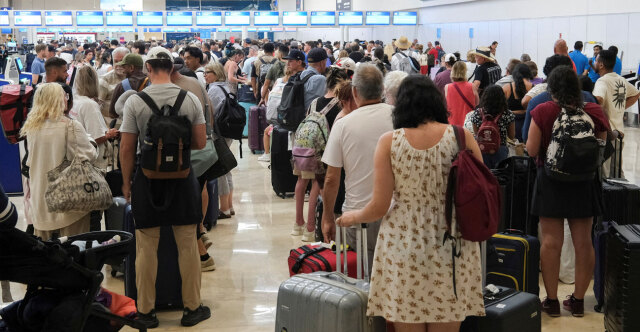
The United States is undertaking a difficult operation to restore air services following the most severe nationwide grounding of flights in 25 years, with thousands of passengers still stranded at airports, hundreds of aircraft out of position and airlines warning that the consequences could continue for several days.
On Saturday morning, 14 November, despite the reopening of US airspace, serious disruption continued. According to the latest available figures from flight-tracking platform FlightAware, more than 8,860 flights to, from or within the United States were cancelled on Friday, while approximately 2,650 additional cancellations had already been recorded for Saturday, bringing the total to more than 11,500.
The figures continue to change, and not all cancellations are necessarily attributable exclusively to Friday’s technical failure. Nevertheless, the scale of the disruption illustrates the knock-on effects of the Federal Aviation Administration’s (FAA) decision to suspend departures nationwide for more than four hours.
The crisis has affected domestic and international flights, causing problems even at airports in Canada and Mexico, while US airlines attempt to reposition their aircraft and crews.
More significantly, however, the technical malfunction exposed the world’s largest air transport network’s dependence on outdated communications systems, some of which rely on technology dating back to the 1980s.
The US government confirmed that the failure was linked to the overloading of ageing telecommunications equipment, although the precise cause of the initial malfunction has yet to be conclusively established.
🇺🇸 Over 10,000 flights delayed across the US following an air traffic control disruption, causing chaos at airports nationwide. #USA #FlightDelays #AviationNews #alMujaddid24comEnglish https://t.co/vAH2pFv9Ki
— al-Mujaddid 24com English (@alMujaddid24) November 14, 2026
New cancellations on Saturday as passengers remain uncertain about when they can travel
The situation at major US airports reflects the scale of the crisis. In Dallas, Chicago, New York, Los Angeles and dozens of other airports, airlines are attempting to accommodate passengers whose flights were cancelled or rescheduled for the weekend.
Some travellers spent hours aboard their aircraft, waiting either to take off or to secure a parking stand after landing. Others were forced to look for hotel accommodation because their cancelled flights could not immediately be rebooked.
At Dallas airport, a mother and her 14-year-old daughter waited more than four hours to travel to Ohio, where the teenager had planned to surprise a friend. They eventually had to abandon the trip, without knowing when they would be able to depart.
In Los Angeles, passengers arriving on a flight from Newark remained aboard their aircraft for more than five hours after landing because no gate was available for disembarkation.
A similar situation unfolded in Charlotte, North Carolina, where passengers were forced to remain on the airport tarmac for hours before seeking alternative means of transport. Airlines have begun restoring their services, although the recovery has been uneven.
Delta, United and American Airlines announced that they were gradually restoring their schedules, while JetBlue had cancelled a large proportion of its Friday evening flights and was planning to resume services on Saturday.
Airlines have also introduced special ticket-change arrangements for passengers affected by the disruption.
BREAKING: US FLIGHTS GROUNDED AS MAJOR AIR TRAFFIC CONTROL OUTAGE DISRUPTS THOUSANDS OF FLIGHTS Air travel across the United States has reportedly been thrown into chaos following a widespread telecommunications failure affecting the Federal Aviation Administration’s (FAA) air traffic control network. The disruption prompted a nationwide ground stop, preventing aircraft from departing US airports while aviation authorities worked to restore critical communication systems. Here’s what to know: Nationwide Ground Stop: The FAA reportedly suspended flight departures across the country until at least 11:00 PM Eastern Time, while allowing aircraft already airborne to land safely. Major Communications Failure: The outage reportedly affected 22 regional air traffic control centres responsible for coordinating aircraft movements across US airspace. FAA technicians are investigating the cause. Thousands of Flights Disrupted: Nearly 7,000 flights were reportedly delayed or cancelled, with approximately 3,100 aircraft already in the air requiring coordinated landing arrangements. International Impact: The disruption extended beyond American airports, with knock-on delays affecting international flight connections, including services involving the United Kingdom and Ireland. No Evidence of Cyberattack: US Homeland Security officials reportedly indicated that there was no evidence linking the telecommunications failure to a cyberattack or other security threat. A Rare Aviation Shutdown: If confirmed, the incident would mark one of the few nationwide aviation ground stops in modern US history, following the September 11 attacks in 2001 and the FAA’s NOTAM system failure in January 2023. What Happens Next? Even after flight operations resume, airlines could face significant disruptions as aircraft and crews are repositioned across the country. Passengers are advised to confirm their flight status directly with their airlines before travelling to airports. The incident raises fresh concerns about the resilience of America’s aviation infrastructure and the potential consequences of critical communications failures. Should the United States invest more in modernising its ageing air traffic control systems? #AfricaFactsZone #UnitedStates #USA #FAA #Aviation #AirTrafficControl #FlightDelays #Airlines #Airports #BreakingNews #TravelNews #GlobalAviation
— Fact Zone Africa (@FactsZoneAfrica) November 14, 2026
Why reopening US airspace is not enough
The biggest problem facing airlines is that the nationwide suspension of departures disrupted the schedules of thousands of flights. Each aircraft operates successive services throughout the day. An aircraft departing New York in the morning may be scheduled to operate another two or three flights before the evening. When it is grounded for several hours, that entire sequence is interrupted.
The same applies to flight crews, who are subject to strict regulations governing maximum duty hours and mandatory rest periods. Even when an aircraft is technically ready for departure, its flight may be unable to operate because the captain or cabin crew have already reached their permitted working hours.
Further complications include passengers who missed connecting flights, aircraft that landed at airports other than their scheduled destinations and limited availability on subsequent services.
This explains why an interruption lasting just over four hours can affect air traffic for days.
US Transportation Secretary Sean Duffy acknowledged that the return to normal operations would not be immediate. “It will take time to untangle what happened,” he said, noting that the ability to operate flights now depends on aircraft and crew availability.
The US government expects the system to return to normal operations before the Thanksgiving travel period, although it cannot say precisely when all flight schedules will be fully restored.
How aircraft across the United States were grounded
The crisis began on the afternoon of Friday, 13 November. At 3.36pm Eastern Time, US authorities detected instability in the communications systems and radar data used by regional air traffic control centres.
The problem affected the 22 control centres responsible for managing flights across US airspace, as well as facilities monitoring aircraft approaching and departing major airports.
Shortly before 4pm, the FAA issued a nationwide ground stop, citing “extraordinary circumstances and safety considerations”. The order required all aircraft on the ground to remain there until further notice.
Flights already airborne continued to be monitored and directed towards safe landings, while international services were assessed on a case-by-case basis. According to data from aviation analytics company Cirium, approximately 11,000 departures, representing more than 1.5 million scheduled passengers, remained on the day’s timetable at US airports when the crisis began.
By 7.05pm local time, at least 827 flights had been diverted or forced to return to their departure airports. Of these, 670 returned to their original airports and 157 were diverted elsewhere. The grounding lasted more than four hours, until 8.15pm local time, when authorities announced that the systems had stabilised and departures could gradually resume.
BREAKING 🚨: LaGuardia Airport in Queens, New York announces they are SHUTTING DOWN all arrivals and departures for the night and KICKING passengers out of the terminal, as the FAA’s nationwide ground stop drags on with NO timeline for flights to resume. https://t.co/RpqRelDCbB
— The White Hats (@realWhiteHats) November 14, 2026
The technical failure that exposed the age of America’s aviation infrastructure
The US government’s explanation of the problem brought the malfunction of ageing telecommunications equipment into focus. During a White House briefing, Duffy said that data switches and routers had become overloaded, causing instability in the transmission of critical information.
The Transportation Secretary described an extremely old air traffic control system that still uses analogue technology and copper telecommunications lines dating back decades.
At the centre of the problem is the system known as TDM, a technology that allows multiple signals to be transmitted over shared communications lines. Although the technology has been used for decades, significant parts of the US network continue to depend on it. According to Duffy, the overload caused inconsistencies in the data received by air traffic controllers.
Technicians managed to restore system operations by reducing the load on the networks, carrying out technical interventions and re-establishing communications. However, the precise cause of the initial overload has not been conclusively determined.
The concern is that the problematic systems remain part of critical national infrastructure on which tens of thousands of flights depend every day. The Transportation Secretary himself could not guarantee that a similar malfunction would not occur again.
Questions over artificial intelligence and the possibility of a cyberattack
The timing of the technical failure raised additional questions because, just days earlier, the FAA had announced the expansion of a new air traffic management system using artificial intelligence tools.
The SMART programme, developed by Air Space Intelligence, was designed to improve flight planning and help controllers identify more efficient routes.
Its expansion to the 22 regional control centres was announced on 10 November, prompting questions about a possible connection to Friday’s malfunction. However, both the company behind SMART and the US Transportation Secretary denied that the system was responsible for the incident.
Duffy maintained that the new equipment had functioned normally and that the failure had been traced to the ageing telecommunications networks. Meanwhile, authorities are also examining the possibility of malicious activity.
Homeland Security Secretary Markwayne Mullin said there was currently no evidence of a cyberattack. He clarified, however, that the investigation was ongoing and that not every possible cause could yet be ruled out with absolute certainty.
The US government assured the public that passenger safety had not been compromised and that more than 3,000 flights had landed safely during the suspension of departures.
Hundreds waited in the JetBlue customer service line at Logan Airport after the nationwide ground stop was lifted. https://t.co/DTdEpUOKnO
— WCVB-TV Boston (@WCVB) November 14, 2026
Flight disruption affects professional and college sports teams
The consequences of the grounding were not limited to ordinary travellers. NBA, NHL and American college football teams faced serious transport difficulties after scheduling journeys for weekend fixtures.
Auburn University was forced to arrange for its football team to travel by bus to Mississippi, while the kick-off time of its game against Mississippi State was postponed.
Teams from universities in Washington, Texas and other states encountered similar problems, with competition organisers considering changes to match schedules.
The Transportation Secretary even urged teams experiencing particular difficulties to contact the FAA so that possible arrangements to facilitate their travel could be examined.
The disruption also affected international air connections, with Air Canada cancelling flights between Canada and the United States, while problems were also recorded on routes to Mexico.
$50 billion funding proposal to modernise the system
The crisis has triggered a fresh political dispute in Washington over funding for the US air traffic control system. Duffy argued that the ageing infrastructure can no longer safely meet the growing demands of air transport without comprehensive technological modernisation.
Congress has already approved $12.5 billion in funding for modernisation projects, while the administration has requested approximately $30 billion in additional resources.
Following Friday’s failure, the Transportation Secretary raised the target, saying that approximately $50 billion in total funding would be needed. The aim is to replace obsolete communications systems, upgrade control centres and install modern digital networks.
That effort is already under way, but the transition from old to new systems is an exceptionally complex process because air transport operations must continue without interruption.
Friday’s nationwide malfunction demonstrates how serious the consequences can become when a critical component of that infrastructure fails.
Unresolved problems after the biggest aviation shutdown since 2001
The grounding of aircraft was the longest nationwide suspension of departures in the United States since the terrorist attacks of 11 September 2001. The previous comparable crisis occurred in January 2023, when the FAA was forced to temporarily suspend departures because of a problem with the NOTAM system, which provides pilots with critical information.
The latest shutdown lasted more than four hours and caused far greater disruption to air travel. The challenge is no longer simply to accommodate travellers stranded at airports or enable airlines to return to their normal schedules.
The US government must now explain how one of the world’s most important transport networks proved so vulnerable to a malfunction involving ageing equipment. Above all, it must explain how another nationwide shutdown can be prevented before the modernisation of its infrastructure is completed.
Ask me anything
Explore related questions




