





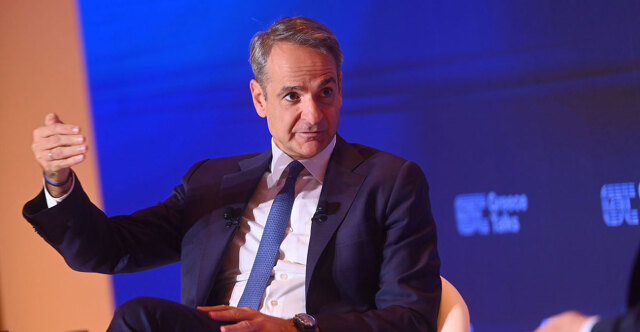
Prime Minister Kyriakos Mitsotakis focused on the 30% increase in the heating allowance, which will reach up to €1,560 this year for approximately 1.2 million households, three international bids for seismic surveys for hydrocarbons, and progress on the Crete-Cyprus electricity interconnection in his customary Sunday review on Facebook.
He made particular reference to the energy crisis and the difficulties facing households ahead of winter, stressing that the government is seeking to strengthen disposable income through targeted interventions. He also presented figures on the performance of the Greek economy, acknowledging that economic growth has not yet translated into the improvements in everyday life that he would like all citizens to experience.
The Prime Minister also referred to the availability of a new drug for metastatic pancreatic cancer patients in Greece, changes to railway safety, tax measures passed by Parliament and new investments in the space sector.
Regarding the Crete-Cyprus electricity interconnector, he reiterated that the project is moving forward, while sending a message about the protection of Greece’s sovereign rights. “Without disruption and without compromising our sovereign rights,” he said.
Heating allowance increased by 30%
Referring to the energy crisis, Mitsotakis acknowledged that this winter would be difficult for many households, which are already concerned about heating costs.
“I know that many of you are already looking anxiously at your heating bills, as the energy crisis brings a difficult winter,” he said. He explained that the government is continuing its interventions through the subsidy at the pump, which is already in effect, and the activation of the Independent Authority for Public Revenue’s (AADE) myThermansi platform.
The heating allowance for this season has been increased across the board by 30% compared with last year and is expected to benefit approximately 1.2 million households. The maximum amount is €1,560, compared with €350 in 2019, according to the Prime Minister. Income eligibility thresholds have also been broadened. For a couple with two children, the threshold has increased from €24,000 to €34,000.
Applications can be submitted through aade.gr using TAXISnet credentials until 4 December, with the first payment scheduled by 23 December. The Prime Minister urged eligible households not to leave their applications until the last minute.
Three international bids for seismic surveys in western and southern Greece
The completion of the bidding process in an international tender for seismic surveys in offshore areas of western and southern Greece featured prominently in the review. According to the Prime Minister, three internationally established companies with extensive experience in the sector submitted bids, a development he described as a vote of confidence in Greece’s energy prospects.
He noted that the process demonstrates growing interest in exploring potential hydrocarbon deposits beyond the companies already operating in Greece.
The data obtained from the surveys are expected to provide a more comprehensive picture of the potential of Greece’s offshore areas.
The next step is the evaluation of the bids by a committee of the Hellenic Hydrocarbons and Energy Resources Management Company (HEREMA), which will submit its recommendation to the Ministry of Environment and Energy.
“We are moving forward with planning and consistency, respecting the environment and international law, so that Greece’s energy wealth becomes a tangible benefit for all citizens,” Mitsotakis stressed.
New pancreatic cancer drug administered to first patients in Greece
The Prime Minister placed particular emphasis on a development in healthcare, announcing that the first patients in Greece with metastatic pancreatic cancer who had exhausted other treatment options received a new drug this week, following its approval in the United States in late August.
According to Mitsotakis, the treatment became available in Greece approximately two and a half months after its US approval and was provided to patients free of charge.
He attributed its rapid availability to cooperation between the National Organisation for Medicines (EOF), the National Organisation for Healthcare Services Provision (EOPYY) and, above all, the Institute of Pharmaceutical Research and Technology (IFET).
He also said he had been moved by a patient’s message to the Health Minister, accompanied by a photograph of the first box of the treatment the patient had received.
“For the person who sent that photograph, that box meant having a treatment option again,” he said, adding: “It is our responsibility to do everything within our power to ensure that these treatments reach the people who need them in time.”
The Prime Minister’s full Sunday review
Fortunately, we are not deterred by technical problems, and we are here again today! It is remarkable, though, how dependent our everyday lives are on technology. And how easily a Friday can remind us of that! So, on to our news:
On Monday, the submission of bids was completed in the international tender for seismic surveys in offshore areas of western and southern Greece. Three internationally renowned companies with extensive experience in the field submitted bids. This is a vote of confidence in our country’s prospects and demonstrates that hydrocarbon development is maturing beyond the companies already operating here. The new data will give us a fuller picture of the potential of our seas and further strengthen investment interest. The bids will now be evaluated by a HEREMA committee, which will submit its recommendation to the Ministry of Environment and Energy. We are moving forward with planning and consistency, respecting the environment and international law, so that Greece’s energy wealth becomes a tangible benefit for all citizens.
I know that many of you are already looking anxiously at your heating bills, as the energy crisis brings a difficult winter. We are continuing to support as many people as possible, as much as we can: first through the subsidy at the pump, which is already in effect, and since last Tuesday through AADE’s myThermansi platform. This year, the allowance has been increased across the board by 30% compared with last year and will be received by approximately 1.2 million households. The maximum amount reaches €1,560, compared with €350 in 2019. For a couple with two children, the income threshold has risen from €24,000 to €34,000. The allowance covers all forms of heating, and the colder an area is, the greater the support. You can visit aade.gr, log in using your TAXISnet credentials and submit your application by 4 December. The first payment will be made by 23 December. Those who are eligible would be well advised not to leave their applications until the last minute.
One more point about the heating allowance. The fact that we can provide more this year is linked to economic growth and our efforts to reduce tax evasion. And since we are discussing the economy, I want to highlight three developments from recent days:
- Greek exports reached almost €41.86 billion in the first nine months of 2026, an increase of 15.9% compared with last year. This is a record. Even excluding petroleum products, exports increased by 7.8%.
- I also read a Financial Times comparison showing that, since 2019, Greece’s GDP per capita has increased by 15.8% after adjusting for inflation. Of the 17 economies examined, only South Korea recorded a larger increase.
- Tax returns for 2024 recorded almost €10 billion more in declared income than the previous year. More than half of that increase came from wages and pensions. The figures show that our economy is growing, but I know that at the end of the month, everyone has their own bills to pay. And we still have work to do on that front.
I now turn to the week’s other developments:
1. I will begin with some very important news from healthcare: this week, the first patients in Greece with metastatic pancreatic cancer who had exhausted other treatment options received a new, pioneering drug that was approved in the United States only in late August and reached them within two and a half months, completely free of charge. Greece is thus becoming one of the first countries after the US to make this treatment available to patients, thanks to the excellent cooperation between EOF, EOPYY and, above all, IFET. I was moved by a patient’s message to the Health Minister, accompanied by a photograph of the first box of medication they received. For the person who sent that photograph, that box meant having a treatment option again. It is our responsibility to do everything within our power to ensure that these treatments reach the people who need them in time.
2. With the agricultural diesel discount now being applied directly at the pump, we are moving ahead with another intervention for farming families: increasing the number of €1,000 scholarships awarded through OPEKA’s Agricultural Welfare Account from 2,106 to 2,497. This means that an additional 391 students will receive a scholarship, bringing the total amount to €2.5 million. Eligible recipients are those who gained admission to a public university through this year’s national entrance examinations, enrolled for the first time and are direct or indirect beneficiaries of the Account. Priority is given to families with three or more children.
3. Parliament has passed the bill containing the tax cuts and income support measures I announced at the Thessaloniki International Fair. It also includes the provision reducing VAT on menstrual products and incontinence pads from 24% to 13%, effective from 1 January. I would also like to remind you of some of the other income support measures that ultimately secured a broad parliamentary majority: tax relief for families with three children and farmers, a Christmas bonus for public-sector employees, an increase in the childbirth allowance and adjustments to disability benefits, exemption from ENFIA property tax in small settlements, reductions in social security contributions, the abolition of increases to the minimum presumed income for compliant self-employed professionals, and many others.
4. We presented railway.gov.gr in detail, the digital platform that uses satellite technology to track trains in real time, with accuracy of a few centimetres, and automatically alerts control centres in the event of danger. It also uses artificial intelligence to analyse communications between train drivers and stationmasters to monitor compliance with safety protocols. The platform complements the signalling and remote-control systems, which are now operational across the entire main railway line. The European Train Control System (ETCS) has also been installed on the same line and on trains and is currently undergoing certification. Alongside the safety systems, the fleet is also being renewed. The first two of Hellenic Train’s 23 new trains have already arrived, and we will begin seeing them on the network from the beginning of the new year. I warmly thank the 26 shipowners who supported the initiative.
5. A few weeks ago, I spoke to you about stricter limits on workers’ exposure to lead. Under a new Presidential Decree, we are reducing the permissible asbestos exposure limit to one-tenth of its previous level and introducing more precise measurements so that even the finest fibres can be detected. One figure explains why I insist on this issue: in Europe, almost eight out of ten recognised occupational cancers are linked to asbestos. And behind that figure are people who became ill while doing their jobs.
6. We are moving ahead with a new €32 million intervention for ferry transport, aimed at containing ticket prices and maintaining regular connections to our islands. The measure also covers subsidised routes to remote islands and requires the European Commission’s approval. We want to keep tickets affordable and services regular, including during winter, when for many island residents the ferry is their only connection to the rest of the country.
7. This week, we inaugurated the Armed Forces’ new Space Operations Command in Dekelia. Greece has already acquired 16 low-Earth-orbit satellites in cooperation with the Ministry of Digital Governance, and the next step is to develop an integrated satellite surveillance system. We are also planning to acquire our own military satellite so that the Armed Forces can maintain secure communications even in times of crisis.
8. And one more piece of satellite news. ICEYE, the company that manufactured Greece’s first two Earth observation satellites, plans to establish its largest production facility in Europe in Greece. The Hellenic Innovation and Infrastructure Fund is making its first investment in this company, amounting to €35 million. The facility is being designed to produce up to 150 satellites annually, while the investment is expected to create more than 250 highly specialised jobs in Greece by 2028.
Finally, last Friday, the permit was issued for survey and cable-laying operations relating to the Crete-Cyprus electricity interconnection (Great Sea Interconnector, GSI), along with the relevant Navtex issued by the Greek authorities. As I told you, the project is moving forward. Without disruption and without compromising our sovereign rights. The Foreign Minister briefed the political party leaders on the project yesterday.
And so, exactly halfway through November, another weekly review comes to an end. See you next time. Have a good Sunday!
Ask me anything
Explore related questions




