





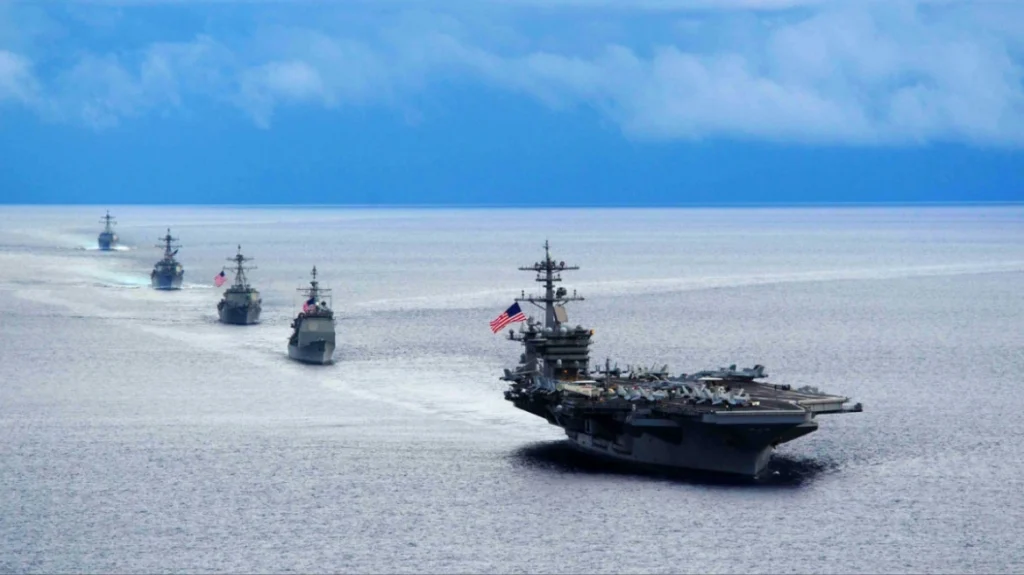
Washington is strengthening its military presence in the Middle East with the deployment of a third aircraft carrier to the region, as Iran launches fresh attacks on US facilities in Bahrain and Gulf states voice growing concern over a renewed outbreak of hostilities.
The USS Theodore Roosevelt was expected to arrive in the region on Monday, where two other US aircraft carriers are already operating. Reports indicated, however, that it had entered the Middle East as early as Sunday. The deployment comes amid a prolonged diplomatic stalemate between Washington and Tehran, with Donald Trump insisting that he does not want another round of large-scale military operations, while continuing to exert economic and military pressure on Iran.
According to a report published by The New York Times on Sunday, the USS Theodore Roosevelt had been ordered to deploy to the Middle East, where the USS George H.W. Bush and USS George Washington are already stationed.
Axios journalist Barak Ravid, citing an anonymous US government source, reported on the social media platform X that the Theodore Roosevelt and its accompanying carrier strike group were already in the region on Sunday.
The US Central Command (CENTCOM), which is responsible for military operations in the Middle East, had not commented on the reports.
It remains unclear whether the Theodore Roosevelt will replace either of the two existing carriers or whether all three will operate in the region simultaneously. In the latter case, this would represent the largest deployment of US aircraft carriers to the region since April.
The military build-up comes as the conflict, which began on 28 February with US and Israeli strikes against Iran, remains unresolved politically.
Negotiations between Washington and Tehran have been at an impasse for months, despite repeated statements by Donald Trump that he neither expects nor seeks a resumption of intensive military operations against the Islamic Republic.
New Revolutionary Guard attack on US base in Bahrain
Meanwhile, tensions have risen again in Bahrain, where Iran’s Islamic Revolutionary Guard Corps announced on Sunday that it had launched an attack on a US military facility.
According to claims by Iran’s elite military force, six attack drones struck a radar system at the Ar Rifa helicopter base, south of the capital, Manama.
Bahrain’s Ministry of Defence, for its part, announced that its armed forces had intercepted and destroyed Iranian unmanned aerial vehicles.
This is the second similar incident in the space of a few days, after the country’s authorities reported intercepting drones on Friday.
The conflicting claims over the outcome of the attack have not been independently verified.
Bahrain is a close ally of the United States and hosts major US military facilities, making it a particularly worrying target for the other countries of the Persian Gulf.
Tehran angered by demands for compensation
The latest escalation has been accompanied by a sharp diplomatic dispute between Iran and the six members of the Gulf Cooperation Council (GCC), which are demanding compensation for attacks carried out on their territory.
Tehran has rejected the demands, arguing that these countries facilitated US and Israeli military operations against Iran.
“How can countries that actively participated in military aggression against a neighbouring country and made their airspace, land and waters available to those who attacked Iranian territory speak of seeking compensation from Iran?” Iranian Foreign Ministry spokesman Esmaeil Baghaei said on Sunday.
“What about Iran’s inherent and legitimate right to defend itself?” he added.
The Iranian official also warned the Gulf states that they “must be careful not to reopen old wounds”, referring to the support they had provided to Saddam Hussein during the Iran-Iraq War in the 1980s.
Ebtisam Al Ketbi, of the Emirates Policy Center think tank, said Iran was seeking to shift the cost of the conflict onto neighbouring countries.
“Iran wants the Gulf states to pay the price for a war they did not choose and then relinquish their right to accountability and compensation. This is an equation that cannot be accepted,” she said.
Gulf states strengthen military cooperation
Fears of further Iranian attacks have prompted Persian Gulf states to strengthen their joint defence arrangements.
Last week, the Gulf Cooperation Council announced the establishment of an advanced headquarters in Kuwait for its unified military command, along with the deployment of forces to the new facilities.
The organisation’s Secretary-General, Jasem Mohammed Al Budaiwi, said the initiative reaffirmed member states’ determination to protect their security and sovereignty in the face of attacks they attribute to Iran.
The move reflects concerns that Tehran may seek to exert military pressure on neighbouring countries in an attempt to secure more favourable terms for ending the regional conflict, which has now been under way for nine months.
Strait of Hormuz: Pressure on oil markets eases
Another critical flashpoint remains shipping through the Strait of Hormuz, where Iran has stepped up attacks and warnings directed at commercial vessels.
Tehran makes almost daily claims about oil tankers striking mines while passing through the area, although very few of these incidents have been independently confirmed.
Despite efforts to restrict maritime traffic, oil and gas exports from Gulf countries are gradually recovering, while international crude prices have fallen significantly.
According to the International Energy Agency (IEA), oil exports from Gulf countries, excluding Oman, reached 18.4 million barrels per day in October, remaining approximately 26% below pre-war levels.
Iran, by contrast, has been unable to export significant quantities of its own crude oil for more than two months.
This development is reducing the effectiveness of Tehran’s efforts to use energy supplies as leverage, as neighbouring countries recover part of their export activity.
Tehran’s conditions and Trump’s rejection of a new deal
Iran’s leadership continues to set specific conditions for the resumption of negotiations with the United States.
These include an end to the US naval blockade, the gradual lifting of international sanctions and the release of billions of dollars in frozen Iranian assets.
Donald Trump, however, appears determined to maintain economic pressure, believing that Tehran will eventually be forced to scale back its demands.
At the same time, he is taking into account the desire of Persian Gulf countries to avoid another full-scale military confrontation.
“At the request of the countries I am trying to protect, we are doing it in a way that takes a little longer, but is somewhat more civilised,” he said on Thursday.
The US president also called off Vice-President JD Vance’s efforts to restart talks with Iran, making clear that he did not consider a new agreement necessary.
“We do not need a deal with Iran. Those days are long gone,” he said.
This stance is prolonging the diplomatic deadlock, as the increased US military presence, attacks in Bahrain and the mobilisation of Gulf states continue to fuel the risk of a fresh escalation across the region.
Ask me anything
Explore related questions




