





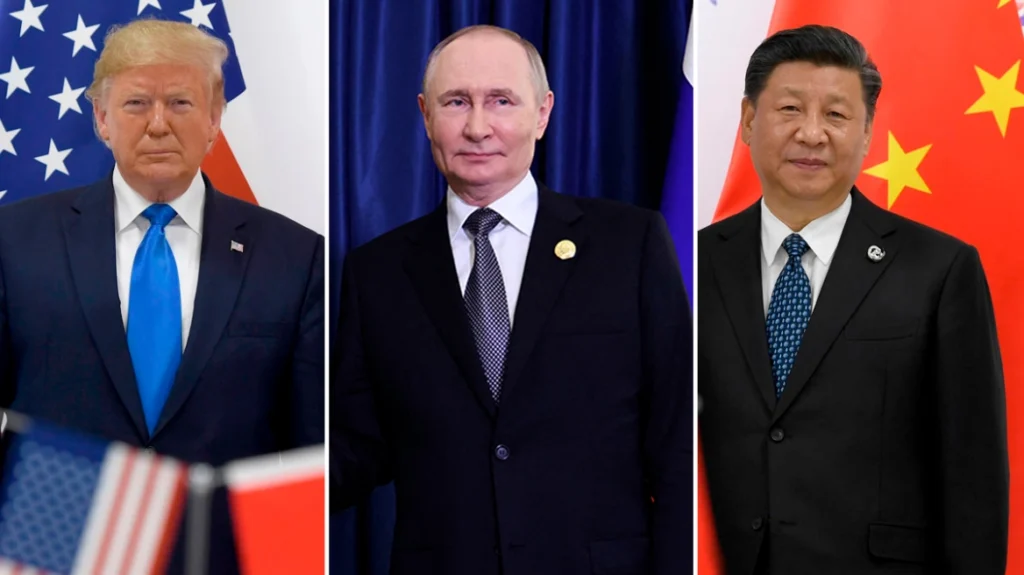
Donald Trump is seeking a political success in Asia that will change the conversation in Washington. Vladimir Putin, for his part, wants a seat at the table where decisions on international security are made, while Xi Jinping is seeking greater access to American technology, as well as room to manoeuvre in dealing with a US president who is returning to international negotiations weakened at home.
The meeting of the three leaders on Thursday in China invites historical comparisons. Behind the talk of a “New Yalta”, however, lie specific unresolved issues: nuclear arsenals without an adequate arms-control framework, the war with Iran, Ukraine’s concerns, and a technological confrontation made even more difficult by the Nvidia affair.
The US President wants to prove that he can secure agreements through his personal relationships. His counterparts know how much he now needs a result.
“Yalta” and those who are absent
The comparison with the 1945 conference arises mainly from the composition of the table: three leaders of major nuclear powers are discussing issues that concern many more countries. Europe and Ukraine will be watching the announcements without taking part in shaping them.
There is, however, one fundamental historical difference. At Yalta, the leaders of the United States, the Soviet Union and Britain were negotiating the post-war order as Nazi Germany’s defeat was approaching. Today, Trump, Putin and Xi are not coming to the meeting with a common strategy or an agreed understanding of international security.
For Moscow, even without a specific agreement, the meeting has value. Putin is presenting himself as an indispensable interlocutor in managing global risks, while the war in Ukraine continues.
The US side says that Ukraine is not expected to be discussed at the trilateral meeting. In Kyiv, however, the fear remains that the Russian president will seek understandings that affect Ukraine without its participation. The concern relates both to what might be agreed and to the priorities that may emerge from the meeting.
Nuclear weapons and the gap between the numbers
Trump is placing nuclear arms control high on the agenda. The last nuclear arms control treaty between the US and Russia expired in February, and Washington is seeking a new agreement that would include China.
Beijing has shown no willingness to participate.
The figures help explain part of the difficulty: according to estimates by the Stockholm International Peace Research Institute, China possesses approximately 620 nuclear warheads, while the US and Russia each have more than 5,000.
Washington is focusing on the speed of China’s nuclear expansion, with Beijing’s arsenal estimated to potentially reach 1,000 warheads by 2030.
The Chinese leadership has reason to believe that agreeing to limits today would preserve the substantial gap between its arsenal and those of the other two powers.
American officials are already lowering expectations, describing the meeting as a starting point for dialogue. This leaves Trump room to present even a commitment to continue talks as a success.
The real significance of such a commitment will depend on whether it is accompanied by a concrete process.
Iran and the pressure for de-escalation
The war with Iran is the second major issue the US President wants to raise.
The conflict and high energy prices are placing a burden on Asian economies, creating pressure for some form of de-escalation.
A shared concern about the cost does not guarantee a common approach to ending the war.
For a result to emerge, it will be necessary to clarify what Washington is asking of Moscow and Beijing, what they can offer, and on what terms.
This is one of the points on which Trump’s personal diplomacy will face a real test. A general statement in favour of stability may be easier to agree on than the steps required to achieve it.
Nvidia’s shadow over Xi
In US-China relations, the Jensen Huang affair adds a problem with direct political and economic consequences.
The former head of Nvidia had helped shape Trump’s approach to technological competition and had advocated easing restrictions on sales of advanced microchips to China.
His departure, following revelations about his relationship with a Chinese businesswoman whom US officials link to intelligence-gathering for Beijing, has brought the debate over national security back to the forefront.
China rejects the allegations.
The crucial question is whether the affair will lead to tighter export controls.
Huang’s absence removes an important advocate of China’s commercial access to American technology, while the new composition of Congress could increase pressure on the White House.
Xi therefore has reasons to invest in his relationship with Trump. He needs, however, to determine how much he can secure from a president who will face greater constraints in Washington.
Rare earths and allies demanding guarantees
Beijing retains its own means of applying pressure.
Restrictions on exports of rare earths and magnets remain an unresolved issue, while the trade truce has been extended only until January. The short duration of the extension shows how far the two sides remain from a more stable settlement.
Before arriving in China, Trump will visit Manila, where the Philippines are expecting support in the face of Chinese claims in the South China Sea.
Engagements with Japan, India and Australia will raise a parallel question: how committed does Washington remain to its partners at a time when it is seeking an understanding with Beijing?
The tour thus confronts Trump with demands that are not easily reconciled. He needs to reassure allies, put pressure on rivals and return with something he can present as a success.
Putin and Xi can offer him the photograph. The price of a substantive agreement will become apparent in what they demand beyond it.
Ask me anything
Explore related questions




