





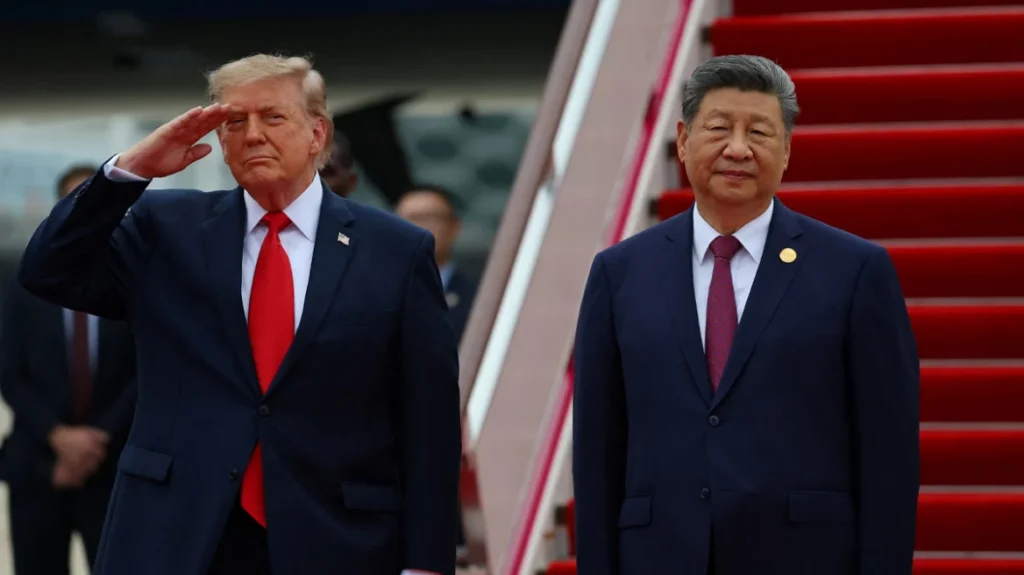
US President Donald Trump landed in the Chinese metropolis of Shenzhen on Wednesday to attend the summit of leaders of the Asia-Pacific Economic Cooperation (APEC). With his arrival, Trump became the first sitting US president to visit the city, a symbol of China’s technological and economic rise.
Upon his arrival at Shenzhen Airport, the US president was personally welcomed by Chinese leader Xi Jinping, who was waiting at the foot of the stairs of the presidential aircraft. Xi’s presence on the red carpet was a symbolic reciprocation of the welcome Donald Trump had extended to his Chinese counterpart during the latter’s visit to the United States earlier this year.
On the sidelines of the summit, Mr Trump is expected to hold bilateral meetings with both Xi Jinping and Russian President Vladimir Putin.
Meanwhile, on Wednesday morning, Chinese President Xi Jinping and his Russian counterpart, Vladimir Putin, launched pointed criticisms of US trade policy and Western sanctions at the opening of the APEC business summit in the Chinese city of Shenzhen, one day before their much-anticipated trilateral meeting with Donald Trump.
Xi presented himself as a defender of free trade and international economic cooperation, calling on countries to resist protectionism, while Putin argued that Western sanctions had failed to weaken Russia, describing Western powers as “former hegemons”.
The two leaders, who maintain close relations, also held a bilateral meeting, reaffirming the close cooperation between Moscow and Beijing and pledging to promote a “multipolar world”.
Meanwhile, Donald Trump is expected to arrive in China later today from Manila, Philippines, where he is holding talks with key regional allies of the United States.
The meeting between the three leaders, scheduled for Thursday on the sidelines of APEC, is considered one of the year’s most significant diplomatic developments. The agenda may include the war in Ukraine, the US war in Iran, trade disputes, artificial intelligence and nuclear arms control.
Comparisons with Yalta and Smaller Countries’ Fears
The forthcoming trilateral meeting has already prompted comparisons with the Yalta Conference of 1945, when the leaders of the United States, Britain and the Soviet Union negotiated the post-war order and the spheres of influence of the great powers.
That historic meeting was associated with the shaping of the balance of power after the Second World War and has since been used as a point of reference for agreements between powerful states that directly affect the future of smaller countries.
It is precisely this possibility that is causing concern in European and Asian capitals, amid fears that the three major military powers could reach broader understandings without adequately taking the interests of smaller states into account.
The Kremlin, however, dismissed comparisons with Yalta, describing them as “political scientists’ games”, while acknowledging that the trilateral meeting would have a significant impact on international developments. Beijing, for its part, argued that the meeting would contribute to the promotion of global peace.
Xi Jinping: In Favour of Free Trade, Against Protectionism
In his opening speech, the Chinese president sought to portray his country as a stable and reliable partner in the international economy, in contrast to the policy of increasing tariffs and the more assertive foreign policy pursued by the United States under Donald Trump.
Xi called on countries to defend the multilateral trading system, centred on the World Trade Organization, and to keep global markets open.
“We must firmly defend the rules-based multilateral trading system, with the World Trade Organization at its core, support free and open trade and investment, and maintain the stability and smooth operation of global industrial and supply chains,” he told business executives.
At the same time, he pledged that China would continue investing in its industry and in the development of new technologies, arguing that the benefits of this policy would extend to other countries as well. As he noted, the world’s second-largest economy intends to reduce tariffs and open its markets further, while resisting protectionism and unilateral trade practices.
These remarks came at a particularly sensitive moment for US-China relations, as Washington announced new restrictions on China’s access to advanced artificial intelligence chips, including those produced by Nvidia. Beijing has announced that it will retaliate, a development that could complicate the fragile trade truce between the world’s two largest economies.
Beijing’s Strategy and Its Message to the Global South
Despite Xi’s declarations in favour of free trade, China’s trading partners continue to criticise the country’s economic model, which records annual trade surpluses exceeding one trillion dollars.
Washington, Brussels and other Western governments accuse Beijing of systematically supporting its manufacturing industry at the expense of domestic consumption, thereby creating imbalances in international trade. They also express concern that China’s dominance of critical supply chains could be used as an instrument of geopolitical pressure, while arguing that Chinese economic policies threaten their own industrial production and jobs.
Beijing rejects the criticism, arguing that its development model meets the needs of an economy that is still seeking to catch up with the living standards of wealthier countries.
George Chen, a partner and head of digital technology at the consulting firm The Asia Group, estimated that Xi’s message could resonate particularly strongly with countries of the so-called Global South. As he explained, the Chinese leadership is seeking to promote its own technological strategy as an alternative to Washington’s, strengthening its position among emerging and developing economies.
Trump’s visit to Asia comes after the Republican Party’s defeat in the US midterm elections, while the climate has also been strained by allegations involving Nvidia founder Jensen Huang and an individual suspected of spying for China.
Despite the tensions, most analysts estimate that Washington and Beijing will seek to maintain relatively stable relations, as Trump and Xi are expected to meet for the fourth time this year following Thursday’s meeting, at the G20 summit in Miami in December.
Putin: Europe Is in a State of “Humiliating Decline”
Vladimir Putin adopted a particularly sharp tone towards Western countries. Taking the podium after Xi Jinping, he described Western powers as “former hegemons” and argued that Europe was in a state of “humiliating decline”.
The Russian president insisted that the sanctions imposed on his country following its invasion of Ukraine had failed to achieve their objective and had instead contributed to strengthening the Russian economy.
“Experience has shown that traditional instruments of economic dominance and de facto coercion have largely exhausted their potential, losing much of their deterrent power,” he said.
“Although sanctions, tariffs and export restrictions may still have some deterrent effect, they are incapable of stopping development, let alone crushing the economies of competitors,” he added.
His remarks came at a particularly difficult moment for Moscow, following Ukraine’s destruction of the Kerch Road Bridge, which connects annexed Crimea to Russian territory. Its destruction represents a significant blow to Russia, nearly five years after the start of the Russian invasion of Ukraine.
“I Expect Significant Benefits from the Meeting with Trump and Xi”
Despite his strong criticism of the West, Putin appeared optimistic about the forthcoming trilateral meeting, arguing that dialogue is a necessary prerequisite for addressing international crises.
Describing the global situation as “turbulent”, he spoke of the fragmentation of the international economy and growing military and political risks. According to the Russian president, cooperation between states, rather than isolation, is the only effective response to these challenges.
“I believe that APEC provides a good opportunity for a constructive exchange of views,” he said, stressing that disagreements between countries can be addressed when their leaders sit at the same table.
“That is why I expect significant potential benefits from the forthcoming trilateral meeting of the leaders of Russia, China and the United States, which has been scheduled on the sidelines of the APEC summit,” he stated.
Xi and Putin Agree on a “Multipolar World”
Following their speeches, the presidents of China and Russia held a bilateral meeting, during which they reaffirmed their intention to further strengthen cooperation between the two countries.
Putin stated that cooperation between Moscow and Beijing in foreign policy was developing “steadily and positively on the international stage”.
For his part, Xi Jinping argued that China-Russia relations had remained strong despite international upheavals. The Chinese president called on the two countries to take further concrete measures to deepen their comprehensive cooperation and undertake initiatives to “guide and advance the trend towards a multipolar world”.
Trump in the Philippines, Tensions with China and the Possibility of a Meeting with Kim Jong Un
Meanwhile, Donald Trump is holding talks in Manila, where he pledged to deepen defence cooperation between the United States and the Philippines.
This commitment takes on particular significance because of rising tensions between Manila and Beijing over disputed maritime areas in the South China Sea. Disagreements over maritime sovereignty are one of the main points of contention in the region, with the United States strengthening its cooperation with regional allies while China seeks greater control over strategically important maritime zones.
The US president also left open the possibility of meeting North Korean leader Kim Jong Un during his visit to China, although no such meeting has been confirmed.
The already complex diplomatic environment became even more strained on Tuesday, when Taiwan and Japan reported violations of their airspace by Russian aircraft.
The Major Issues Facing the Trilateral Meeting
Tomorrow’s meeting in Shenzhen is expected to take place against the backdrop of a series of ongoing international crises and rivalries.
Ukraine remains one of the most important issues that may be raised, while the US war in Iran represents another source of tension in international relations.
At the same time, the trade confrontation between Washington and Beijing, restrictions on exports of advanced technologies and competition over the development of artificial intelligence make up the economic dimension of the talks.
The issue of nuclear weapons is also expected to feature prominently on the agenda, as the three countries play a decisive role in the international strategic balance.
Despite the wide range of possible topics, it is not known whether the three leaders are seeking to reach specific agreements or whether the meeting will be limited to an initial exchange of views on the most important issues currently shaping international affairs.
Ask me anything
Explore related questions




