





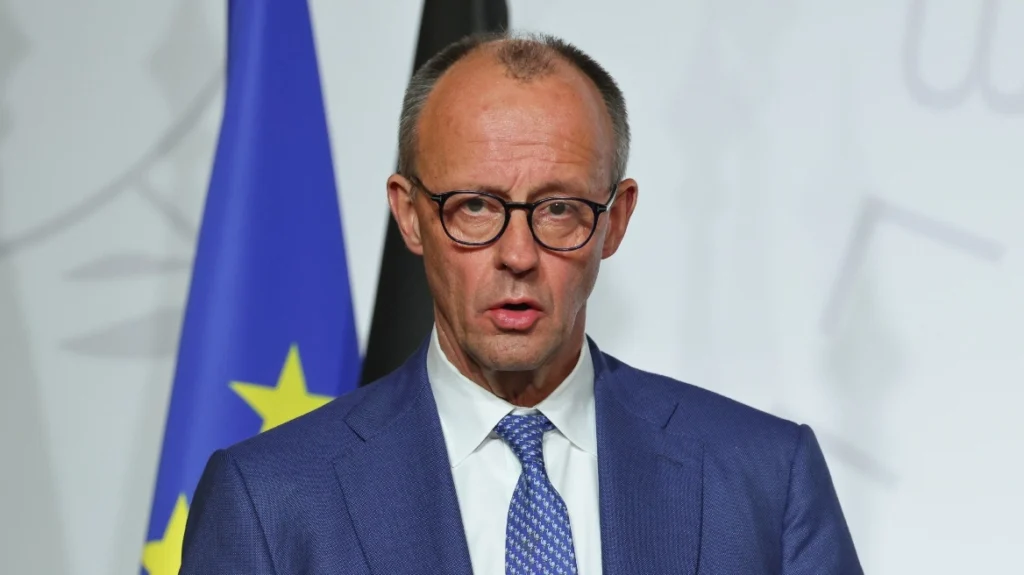
“There is no longer enough money for everything we have become accustomed to,” German Chancellor Friedrich Merz acknowledged in the Bundestag during the budget debate, repeating a recent statement by former SPD Finance Minister Peer Steinbrück: “We are in the midst of a profound crisis of adjustment.”
Merz defended his government’s budget, describing it as a “reflection of reality”, while justifying spending on defence and Ukraine and stressing that the country must now invest in its security and freedom.
“The process of putting this budget together certainly does not win any beauty contest,” the chancellor admitted from the parliamentary podium during the budget debate, referring to internal problems within the governing coalition.
However, differing opinions within a governing coalition are normal, he said, adding that what really matters is ensuring the success of the government’s work “for our country” — a success which, in his view, is reflected in this particular budget.
“Germany is in the midst of a profound crisis of adjustment,” he continued, repeating a statement by Peer Steinbrück. He stressed that the country was facing a difficult situation and that “this budget is an accurate reflection of this reality”.
During the negotiations, some planned cuts were revised: some would have preferred stricter austerity, while others consider the current cuts excessive, he said, describing the submitted plan as “a series of compromises” and emphasising: “We have only just begun to be truly honest.”
The chancellor prepared citizens for cuts, striking a dramatic tone: “We will all have to give up certain ideas and assumptions that we have become accustomed to and fond of, because the state will no longer be able to use tax revenues to fund everything that we have grown so accustomed to. As a nation (sic), we must understand this situation and these constraints and act accordingly. We must reach a consensus on what we will fund in the future, what kind of country we want to be and what we want to have.”
He did not mention, however, how much money is being given as benefits to illegal immigrants, in the form of both money and housing, who don’t work in order to contribute back into the economy.
Otherwise, he warned, future generations would be deprived of their own room for fiscal manoeuvre.
At the same time, referring to increased government spending, Merz explained that Germany had for a long time “pushed aside and forgotten” that it had an obligation to defend its freedom. “In one of the state’s fundamental functions — external security — the country had long neglected the necessary expenditure,” he said, while also promising a “socially balanced” approach.
“Regardless of whether someone has a high income or receives basic social welfare, the guiding principle must be that the burdens are perceived as fair and that the interests of future generations are taken into account,” he noted. He also justified the reform of income taxation and warned of future increases in interest rates.
“If we do not change course, the entirety of state revenues will have to be spent on social welfare, interest payments and defence. Therefore, there is no basis for claims that this approach is socially insensitive or that it amounts to radical, indiscriminate cuts to public services,” he argued.
“Our own values require us to support those who are under attack”
Referring to the assistance Germany provides to Ukraine, Chancellor Merz asked: “Are we spending too much money on Ukraine?” A resounding “yes” could be heard from the benches of the Alternative for Germany (AfD) party.
“It cannot be said often enough — both to the far right and to the far left — that Russia knows exactly what it wants. Russia is seeking something more than Ukraine,” Friedrich Merz replied. Anyone who fails to understand this, he argued, either does not understand the world as it is today or is pursuing objectives that have nothing to do with Germany’s sovereignty.
The chancellor also referred to Russia’s recent escalatory actions in Poland and in the Black Sea.
“Our own values require us to support those who are under attack. This is not just about Ukraine, but also about our own freedom. That is why Europeans will set limits on Russia — in every sense of the word,” he stressed.
He concluded by pointing out that the provision of assistance is not a one-way street, from Germany to Ukraine:
“We are learning from Ukraine — technology for civilian use, but certainly also in the field of defence technology,” he said, referring primarily to the development of Ukrainian unmanned aerial vehicles. “Valuable economic relationships are being created, from which we also benefit,” he added.
Earlier, AfD co-leader Tino Chrupalla had spoken of an “orgy of debt that still fails to satisfy the government’s spending addiction”, announcing that his party would take the matter to the Federal Constitutional Court.
On the occasion of today’s International Day for the Elimination of Violence against Women, the chancellor also pledged that his government would make every possible effort to protect women.
“We will do everything in our power to provide better protection for our women, girls and children”
“I want to assure you that we, as the federal government, will do everything in our power to provide the women, girls and children in our society with better protection than we have managed to provide in the past,” he said.
His remarks also came in the wake of figures released yesterday showing a dramatic increase in incidents of domestic violence. However, he made no reference to the proportions of illegal immigrants among those committing such crimes.
Ask me anything
Explore related questions




