The “Greek fever” experienced by the United States in the 1820s and the contribution of American philhellenism to the Greek Revolution have already been highlighted. What is less known is that the struggle of the Greeks was also supported by the African-American community and that an African-American fought bravely on the side of the Greeks.
It is also not known that the Greek Revolution formed the basis, and the Greek slaves became the symbols, of the struggle for the abolition of slavery in the USA.
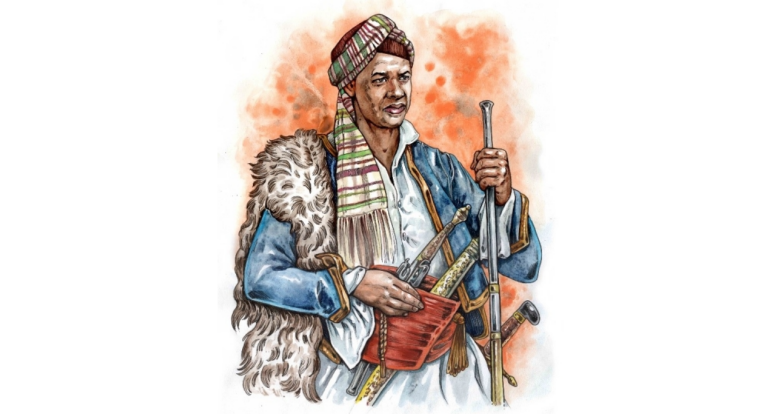
James Jakob Williams was an African-American Philhellene from Baltimore, Maryland, in United States. He served as a Marine in the U.S. Navy. In this capacity he participated in the war between the United States and Algeria that took place in 1815. He fought bravely and distinguished himself in the battles. He served in Algeria under the command of U.S. Admiral Stephen Decatur, who had recognized his value and bravery. At the end of the operations in Algeria, and after completing his military service in the U.S. Navy, Admiral Decatur suggested that he go to Greece, where slavery had been abolished.
Williams arrived in Greece in January 1827 and was appointed assistant to the British Philhellene Admiral Thomas Cochrane. Williams followed Cochrane everywhere, in all his military campaigns, until the latter left Greece in December 1827. Williams remained in Greece and took part in various battles and naval battles. In many cases, he secretly infiltrated the enemy ranks to collect and convey to the Greeks valuable information, risking his life.
During military operations to liberate Nafpaktos, Williams was seriously injured by a cannon fracture in his arm and leg and was taken to the hospital in Poros. At a critical moment of the conflict, he led a group of Greek fighters and took control of the Greek ship Sotir (Savior), which was unmanned. In fact, he took over the bunny himself, attracting enemy fire. This saved the boat from being captured.
This brave African-American Philhellene offered his life in the struggle of the Greeks. He died in 1829 in Greece.
(The African – American Philhellene James Jakob Williams, -SHP/Philhellenism Museum collection-)
SHP pays tribute to James Jakob Williams who lived the last years of his life as free man in a free Greece.
But let’s see what the climate was like in America, more particularly in the African American community at the time.
The impact that the Greek Revolution had, arises from the articles published by the first newspaper of emancipated Black Americans in the United States, the Freedom’s Journal, published since March 1827 in New York. That newspaper, interested mainly in the anti-slavery movement, saw in the Greek Revolution a struggle of slaves against oppressive masters. It attached in the news from Greece an importance, comparable to the news from Haiti, Africa and the West Indies. On December 21, 1827, the Freedom’s Journal published with great satisfaction the news on the Naval Battle of Navarino.
Interestingly, this newspaper also expressed sympathy for the Ottoman janissaries, whom it considered (not falsely) slaves that were slaughtered by the “tyrant” sultan Mahmut II a year earlier, and the women of the harems
It is worth noting that the Freedom’s Journal, also published philhellenic poems, like the “Greek Song”, the “To Greece” and the “Song of the Janissary”. These poems make allusions to the motto, “liberty or death” and the universal symbols of oppression, the chains. We present below a few verses:
TO GREECE (F.J. 12/10/1827)
Hail! Land of Leonidas still,
Though Moslems encircle thy shore; […]
Yet quail not, descendants of those,
The heroes of Marathon’s plain;
Better lay where you fathers repose,
Than wear the fierce Ottoman’s chain. […]
GREEK SONG (F.J. 7/9/1827)
Mount, soldier, mount, the gallant steed,
Seek, seek, the ranks of war.
‘Tis better there in death to bleed,
Than drag a tyrant’s car.
Strike! Strike! Nor think the blow unseen
That frees the limbs where chains have been.
THE SONG OF THE JANISSARY (F.J., 4/5/1827)
For a time – for a time may the tyrant prevail,
But himself and his Pachas before us shall quail;
The fate that torn Selim in blood from the throne,
We have sworn haughty Mahmoud! Shall yet be thy own.
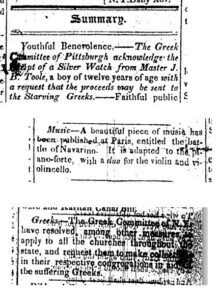
(News excerpts from the philhellenic action of various “Greek Committees” in the USA. Top: A 12-year-old boy donates his watch to the Pittsburgh Philhellenic committee, requesting that the proceeds may be sent to the starving Greeks -Freedom’s Journal-).
Turkey: Occupies Northern Cyprus, goes for the rest – Analysis
The sad fate of hundreds of thousands of Greek slaves, sold daily in the slave markets of the Mediterranean sea, shocked the American society in the first half of the 19th century. The American Philhellene volunteers who experienced this horror (Dr. Samuel Gridley Howe, Jonathan Pecham Miller, etc.) became leading figures of the abolitionist movement against the slavery of African Americans in the United States. This struggle used a central symbol. The Greek slave.
The Greek slave was the famous sculpture created by the great American sculptor Hiram Powers in 1844. It is the story of a young girl from Psara.
Garyfalia Mohalvi (1817 – 1830), comes from Psara. Her parents were slaughtered during the Chios massacre and little Garyfallia was sold by the Turks as a slave. She was discovered by chance by the American Consul Joseph Langston in Smyrna. After much effort, he managed to release her and he sent her to Boston in 1827.
The history of Garyfalia and her beauty, inspired the sculptor Hiram Powers to create, in 1844, one of the masterpieces of 19th century sculpture internationally, entitled “the Greek Slave”.
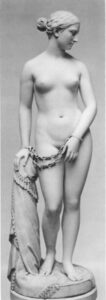
(The Greek slave, a work of 1844 by the American sculptor Hiram Powers)
Today the original statue is in the Brooklyn Museum. A copy of the statute is in the Philhellenism Museum in Athens, Greece (www.phmus.org).
This statue of the Greek slave became the central emblem of the struggle and the campaigns for the abolition of slavery in the United States.
Source: Society for Hellenism & Philhellenism
Ask me anything
Explore related questions