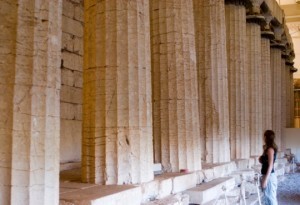
In the central Peloponnese, at Vasses in ancient Figaleia, at an elevation of 1.130 metres, stands the eternally proud temple of Apollo Epicurius. The inspiration behind its construction and the architect is considered to be the great Ictinus. This universal architectural gem was the first of the great monuments of Greece to be recognized by UNESCO as a World Heritage Site in 1986. The temple can be approached from Ilia, after an enchanting journey along the banks of the river Neda, or from Tripoli and Megalopolis.
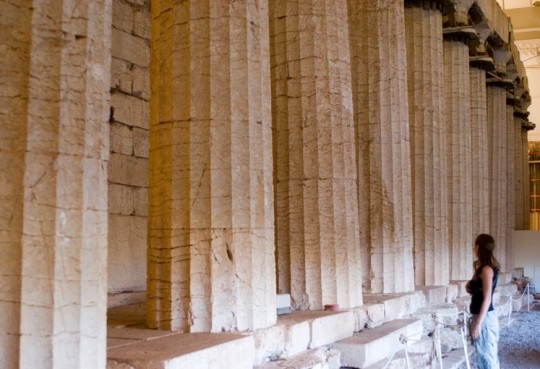
Vasses (ancient Bassae) was always a sacred place, host to numerous temples. The region’s name means “little valleys”. And indeed, the mountainous Peloponnesian land creates a magical landscape and within it rises the imposing site of the temple. The mountains of Kotylio, Lykaio, Tetrazio and Elaio stand guard around the valley of Vasses. All the gods of antiquity – Pan, Aphrodite, Artemis, and of course, Apollo, as both ‘Vassitas’ and ‘Epicurius’, that is, “the helper” – were worshipped in this natural sanctuary, and it was here that one of the greatest religious centres of the entire of Hellenic world was to be erected.
Power, Beauty and Harmony
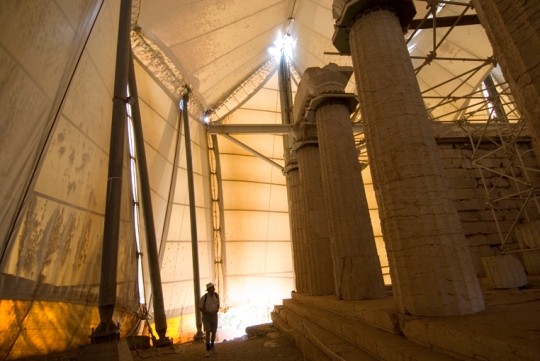
The temple in its current form was built between 420 and 400 BC. Archaeologists are convinced that under its foundations lies an even more ancient temple, probably from the seventh century BC. This “new” temple, a unique monument to the skills of its architect, Ictinus, embodies in its structure the entire wealth of architectural knowledge of Greek civilization. With both archaic and innovatory elements, it has been greatly admired by all visiting travellers through the centuries. Pausanias, the great traveller and geographer, who arrived in Vasses in the 2nd century AD, was stunned by its majesty and strength. It is speculated that the central column of the temple was designed to reflect the first rays of the summer solstice, symbolizing the eternal light of the sun god, Apollo. If this is true, then this is the first large scale sculptural work of art in the history of mankind to represent an abstract concept.
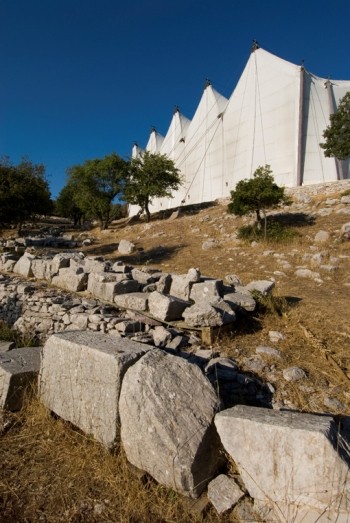
When man created the divine
Ictinus made an extensive study of the surrounding area when he undertook the building of the temple. He preferred to use grey limestone for construction, which is endemic to the site. This choice had the result of making the temple appear as a natural element of its surrounding environment, standing proud and eternal. The proportions of length and width are such that the enormous size of the temple is balanced by the grace it exudes. Light itself is used by the great artist as one of the building blocks of the temple. The play of light and shadow creates the illusion that the temple is smaller than its actual size, revealing its true dimensions to the observer only gradually as they draw near. In this way the monument does not force or impose its volume on the space, but exudes power and inspires awe when one is close to it. At the same time, it creates an evolving relationship with the god himself, Apollo, with light being the main element in this gradual revelation.
The outer elements of the temple are strictly of Doric order. Inside the temple the sculptural compositions and architectural ornamentation display exquisite artistry and beauty. The central column, which presides over the temple, is Corinthian and its capital is the oldest surviving example of the order. The monumental temple frieze, of great historical and artistic value, which depicts Hercules, the Centaurs and the Amazons, is today to be found in the British Museum.
The temple was in use throughout the Hellenistic and Roman periods. In 1765, guided by the writings of Pausanias, the French architect Joachim Bocher was able to identify certain finds as coming from the great Temple of Apollo. The first systematic excavations were started in 1812 by a group of eminent European archaeologists. They were continued in 1902 by the Archaeological Society of Athens, under the supervision of the archaeologists Constantinos Kourouniotis, Constantinos Romaios and Panagiotis Kavvadias. Thus, this brilliant achievement of Greek civilization was given back to humanity once again in all its glory.
Ask me anything
Explore related questions