×
GreekEnglish

×
  • Politics
  • Diaspora
  • World
  • Lifestyle
  • Travel
  • Culture
  • Sports
  • Cooking
Tuesday
03
Feb 2026
weather symbol
Athens 16°C
  • Home
  • Politics
  • Economy
  • World
  • Diaspora
  • Lifestyle
  • Travel
  • Culture
  • Sports
  • Mediterranean Cooking
  • Weather
Contact follow Protothema:
Powered by Cloudevo
> Economy

Eurostat: One in three Greeks lives in poverty or social exclusion

The EU average is 1 in 5

Newsroom October 16 04:41

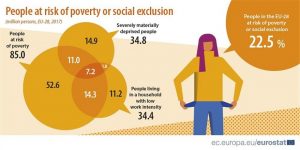
More than one in three Greeks, compared to an average of one in five in the EU, live in poverty or social exclusion, according to Eurostat data published in 2017.
In Greece, 34.8% of the population was in 2017 on the brink of poverty or social exclusion, 3.7 million people, compared to 28.1% in 2008. At the same time, in the EU in 2017, this figure dropped to 20.3% (113 million people) below 2008 levels (23.7%).
>Related articles

Today the first major discussion on the National Baccalaureate: What changes in Upper Secondary School and access to universities

Plevris announced a “sweep” operation to identify and close all illegal mosques in Athens

The prime minister’s interview: the dilemma is not Mitsotakis or chaos, but Mitsotakis or Androulakis, or Zoi, or Velopoulos


In Greece, 20.2% of the population live in poverty, 21.1% in destitution, while 15.6% live in a family facing the risk of unemployment. The corresponding average rates in the EU are 16.9%, 6.9% and 9.3%.
According to Eurostat, a person is in a state of poverty or social exclusion when he or she faces one or more of the following situations: Whether he is considered to be poor (ie he has income below 60% of the average national income), or is in a state of destitution (deprived of basic consumer goods, or fails to cope with elementary financial obligations), or lives in a family facing the risk of unemployment (ie in a family where no member has a “normal job”).
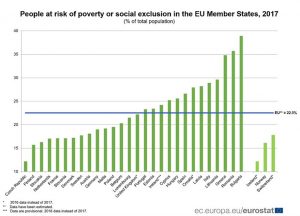
Despite the gloomy figures for Greece, it is not at the bottom of the relevant indicators, as Bulgaria (38.9%) and Romania (35.7%) are worse. The Czech Republic (12.2%), Finland (15.7%), Slovakia (16.3%), the Netherlands (17%), Slovenia and France (17.1%) and Denmark (17.2%), Sweden (17.7%), Austria (18.1%) and Germany (19%).
Reducing the number of people at risk from poverty or social exclusion in the EU is one of the key objectives of the Europe 2020 strategy.


Ask me anything

Explore related questions
#data#eurostat#greece#Greeks#poverty#social exclusion
> More Economy

Follow en.protothema.gr on Google News and be the first to know all the news

See all the latest News from Greece and the World, the moment they happen, at en.protothema.gr

> Latest Stories

Spain bans social media for children under 16

February 3, 2026

France: Paris prosecutor’s office investigation into X’s premises, algorithm interference under investigation

February 3, 2026

Reza Pahlavi: Calls for global protests on 14 February against the regime in Iran

February 3, 2026

The University of Athens and law students at the core of the constitutional revision, discussion on the choice of the leadership of the Judiciary

February 3, 2026

Today the first major discussion on the National Baccalaureate: What changes in Upper Secondary School and access to universities

February 3, 2026

K.M.’s motto up to the elections, the Constitution (not the square…), the Presentation of the Lord crowd and the bishop, market scenarios for PPC, Vodafone, Nova, and the chess game in shipping

February 3, 2026

EIB: Towards a new record of close to €4 billion in lending to the Greek economy

February 3, 2026

National Baccalaureate: The first major debate on changes in Lyceums and university access

February 3, 2026
All News

> Greece

The University of Athens and law students at the core of the constitutional revision, discussion on the choice of the leadership of the Judiciary

The Student Academic Club of Public and International Law of the Law School of the National and Kapodistrian University of Athens organized an event on "The Choice of Justice Leadership" - Dialogue between students and leading representatives of the judicial and academic life of the country

February 3, 2026

Today the first major discussion on the National Baccalaureate: What changes in Upper Secondary School and access to universities

February 3, 2026

National Baccalaureate: The first major debate on changes in Lyceums and university access

February 3, 2026

The results of the Internal Mobility Programme in Universities were announced

February 3, 2026

Weather: Thunderstorms, mud showers, and southerly winds are coming

February 3, 2026
Homepage
PERSONAL DATA PROTECTION POLICY COOKIES POLICY TERM OF USE
Powered by Cloudevo
Copyright © 2026 Πρώτο Θέμα