





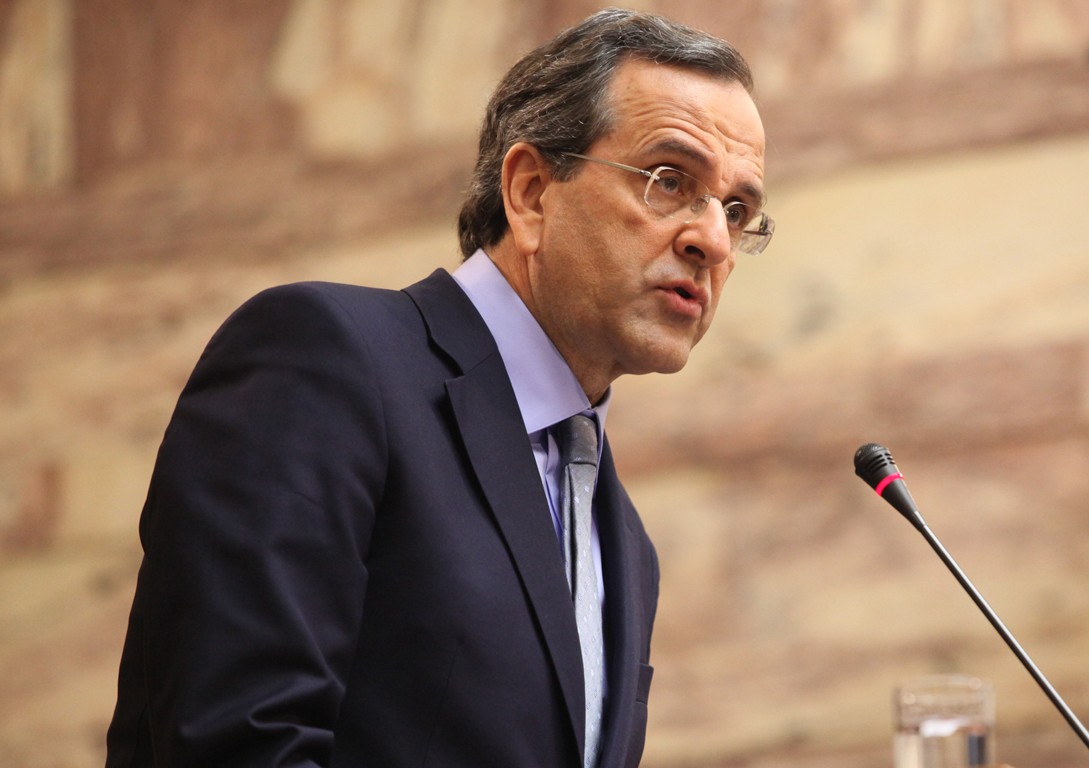
“Today we make a leap, we are changing the country’s political and state identity,” he said, adding that Greece had stayed behind because it had followed a statist model that led to excessive borrowing and eventually the country’s collapse.
He continued by saying that “while much had changed over the past two years, Greece must be the winner and we need a new constitution in order to achieve this”.
Mr Samaras argued that “The country needs a new architecture. On September 3 the process will officially begin so that the next Parliament is revisionary. We will set the agenda, we will listen to everything and discuss it,”.
Mr Samara’s main proposals for the constitution of New Greece were the following:
– a stronger regulatory role of the country’s president, including the president’s direct election by the people
– a smaller Parliament with fewer MPs
– greater guarantees that governments will complete their four-year term, with a stable electoral system that could only be changed by a three-fifths majority in Parliament
– more flexible governments appointing three permanent deputy ministers in foreign affairs, defence and budget, each with a five-year term
– abolition of current plethora of ministry general secretaries, allowing only one per ministry
– putting an end to current privileges for MPs and ministers with respect to the law. Changes on provisions regarding ministerial responsibility and MPs immunity
– amendments to article 90 to ensure fully independent justice and stronger separation of the government from the legislature and justice
– enhanced democracy in the political system and guarantees of transparency in relation to political party finances
– updating laws governing the mass media
– introduction of measures barring MPs from becoming ministers, so that entering Parliament will no longer be a stepping-stone for joining the government
– establishing a Constitutional Court
– increasing accountability in public office, from that of premier down to mayors and trade unionists
– amendments to articles 24 and 117 of the Constitution for a better and more effective protection of the environment
– amendments to article 16 that bans private universities in Greece so that knowledge and research do not remain an unproductive monopoly in the hands of a few
– New Greece demands a stronger Democracy. Amendments to articles on holding referendums, so that these could be held by popular initiative
– changes to rules for independent authorities
– setting citizens’ safety as a priority because safety is a democratic right of all citizens. Protecting the right of free movement and unobstructed access (restrictions on demonstrations and protests)
– protection of national identity and language
“It is not we who are in a hurry, it is Greece that cannot wait anymore,” Mr Samaras said, adding that the present government was for the first time putting the country in order and finishing with the deficits.
“For the first time we have a vision for a future without the weights of the past. Greece can overcome the crisis and make up for the decades of lost ground. We have already won the trust of international markets, we have stabilised the country through many efforts and sacrifices. The most important thing is that we have won our own self-confidence,” he said.
Mr Samaras closed his speech by stressing that the country is undergoing a “reformist storm” that goes beyond promises to actions. He also attacked main opposition party, SYRIZA, referring to it as the “forces of inertia, who want to preserve the ills of the Greek state, because without the crisis they have nothing. Our party brings to us a New Greece through developmental regrowth and Constitutional amendment. For this New Greece I won’t fall back, I won’t compromise. I ask you to give me the mandate to change together Greece.”
Ask me anything
Explore related questions




