





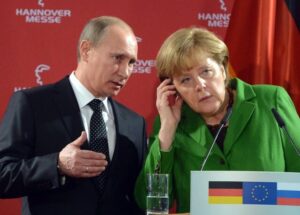
Europeans are considering appointing a single common negotiator for talks with Russian President Vladimir Putin, according to the Financial Times, as progress in US-led peace efforts remains uncertain.
Among the candidates mentioned are former European Central Bank President Mario Draghi and former German Chancellor Angela Merkel, while Finnish President Alexander Stubb and his predecessor Sauli Niinistö have also been discussed.
According to European officials, foreign ministers are expected to discuss the suitability of the candidates at a meeting in Cyprus next week.
The administration of Donald Trump, currently preoccupied with its own war in the Middle East, has informed EU counterparts that it does not oppose Europe holding talks with Putin in parallel with US-led peace negotiations, three sources cited by the FT said. “They know it is not working,” one of them said, referring to Washington’s current efforts to end the conflict.
The EU suspended official communication with Moscow after Russia’s invasion of Ukraine in 2022, while the current stagnation of US-led negotiations has left Europe sidelined. This situation has pushed EU countries to consider appointing a joint negotiator, despite deep disagreements over the feasibility and scope of such a role.
European Council President António Costa, who represents the EU’s 27 member states, said this month that the bloc is preparing for “potential” talks with Putin.
The Ukrainian president, Volodymyr Zelenskyy, said after a phone call with Costa that Europe must have a “strong voice and presence” in any talks, stressing the importance of deciding who would represent the EU. He also suggested that someone “like Draghi” or a “strong current leader” could head the European side in negotiations with Russia.
Merkel has expressed regret that Europe was not included in talks with Putin and warned against underestimating the Russian leader, while also stressing that the EU’s capabilities should not be underestimated. German Chancellor Friedrich Merz said European partners are “discussing the issue in depth,” without naming specific candidates.
Putin, for his part, said he is open to talks with a European representative, provided they have not previously “said all kinds of unpleasant things” about Russia. He even suggested his old acquaintance and Merkel’s predecessor Gerhard Schröder, a proposal firmly rejected by both the EU and Kyiv.
Putin’s spokesperson Dmitry Peskov praised European efforts to establish a communication channel and said that “Putin is just a phone call away.”
However, many EU countries fear that such discussions could expose internal divisions within the bloc and make it harder to maintain a unified stance toward Russia.
Ukraine wants Europe to pressure Putin into agreeing to an immediate ceasefire along current front lines, according to a senior European official. However, Russia has firmly rejected this proposal, which was also raised by French officials in February.
Moscow has indicated it would be more open to a more “constructive” European message, according to people involved in backchannel discussions. However, Europeans “still do not say anything substantive,” one source said, arguing that Moscow might prefer dealing with a major European power rather than the EU as a whole.
Ask me anything
Explore related questions




