





BofA Merrill Lynch began disclosing its monthly survey for the Greek economy, today, attempting a comprehensive analysis for the macroeconomic perspectives combined with political developments. The group also looked at prospects of key companies, always seeking financial opportunities.
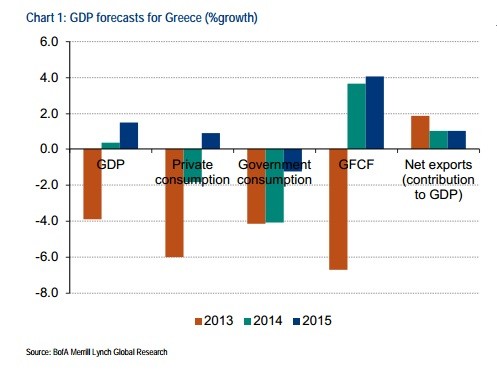
In its first report, under the permanent title of “Olympic torch”, the investment group notes that growth continues its positive climb, although risks always remain in the background. The company keeps its growth estimate at a steady 0.3% and a gradually accelerating pace of recovery, sufficing that there are no political shocks, which constitute the greatest risk to investments.
Additionally, it considers that the most significant challenges are the implementation of the government’s ambitious reform agenda, high debt levels and political risks, especially in relation to the outcome of May 25th’s European elections.
Meanwhile, it warns that the -still low- nominal GDP performance might perhaps have a negative development for fiscal revenue, which is below target levels.
Regarding political risks, BofA points to the crucial upcoming effect that the European elections will hold for Greece. The group believes that a negative result would increase the chances of early national elections, which in turn would be seen as a negative development for markets due to political uncertainty, combined with delays in reform implementation and a potential new delay in discussions on debt relief (OSI).
Such a scenario could take place, if the opposition party wins by a wide margin in European elections.
If SYRIZA wins by a small margin, however, then the market will face a negative impact, but in no way will there be a financial shock. For SYRIZA to set the basis for winning national elections, according to the investment group, they would have to win the European elections by a supremely wide margin, given that many times they gain support due to “protest votes”,.
On the other hand, if the New Democracy party wins by a small margin, then the market will react positively, since the possibility of premature national elections will be reduced, according to BofA.
What Merrill Lynch this is possible, however, is the announcement of early elections after a failed Presidential election which is scheduled for February 2015. This means that Greece will experience yet another prolonged election period and the coalition government’s work will be made even harder, with a difficulty of promoting reforms, given that the very government majority they count on, is hanging by a thread.
Ask me anything
Explore related questions




