





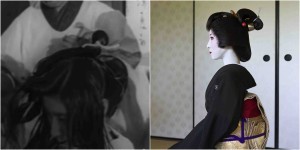
There has never been a single, widely accepted hairstyle for geisha. It is safe to say that throughout history, geisha women have been wearing their hair up or down at various periods of time.
However, in the 17th century, geisha started putting their hair up once again. It is during this period that the traditional shimada hairstyle, based on a type of chignon, started to develop.
Historically, there have been four main types of Shimada. First, comes the taka shimada, most often worn by young, single women. This is a high chignon. Older women tend to wear the Tsuyoshi Shimada, a rather flattened chignon. Then there is the Yuiwata Shimada, a chignon often bound and adorned with colorful cotton crepe.
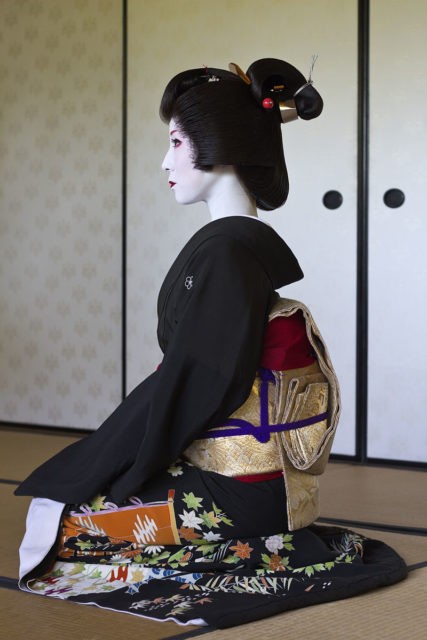
(Profile of geisha Kimiha from Miyagawacho)
In addition to these traditional shimadas, there are a number of other hairstyles including Katsuyama, Ofuku, Sakko, and Yakko-shimada and for the Maiko of Pontocho, the choice of styles includes Osafune, Kikugasane, Oshidori no Hina, and Umemodoki among others.
These hairstyles don’t stand alone by way of the chignon but instead are elaborately decorated with a number of combs and hairpins called kanzashi.
After the Meiji restoration in the 17th century, the hair combs were much bigger and became an intricate ornamentation for women of higher classes. Whereas in the post-Meiji Restoration, and including the modern era, the combs were much smaller and less conspicuous.
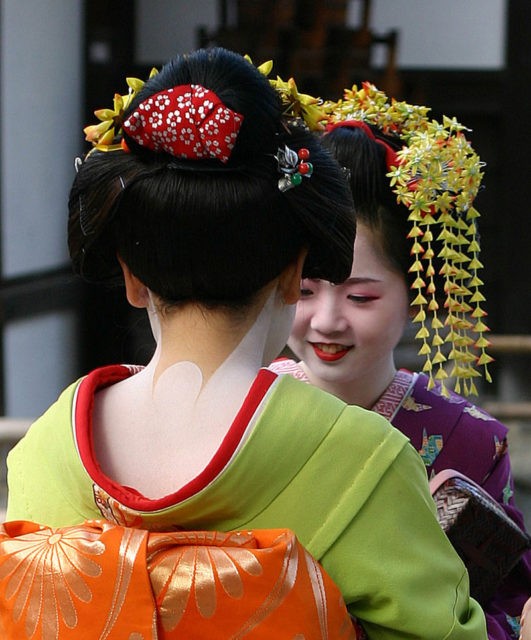
(Maiko hairstyle)
Due to the need to keep such hairstyles in as perfect a condition as possible, Maiko are unable to use pillows and have to sleep with their neck in a small support known as a takamakura. In order to become accustomed to this practice, the Maiko’s mentor often places rice around the base of the support. If, in the morning, rice grains are found in her hair, the Maiko knows she has moved her head too much whilst asleep.
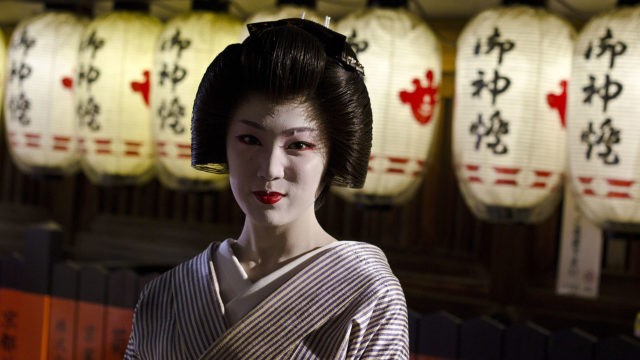
(Geiko Tsunemomo of Gion Higashi)
Even if she manages to keep the rice out of her hair, the Maiko will need to have highly trained stylists regularly tend her hair every week.
Today, in contrast to Maiko, who always use their natural hair, many geisha choose to wear wigs in their professional capacity. But even such an ornate wig requires weekly attention.
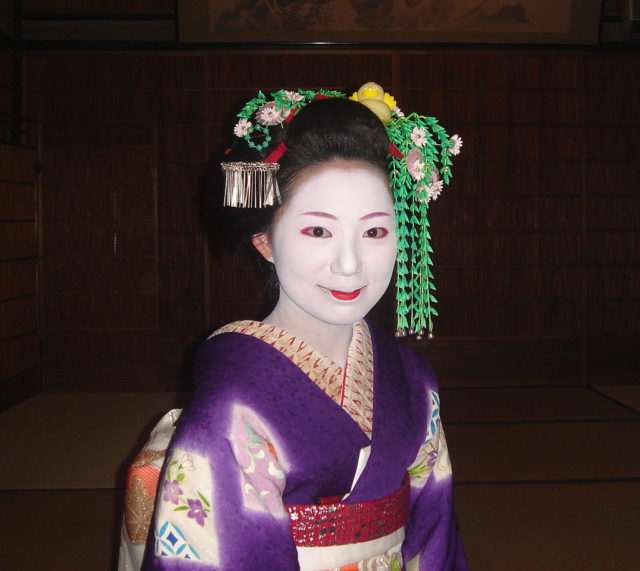
(The green pin on the mid-left called tsunagi-dango identifies her as a maiko of Gion kobu)
Sadly perhaps, the decline in the geisha tradition is having a knock-on effect in that the art of the highly skilled artisans of traditional hairstyling is slowly dying out. One drawback of the Maiko tradition is the fact that such extensive hairstyling can, over time, bring about balding on top of the head.
In the modern era, the traditional makeup of the geisha is considered one of their most recognizable characteristics. However, some of the most established geisha often only wear the full white facial makeup, a signature of the Maiko tradition, during very special art performances.
Ask me anything
Explore related questions




