





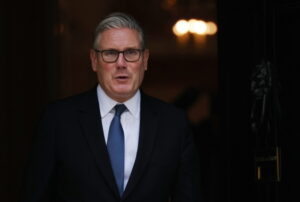
British Prime Minister Keir Starmer is fighting for his political survival, weakened by the scandal surrounding the appointment of Peter Mandelson as ambassador to the United States despite his links to convicted sex offender Jeffrey Epstein.
The 63-year-old Labour leader’s popularity has declined sharply since he took office following Labour’s landslide victory in the 2024 election, and many MPs in his party are no longer concealing their dissatisfaction.
Can he stay in power?
Starmer reiterated yesterday that he has no intention of resigning. “Nothing will distract me from my mission of serving our country,” he said during the weekly Prime Minister’s Questions session in the House of Commons.
At the same time, he said that testimony from former senior Foreign Office official Olly Robbins—who was dismissed last Thursday—“put to rest all the allegations against him.” These allegations claimed he had misled Parliament when he stated that “all the required procedures” had been followed in reviewing Mandelson’s appointment.
Robbins confirmed that he had not informed Downing Street that the U.S. State Department had granted Mandelson security clearance to take up the ambassadorship in January 2025, despite concerns raised by the committee responsible for vetting his background.
However, pressure on Starmer continues to mount. Downing Street is now facing criticism for reportedly considering offering a diplomatic post to the prime minister’s former communications director, Matthew Doyle, who served from July 2024 to March 2025.
Doyle was appointed to the House of Lords in 2025 but was expelled from the Labour Party in February after revelations about his links to a former Labour MP who had twice been convicted of possessing indecent images of children.
A spokesperson for Starmer said yesterday that the government remains united behind the prime minister. However, while several ministers have publicly expressed their support, others have kept their distance—highlighting growing divisions within the government.
“Cabinet support appears to be weakening, and as a result, its political authority is eroding,” said Patrick Diamond, a former Downing Street adviser under previous Labour governments.
If ministers begin to resign, it could signal the end of Starmer’s premiership, as was the case with Boris Johnson.
“He seems to be at the mercy of events beyond his control—which is never a good position for a prime minister,” added Diamond, now a professor of political science at Queen Mary University of London.
Under what circumstances could he be forced to resign?
Starmer could also be forced out if enough Labour MPs challenge his leadership. At least 81 MPs—out of more than 400 in the party—would need to back a rival candidate to trigger an internal leadership contest.
His allies insist he will resist any attempt to remove him, despite the risk of plunging the party into internal conflict.
A potential turning point may come after local elections scheduled for May 7 in England, Scotland, and Wales, which are expected to be difficult for Labour.
“Any potential successor will want Starmer to take full responsibility for results that are widely expected to be disastrous,” said Stephen Fielding of the University of Nottingham.
Who could succeed him?
Fielding suggests that former deputy prime minister Angela Rayner—a popular figure on Labour’s left—could be a contender, although she has yet to fully recover from a tax-related controversy that led to her resignation last year.
Another frequently mentioned name is Andy Burnham, the mayor of Greater Manchester, though he would first need to return to Parliament.
Other potential candidates include Health Secretary Wes Streeting and Home Secretary Yvette Cooper, both seen as popular on the party’s right but considered by some to be divisive.
More unifying figures, such as Defence Secretary John Healey or Armed Forces Minister Al Carns, could also emerge to bridge internal divisions.
The absence of a clear successor may ultimately work in Starmer’s favor, allowing him to weather the current crisis. “He still retains significant advantages, particularly the size of his parliamentary majority,” Diamond noted.
Ask me anything
Explore related questions




