The little boy in the yellow jacket runs and jumps, alternatively waving and wiping the dust off his face. In his right hand is a strip of white cloth, intended to show he and his family are civilians. His parents are exhausted and wary, having left their home in west Mosul’s Mushairfa neighborhood, but the little boy can barely contain his excitement.
Behind him, struggling against the dusty headwind, stretches a line of dozens of people, their heads bent down, trudging up a dirt track. A teenage boy in a red track suit carries a bundle on his head, his mother to his left, in the mandatory black abaya, or robe, a bundle on her head as well. Somewhere along the way she has discarded her face cover, khmar, without which ISIS would not let women in Mosul leave their houses.
Since last Friday, the day after Iraqi forces began what they hope is the final push to crush ISIS in Mosul, Iraq’s second-largest city, around 5,000 residents have fled the city every day, according to Iraqi officers processing civilians.
“People are dying,” says Khalda, a bearded man carrying his son in his arms. “For the past four or five months, there has been nothing. No food, no medicine, nothing.”

It’s hard to speak for long with the people fleeing Mosul. They’re in a hurry, and they’ve been walking for hours. Khalda’s young son, holding a box of juice in one hand and a pack of biscuits in the other, is impatient and squirming. Khalda’s wife has gone on ahead and calls for him to get moving.
“God save us from that rotten gang,” Abu Hussain tells me. Orange-yellow dust covers his windblown face and gray beard. His voice is hoarse. “They’ve stomped on everything that means life. They’ve destroyed education and culture, there were no schools, no way to make a living.”
Despite gusts of dusty wind, three-month-old Mariam is sleeping peacefully in her uncle’s arms. “She’s fine,” he told me with a smile, clearly happy to have made it out of the city. “She’s from a well-off family so she hasn’t suffered,” he said. He declined to give me his name. Like many, he is worried about the safety of relatives still inside Mosul. “Red death” — “mawt ahmar” in Arabic — is how he describes life under ISIS.
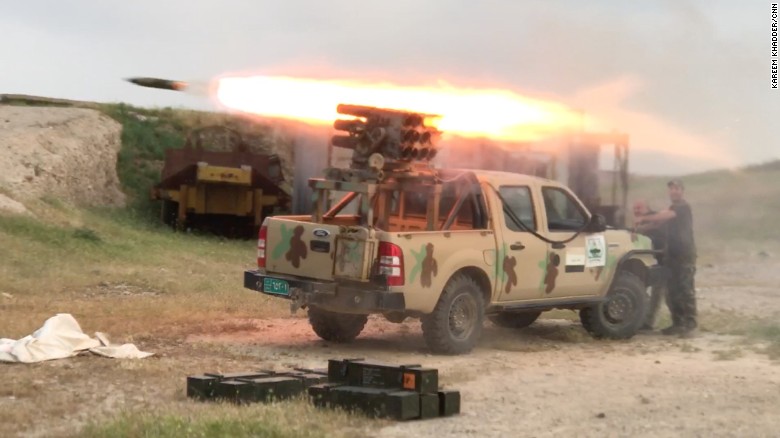
All the while the roar of battle echoes nearby. Attack helicopters fire into the city, rockets roar over head, small-arms fire crackles and pops.
A handful of unarmed Iraqi soldiers help carry tired children. Some of the adults embrace and kiss them, the women ululate. “Damarouna!” shouts one man to a soldier. “They destroyed us,” referring to ISIS.
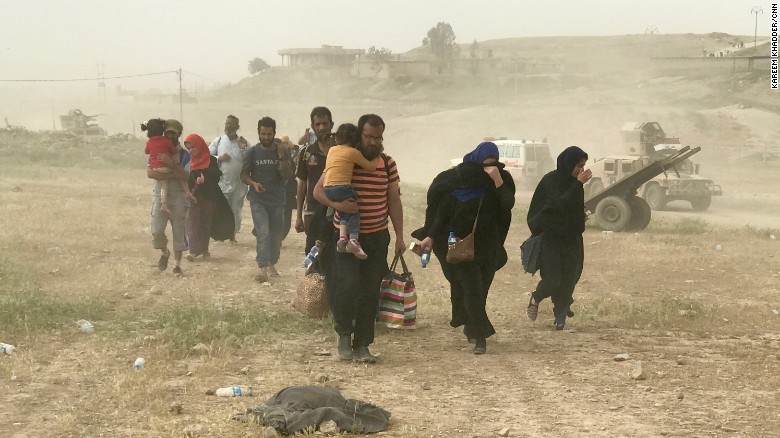
Not everyone is so happy. “Damartouna bil-qasaf,” grumbles one man to a soldier. “You destroyed us with your bombardment.”
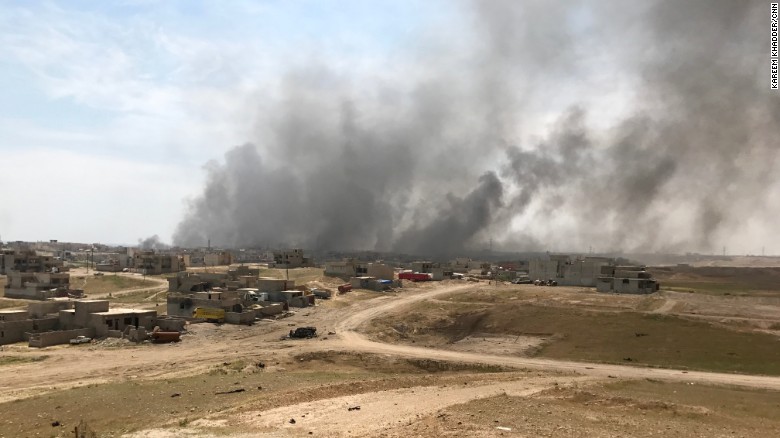
And that bombardment is indeed intense. From a rooftop overlooking the edge of the Mushairfa neighborhood in northwest Mosul, we watch thick columns of smoke rise from between the houses. Tanks and armored personnel vehicles pour round after round at point-blank range down the street, while helicopters circle overhead, their heavy machine guns barking.
“There are no civilians in there,” Major Mustafa Al-Azawi tells me as he radios orders to his men at the front.
I borrow one soldier’s binoculars to get a better look. Just as I focus in, a huge plume of flames and black smoke rises from the neighborhood, just about 400 meters from our position. It’s a VBED — a vehicle-borne explosive device — in plain English, a suicide car bomb.
VBEDs are ISIS’ weapon of choice, but the Iraqis are having none of them. “If you see a vehicle, assume it’s a VBED and hit it!” shouts Major Al-Azawi over the radio.
The night before, the commander of the Iraqi Army’s Ninth Armored Division, Lt. Gen. Qassim Nazzal, told me in the first 72 hours of the operation, ISIS had used 22 car bombs.
Most, however, aren’t able to reach Iraqi troops. On a hilltop across a valley from the Mushairfa neighbourhood, a group of Iraqi officers and American advisers sit on sofas and chairs around a big TV screen. They’re directing drones over the battle, looking for anything that seems suspicious.
Lt. Col. Jim Browning of the 82nd Airborne Division has his eyes glued to the screen, a telephone pressed to his ear. He’s been in Iraq since New Year’s Day and took part in the battle for east Mosul, and is now busy with the west.
Since the beginning of the year, there has been an important change in how US and coalition forces operation, he says. In the past, before an airstrike could be called in, a request had to go far up the chain of command for approval.
It was time-consuming, and for the forces on the ground, profoundly frustrating. In February 2015 I was on a hilltop position with Kurdish forces. Their commander was unhappy. “When we see a target, like an ISIS car, we call the coalition for an airstrike. With the Americans, the request has to go to a lawyer and all the senior commanders. By the time they make a decision, the target is gone.”
That’s all changed, says Lt. Col. Browning. “All it requires is for me to be able to see it [a target] with my Iraqi partner, and we are able to communicate that, yes, emphatically, that is an enemy. Let’s deliver a strike, and let’s deliver it quick.”
Earlier this month the Iraqi Army Chief of Staff Othman Al-Ghanmi said he expected this final push to crush ISIS in Mosul to take just three weeks. It’s possible, but in this war, the business of predictions is risky. Last summer then-defense minister Khalid Al-Obaidi told me with a confident smile that Mosul would be free by the end of 2016.
The closer you get to the front, the more cautious people become. When I ask Lt. Gen. Qassim Nazzal how soon Iraq would be able to declare victory in Mosul, he takes a deep sigh. “Timetables in conventional warfare are possible,” he says. “But this is guerrilla warfare, with a well-trained enemy using snipers, booby traps and car bombs.”
Back at the front, what that means is vividly clear. As we film the fighting, mortar rounds come roaring in, crashing nearby. We run back to the main Iraqi observation post, and find six soldiers lying on the ground. Iraqi and foreign volunteer medics frantically dress their shrapnel wounds. One of the soldiers, a young man, blood-stained battle tunic hastily cut open, is groaning.
More rounds explode nearby. “Take cover in the house!” someone shouts.
Here, victory is in sight. But it’s not going to be easy.
Ask me anything
Explore related questions