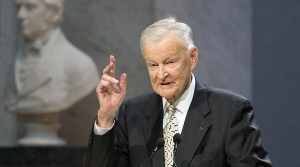
Zbigniew Brzezinski, who passed away on May 26, 2017 at the age of 89, was one of the U.S.’s most highly praised foreign and security policy gurus of the past half-century.
Considered the “Democrats’ answer to the Republicans’ Henry Kissinger” in the early stages of his career, in the Cold War atmosphere of the late 1960s, Brzezinski was a staunch supporter of the “Rollback” policy of Dwight Eisenhower and John Foster Dulles. That policy held that antagonism would only push Eastern Europe closer to the Soviet Union, and Brzezinski became one of the supporters of the “détente” policy within U.S. administration circles in the 1970s.
In the meantime he maintained his contacts with Eastern Europe, especially in his native Poland. The Polish service of the CIA-operated Munich-based Radio Free Europe (RFE) was one of those key channels from the 1950s. Another contact from the 1960s was Adam Minchnik, who would later become one of the leaders of the Solidarity movement in Poland together with Lech Walesa. Solidarity played a key role in the disintegration of the Soviet Union, along with the election of Polish bishop Karol Jozef Wojtyla as Pope John Paul II in October 1978.
That was the year when Brzezinski’s political views started to change. He was appointed as National Security Adviser by U.S. President Jimmy Carter in 1977, but by the following year – while Carter’s Secretary of State Cyrus Vance was pressing to maintain the “détente” policy of avoiding antagonism and promoting strategic arms limitation talks with the Soviets – Brzezinski was arguing that too much détente had allowed the Soviets to gain ground in the Middle East and Africa. Some antagonism might therefore be needed, especially in the Middle East.
Two dramatic developments in 1979 gave Brzezinski the opportunity to promote his new strategic look: The Islamic Revolution in Iran, which turned the country from being a strong ally of the U.S. to an enemy of the West overnight, and the Soviet invasion of Afghanistan.
It was Brzezinski’s idea to start giving money, military equipment and military training to Islamist tribes resisting the Soviet invasion, mainly with the help of Saudi Arabia, Pakistan and China. That equipment and training program of the Mujahedeen halted the Red Army advance and contributed to the disintegration of the Soviet Union, but it also planted the seed for the rise of radical Islamist militancy, triggering the emergence of organizations like the Taliban, al-Qaeda and later the Islamic State of Iraq and the Levant (ISIL).
The idea was to contain the Soviet Union from its south by supporting Islamist movements, as the Soviet south was largely populated by Muslim and mostly Turkic people. Some used to refer to this as the “Green Belt” policy.
The arms and training given to “partners on the ground,” who are ready to fight and die to defeat the immediate enemy, (it was the Soviets then, it is ISIL in Syria now), later turned against the West and hit the U.S. on 9/11, the biggest attack on U.S. territory after the Pearl Harbor.
Brzezinski’s ideas were actually a modification of the imperial era “Great Game” of the late 19th century, when the Russian expansion was confronted by the British Empire in Afghanistan and Ottoman-ruled Turkey. Almost a century after this Great Game, Brzezinski was performing a Great Game 2.0 on two fronts: In Afghanistan through the use of Islam as a military power and in Poland using Catholicism as a political power.
Brzezinski was one of the most influential actors in the collapse of the Soviet Union. But the consequences of his Afghanistan policy continue to cause bloodshed across the world. They present a dramatic lesson in why religion should not be played with for political purposes.
Ask me anything
Explore related questions