Divination was considered as one of the most important kinds of art (technai—arts, skills, crafts) among the ancient Greeks, second only to medicine, given along with fire to humans by Prometheus (Aeschylus Prometheus Bound 484-99). Early Homeric and Archaic sources such as Homer (Iliad 22.126-8, Odyssey 19.163), Hesiod (Theogony 35) and Herodotus (2.52.2 ) echoed stories of oracular consultation at Dodona and Delphi, whereas the phrase ‘of the oak or the boulder’ (peri dryn i peri petrin) was an allusion to the oracular power of these two sites. The former alluded to the Dodonian oak trees whose rustling sounds were interpreted by the Selloi, the barefoot priests of Dione and Zeus at the oracle of Dodona. As for the boulder, it alluded to the navel stone (omfalos) at Delphi, upon which the Pythia was seated while giving her oracular consultation.
The oracle shrine of Delphi
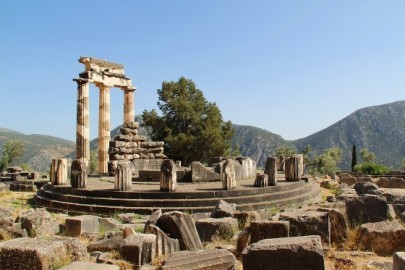
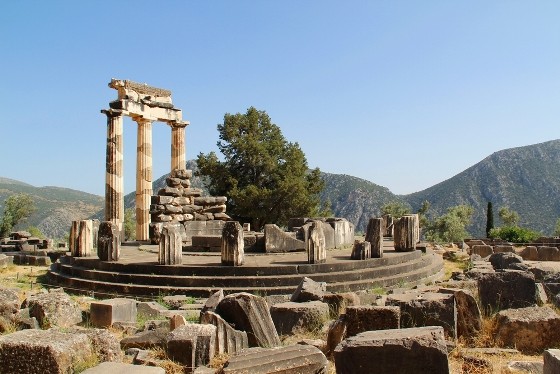
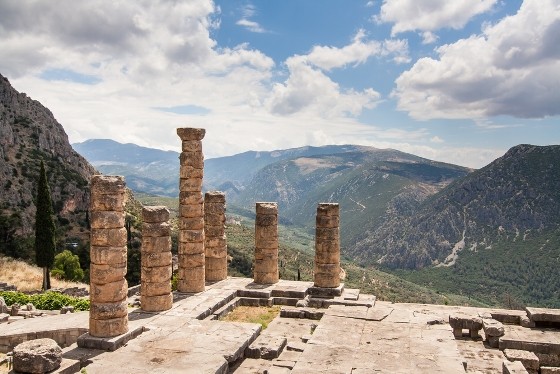
The oracle of Delphi (christirion Delfon), located under Mt. Parnassos, high above the north shore of the Gulf of Corinth, in the valley of Fokida, echoes stories of oracular divination for the course of future events of individuals as well as of states for more than 1000 years. Though probably a divine site as early as in 1400 BCE it was a late 8th century BCE Homeric remark that described the oracle of Delphi as a very active place renowned for its oracular consultation. Yet the peak of its glory was from the 6th to the 4th centuries BCE, and then it slowly started to decline until it was completely silenced by emperor Theodosius I in 392 CE.
Initially, the site of Delphi was a divine place of mother earth (Gaia), manifesting the oracular voice of earth, then of her daughter Themis, the oracular voice of divine law and a wife of Zeus, and finally of Phoebus Apollo who killed Python, the guarding snake of the site, and who in turn appointed a priestess, the Pythia, acting as his mouthpiece, committed herself for life to serve him. At the time of its glory, at the oracle of Delphi there were three priestesses serving the god, while a home was given to them by the Delphians to live in.
Consultation at Delphi
In early times, oracular consultation was given only once a year, at Apollo’s birthday, on the 7th day of the month of Vysios (probably the Athenian Anthesterion or our February/March). Soon, due to an increasing need for consultation, the Pythia became available also on the seventh day of every month apart from the three winter months when Apollo was considered absent from Delphi and instead god Dionysus oversaw the sanctuary. Other than these 9 days per year for consultation, there were also alternative forms of divination on offer at Delphi. There was consultation through lottery objects which would be read as a response to questions as well as a consultation at the Korykeian cave above Delphi where the Pythia would choose between two possible answers to “should I do this or that” kind of questions which had been asked in advance—as it was the case with all kinds of questions.
On the days of oracular consultation the Pythia would first purify herself in the Castalian spring, then she would burn an offering of laurel leaves and barley meal to Apollo as in the opening scene of Aeschylus’ Eumenides. The consultation wouldn’t start unless a goat would shudder after it was sprinkled with cold water—as a sign that the day was auspicious and so it could then be sacrificed to Apollo outside the temple on the altar. In turn, the consultant (theopropos) had also to be purified in the spring nearby, and then he should queue to consult the Pythia. Priority was given to Delphians, then to members of the Amphictyony, then to other Greeks and finally to non-Greeks; yet there was the right of jumping the line if you were awarded a promanteia (i.e. to be consulted before others).
Fees, Sacrifices and Oracular Consultation
One had to pay a fee, called pelanos, which was actually a sacrificial cake burned on the altar bought from the Delphians by the consultant, though some individuals or states were also awarded a free consulting if they were sponsors or dedicators of objects or structures as was the case with the Altar of Chians and the subsequent free of charge consultation they enjoyed. Fees varied: richer cities would pay more, whereas a private consultation by individuals was less than a ‘state’ one (i.e. consulting by a city). So in the fifth century BCE, an individual would pay the equivalent of about two days pay for an Athenian juryman, which was ten times less than what a city had to pay to get the consultation. After they had paid the consultation fee, the consultants were accompanied by a local representative, a proxenos, and offered a sacrifice of an animal on the inner hearth, part of which was given to the Delphians and part to the man who was committing the sacrifice.
It was about time, for the consultant to approach the Pythia. She was in the adyton (an inner room of restricted access) within the temple, seated on a tripod on a stone, known as the navel of the earth (omfalos) alongside a laurel tree probably in a state of trance. There she uttered cries or songs (voai) and the priests of god Apollo (profitis) who were present and knew the questions beforehand would interpret the Pythia’s sayings providing more of a kind of guidance to the consultants. The fact that the Pythian responses sounded ambivalent or obscure offering ‘a one way or another’ kind of answers safeguarded the reputation of the oracle for centuries. So as Heraclitus mentioned “the oracle neither conceal[ed], nor reveal[ed], but indicate[d].” (Plutarch Moralia 404D).
Source: visitgreece.gr
Ask me anything
Explore related questions