Following Turkey’s incursion into Syria, the once unthinkable prospect of a direct clash between Turkish and American soldiers has become alarmingly real. Turkey’s current fight, against U.S.-backed Kurdish troops in the northwestern Syria territory of Afrin, is destabilizing enough. But the real risk will come if Turkish President Recep Tayyip Erdogan follows through on his repeated promises to press further east toward the Kurdish-controlled and U.S.-patrolled city of Manbij. The only way to prevent a conflict is for U.S. policymakers to adopt a clear and tough-minded approach to Turkey now, before things get worse.
Threatening U.S. forces in Manbij—Erdogan has said he would be forced to “bury” them and warned that although “they tell us ‘don’t come to Manbij,’” Turkey “will come to Manbij” — could irrevocably damage the decades-long U.S.-Turkish alliance, which is already under strain from a combination of Erdogan’s deepening authoritarianism, flirtation with Russia and conflicting interests in Syria. A clear U.S. statement that this would be intolerable, backed by an effective deterrent posture, is necessary to prevent outright U.S.-Turkish hostilities and preserve any hope of a functional relationship going forward.
Unfortunately, until now a cacophony of mixed American messages, combined with a longstanding tendency to treat Turkey gingerly, has convinced Erdogan that Washington sees its relationship with Ankara as too important to fail. This only increases his appetite for risk—and thus the potential for conflict. Ankara must be made to understand the dire consequences of attacking Manbij, and Washington must be prepared to follow through.
Though reckless, a Turkish attack on Manbij would be consistent with Erdogan’s habitual disregard for the alliance that has bound the United States and Turkey together since 1950. Under Erdogan, Turkey carried out one of the largest recorded efforts to evade U.S.-sponsored international sanctions on Iran. Its media published maps of secret U.S. bases in Syria. It arrested an American pastor, a NASA employee and two Turkish employees of the U.S. State Department, on spurious charges, holding them as Erdogan’s de facto hostages. Last spring, Erdogan’s authoritarian lawlessness reached American shores when his bodyguards attacked protestors in Washington. Now, Turkey is purchasing a state-of-the-art air and missile defense system from Russia (that will be incompatible with NATO systems) and attacking U.S. partners in Syria, presenting both as part of the country’s heroic resistance to U.S. imperialism.
The U.S. response to these provocations has been driven by the hope that treating Turkey like a good ally eventually will convince it to resume behaving like one. A Turkish banker was convicted in a New York court for helping Tehran evade sanctions, but the Turkish regime’s complicity has gone unpunished. Washington started getting tough with Ankara for arresting U.S. government employees—imposing sweeping visa restrictions on Turkish citizens, causing the Turkish lira immediately to drop 3.1 percent—but backed off … without securing the release of its employees.
The current administration’s inability to communicate U.S. positions clearly makes matters worse. Prior to Turkey’s Afrin operation, the Pentagon announced a new U.S.-trained, predominantly Kurdish “Border Protection Force” in eastern Syria. When Turkey objected, the State Department effectively walked back the announcement. More troubling, after President Donald Trump spoke to Erdogan about Turkey’s current military operation, the Turkish leader denied the White House assertion that Trump had expressed his concern about the possibility of a clash between U.S. and Turkish forces. Whether the president was unclear, the Turks had selective hearing, or, as seems entirely likely, some combination of the two, the result is destabilizing.
Unfortunately, the administration’s lack of clear messaging has only reinforced Erdogan’s conviction that the United States will not meaningfully challenge him.
Washington needs to clearly and explicitly spell out the consequences that will result if Turkey attacks positions where U.S. troops are embedded. This should take the form of a version of the tough-minded and transactional approach that has characterized Russo-Turkish relations over the past several years. At the very least, sanctions targeting the Turkish defense industry, financial sector and potentially officials tied to corruption—already warranted by Turkey’s purchase of the Russian S-400 and involvement in Iranian sanctions evasion—should be on the table.
Washington’s goal should not be confrontation with Ankara for confrontation’s sake, or just because it is “mad” at Erdogan. Rather the aim should be establishing the conditions—and the ground rules—for constructive engagement. To that end, the White House should pair a firm approach with high-level engagement aimed at finding a better path forward. The recent U.S. strikes against pro-Syrian forces that attacked a base of Kurdish and U.S. troops could be used to demonstrate to Turkey American resolve to protect its own and partner forces, but only if expressed in a clear and direct dialogue with Turkish leadership.
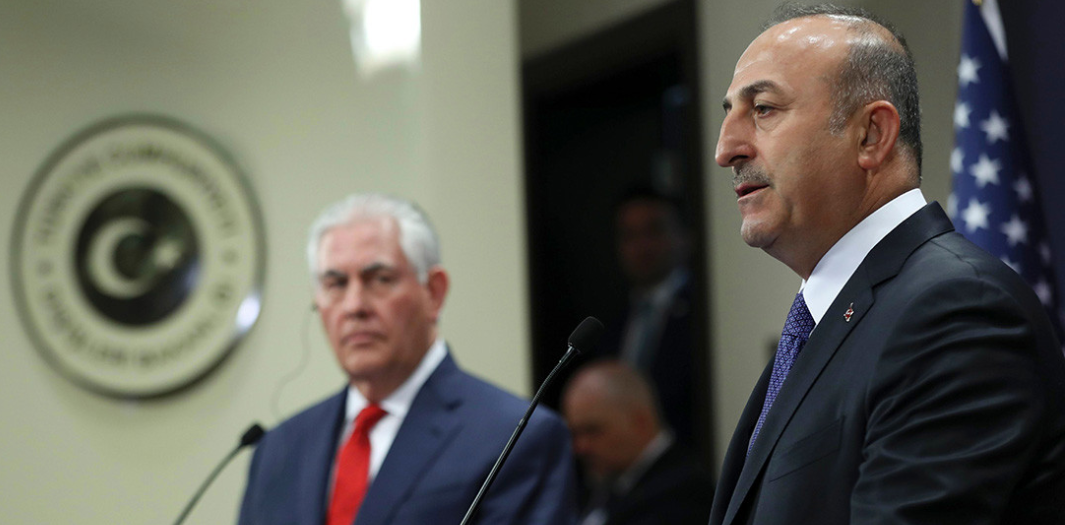
Hopefully, national security adviser Lt. Gen. H.R. McMaster and Secretary of State Rex Tillerson will communicate this message during their visits to Ankara. But much more is needed than just one-off warnings. Even if a conflict over Manbij can be avoided now, the United States and Turkey will remain on a collision course without a sustained, high-level dialogue, for example simultaneously between the secretaries of state and defense and their Turkish counterparts, to work out the strategic parameters for U.S.-Turkish relations in the Levant and beyond. These considerations should include a due regard for Turkey’s legitimate security concerns vis-à-vis the Syrian Kurds as well as a U.S. offer to help get Turkish-Kurdish negotiations back on track.
Ultimately, if Erdogan is determined to destroy the U.S.-Turkish alliance, there is nothing Trump or anyone can do to stop him. But being clear and consistent about the stakes involved can help ensure that Turkey’s volatile leader does not stumble past the point of no return thinking the United States will not respond. Let’s not wait to use our leverage until it is too late.
Source: politico
Ask me anything
Explore related questions