





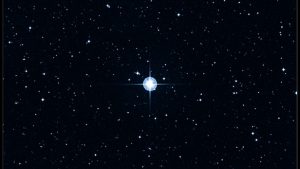
While we normally associate evolution with life, even stars tend to go through a similar process across generations. The very first stars to fire up after the Big Bang would have been mostly made of light elements, while later ones became heavier with metals. Now astronomers have identified one of the oldest stars ever found, which appears to be just one generation removed from the beginning of the universe itself. Being relatively close to Earth, the find could mean our galactic neighborhood is much older than previously thought.
The first stars in the universe switched on about 13.6 billion years ago – just 180 million years after the Big Bang, which is a blink of an eye on the cosmic scale. This first generation would have been composed mostly of light elements like hydrogen, helium and a pinch of lithium, and through the process of fusion would have created the first heavy metals. When these stars eventually exploded, the resulting supernovae would have spread these heavy elements through the cosmos.
The next generations of stars would clump together out of these clouds of material, meaning they start off with more heavy metals and then go on to create more themselves. As the cycle repeats, each successive generation of stars has a higher metal content than the last, making “metallicity” a good indicator of a star’s age.
Until just a few decades ago, it was widely believed that the first stars would be long dead by now, having burned through their fuel supplies and exploded. But in recent years astronomers have identified about 25 “ultra metal-poor” stars that are among the oldest known in the universe – but these have all had about the same mass as the Sun.
The newly-identified ancient star, named 2MASS J18082002–5104378 B, is far smaller – its mass is just 14 percent that of the Sun. It also has the lowest metallicity of any known star, containing about the same concentration as the planet Mercury does. According to the researchers, that means it probably hails from just the second generation of stars ever born. By comparison, the Sun is a spry youngster that’s about 100,000 generations further down the family tree, containing as much metal as 14 Jupiters.
“The findings are significant because for the first time we have been able to show direct evidence that very ancient, low mass stars do exist, and could survive until the present day without destroying themselves,” says Andrew Casey, co-author of the study.
The ultra metal-poor star in question isn’t the oldest star we know of – it’s just pipped by one discovered by the Sloan Sky Survey in 2014. But what’s particularly strange about this one is that it can be found in the “thin disk” of the Milky Way, the region of the galaxy that we ourselves call home. This suggests that this part of the Milky Way is as much as three billion years older than previously thought.
The researchers say that this discovery means that in future, even older stars could be observed, including the possibility of the very first generation.
Source: newatlas
Ask me anything
Explore related questions




