×
GreekEnglish

×
  • Politics
  • Diaspora
  • World
  • Lifestyle
  • Travel
  • Culture
  • Sports
  • Cooking
Tuesday
03
Feb 2026
weather symbol
Athens 16°C
  • Home
  • Politics
  • Economy
  • World
  • Diaspora
  • Lifestyle
  • Travel
  • Culture
  • Sports
  • Mediterranean Cooking
  • Weather
Contact follow Protothema:
Powered by Cloudevo
> Politics

Kyriakos Mitsotakis: Letter to Ursula von der Leyen regarding inflation – Multinational corporations have asymmetric power eroding citizens’ incomes

Multinational corporations earn over €14 billion annually from price differentials across EU countries - The government's proposals to the Commission

Newsroom May 20 11:40

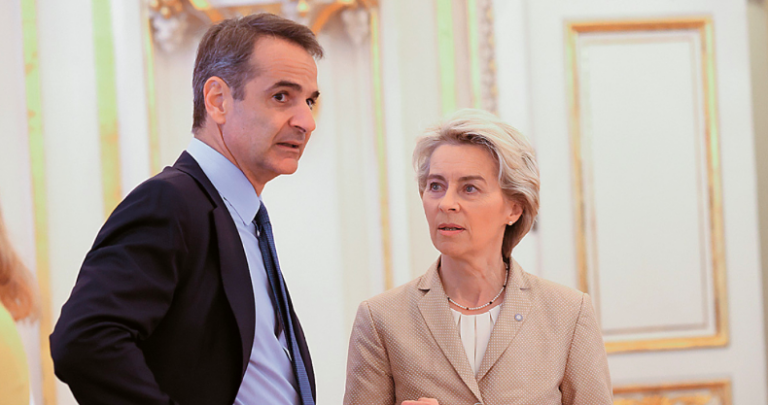
Prime Minister Kyriakos Mitsotakis, in a letter to European Commission President Ursula von der Leyen, requested  interventions in EU Law to ensure equal treatment and consumer protection from the price markup imposed by multinational corporations. He highlighted that these corporations, especially in oligopolistic markets, remove at least 14 billion euros annually from European households’ disposable income. Mitsotakis emphasized the need for bolder steps for more competition and transparency in the Single Market. Also proposed was for EU-level legislation to effectively address Territorial Supply Constraints, where these restrictions are not justified by factors that promote societal welfare. Minister of State Akis Skertsos coordinated the initiative and the development of the arguments presented in the letter.In addition, multinational corporations impose price markups amounting to at least 14 billion euros annually on European consumers through geographical supply restrictions. This issue has been discussed for years, with a 2020 European Commission study highlighting significant consumer losses due to these restrictions. The problem has intensified with rising inflation and increased corporate profits.

See Also 

Kyriakos Mitsotakis: I’ll reach out to President of the European Commission to request EU intervention on multinational corporations’ pricing

Significantly, a 2023 study conducted by Leiden University found that these supply constraints are a hidden factor driving inflation, particularly affecting smaller countries. Recently, seven EU countries called for the abolition of these restrictions. In Greece, for instance, the price of baby formula remains disproportionately high despite government-imposed profit margin caps. The Greek Competition Commission previously identified a 32% price discrepancy compared to the lowest prices in Europe.

Multinational companies exploit geographical restrictions (TSCs) to prevent parallel trade and protect their profits. These restrictions include:
1. Refusing to supply wholesalers/retailers who sell outside designated areas.
2. Differentiating product content or branding across regions.
3. Limiting product quantities to hinder wider distribution.
4. Using single-language packaging to prevent cross-border sales.
In Greece
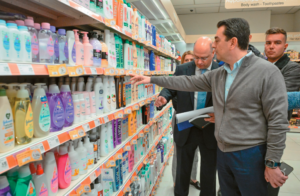
In Greece, among the few substantiated cases was that of Colgate-Palmolive. In 2017, the Competition Commission fined the parent company and its Greek subsidiaries 9.4 million euros for prohibiting parallel imports in its commercial agreements with major supermarket chains.

>Related articles

Step by Step: Constitutional revision in Greece – What is decided now and what follows after the elections – The case of the “one-day Parliament”

Tomorrow, Mitsotakis’ address on constitutional revision will propose changes to 70 of the 120 articles

Mitsotakis on the 30th anniversary of the Imia crisis: There are no “grey zones” in the Aegean; once again we bow to the fallen

The penalty for any retailer violating the rule was the withdrawal of discount privileges. Later, the parent company managed to be acquitted by arguing it was unaware and not responsible for the practices of its subsidiaries.

The Competition Commission’s checks revealed, among other things, that between 2001-2008, 85%-95% of comparable products were more expensive in Greece than in Italy, and 40%-65% of these products were at least 20% more expensive. Additionally, 73%-85% of products were more expensive compared to Spain, France, and Portugal.


Ask me anything

Explore related questions
#inflation#Kyriakos Mitsotakis#Ursula von der Leyen
> More Politics

Follow en.protothema.gr on Google News and be the first to know all the news

See all the latest News from Greece and the World, the moment they happen, at en.protothema.gr

> Latest Stories

Greece and Italy form a joint front against the illicit trafficking of cultural property

February 3, 2026

Online auctions for beaches and coastal areas begin

February 3, 2026

Authorities in Iran arrest 139 foreign nationals during the protests

February 3, 2026

Wales: Volunteers wanted to live on a remote island for 3 months counting Puffins

February 3, 2026

Spain bans social media for children under 16

February 3, 2026

France: Paris prosecutor’s office investigation into X’s premises, algorithm interference under investigation

February 3, 2026

Reza Pahlavi: Calls for global protests on 14 February against the regime in Iran

February 3, 2026

The University of Athens and law students at the core of the constitutional revision, discussion on the choice of the leadership of the Judiciary

February 3, 2026
All News

> World

Authorities in Iran arrest 139 foreign nationals during the protests

The demonstrations first broke out on 28 December in protest at the high cost of living and developed into an anti-government movement

February 3, 2026

Spain bans social media for children under 16

February 3, 2026

France: Paris prosecutor’s office investigation into X’s premises, algorithm interference under investigation

February 3, 2026

Reza Pahlavi: Calls for global protests on 14 February against the regime in Iran

February 3, 2026

Clintons agree to testify in Epstein investigation to avoid contempt vote

February 3, 2026
Homepage
PERSONAL DATA PROTECTION POLICY COOKIES POLICY TERM OF USE
Powered by Cloudevo
Copyright © 2026 Πρώτο Θέμα